
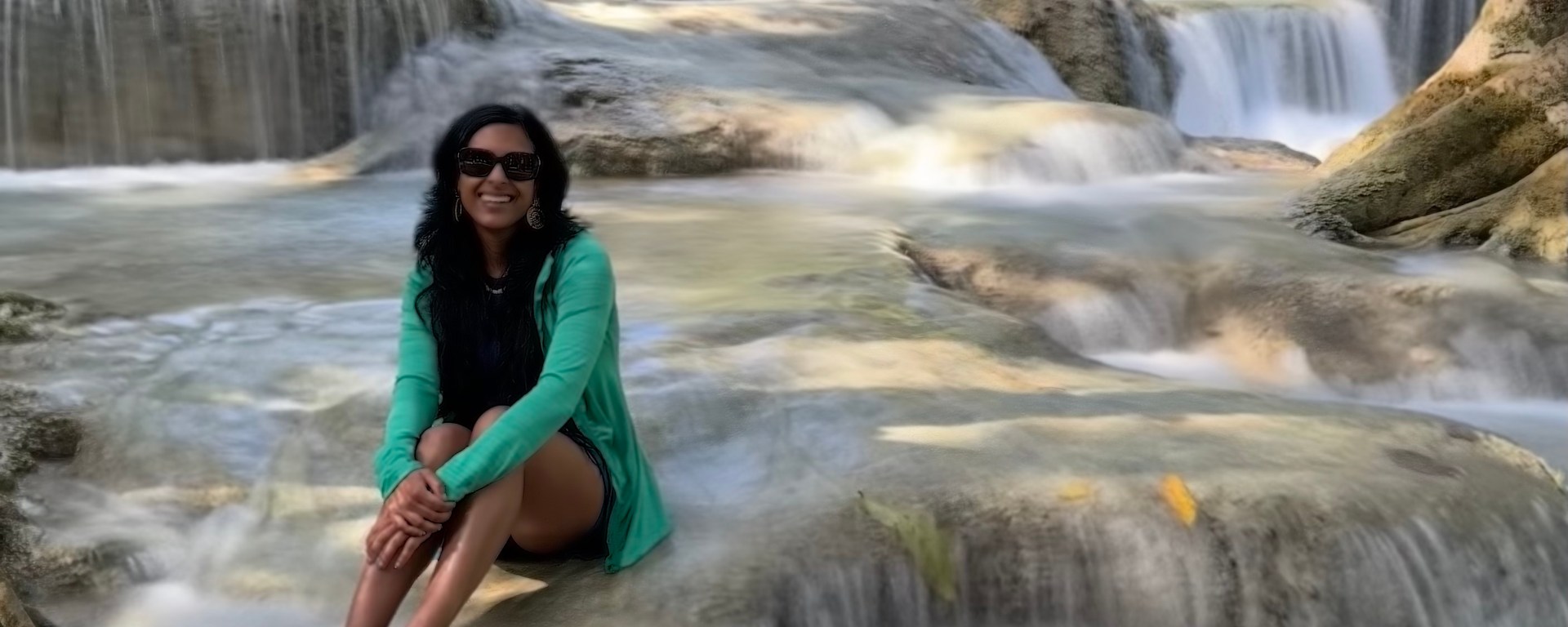
In December 2023 I travelled to:
Luang Prabang (Laos)
Nong Khiaw (Laos)
Muong Ngoi (Laos)
Siem Reap (Cambodia)
Kratie (Cambodia)
Phnom Penh (Cambodia)
I researched both countries like I was on the hook for a dissertation – well that’s an exaggeration, but you get the idea….I did A LOT of research which I have shared in this blog. So not only will you find info about the places we went to, but the places we didn’t go as well so that you can design the best trip for you.
Our trip was 2.5 weeks including travel to/from southeast Asia from Los Angeles.


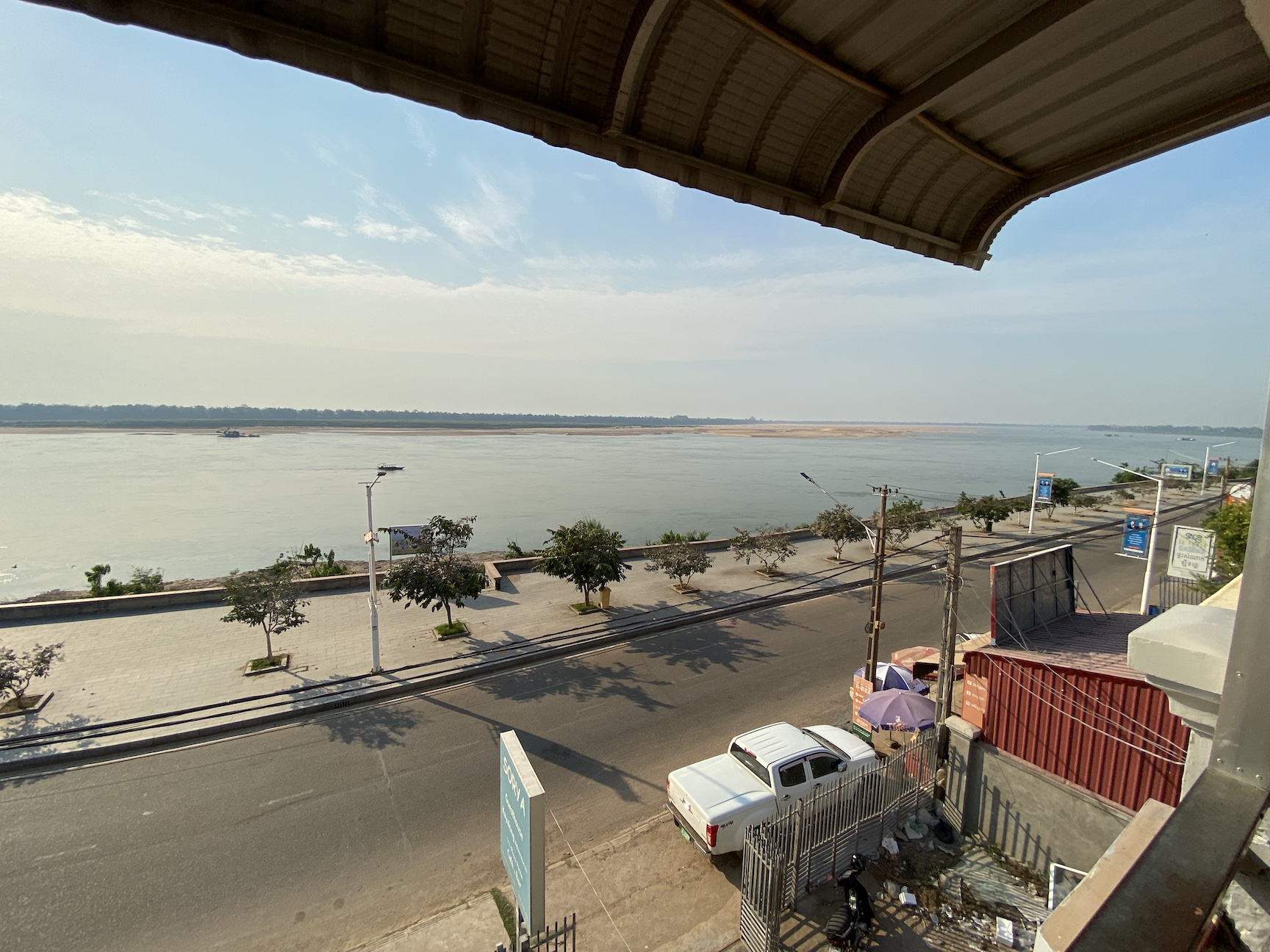
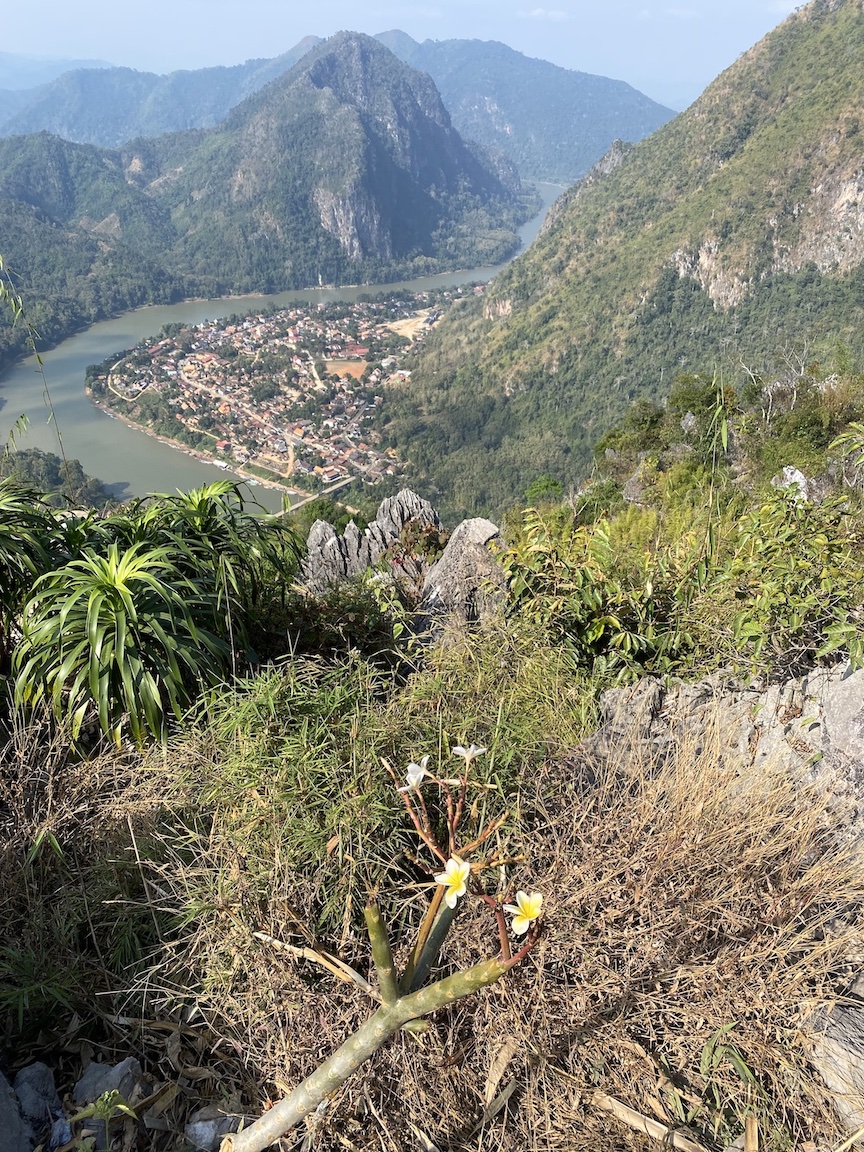
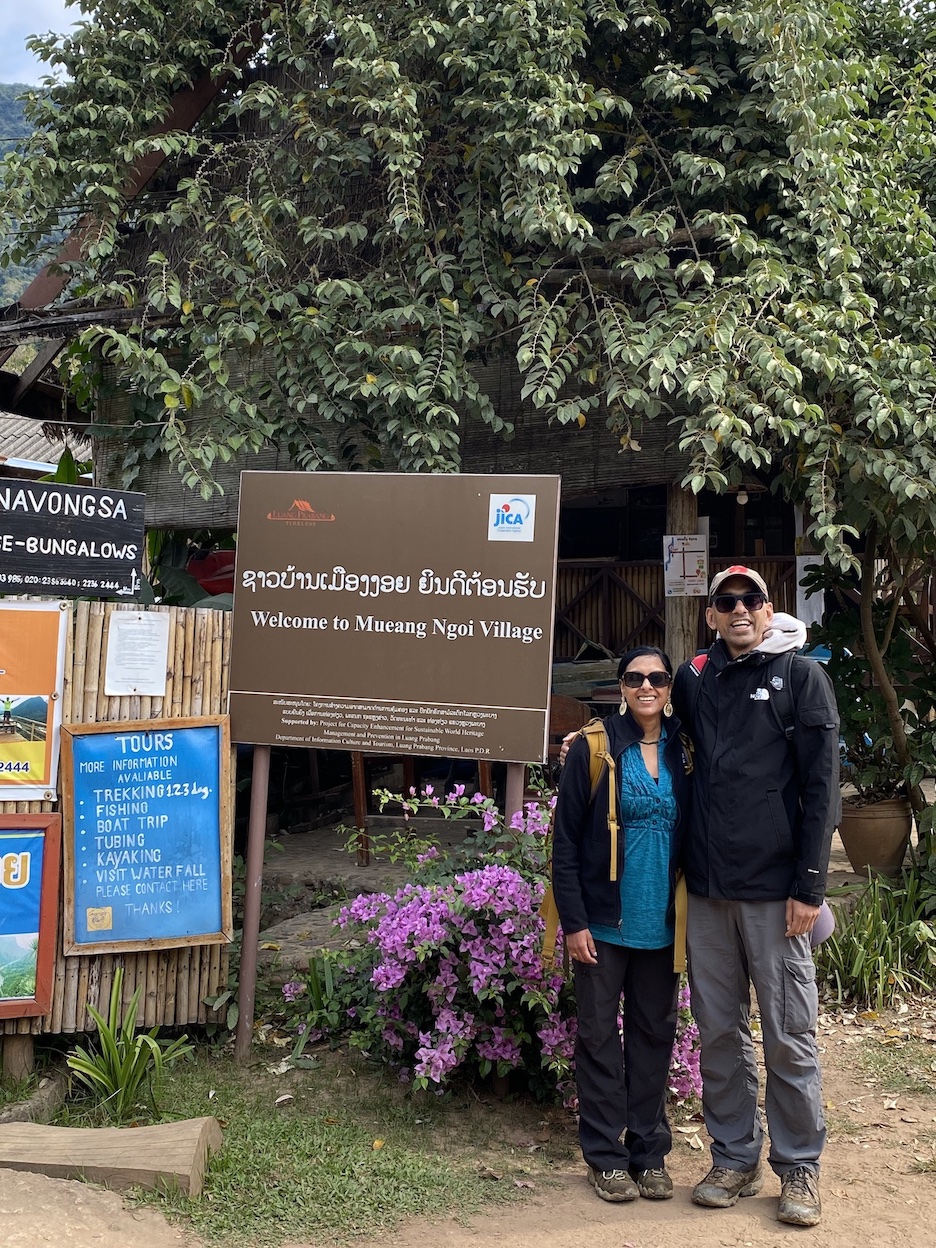
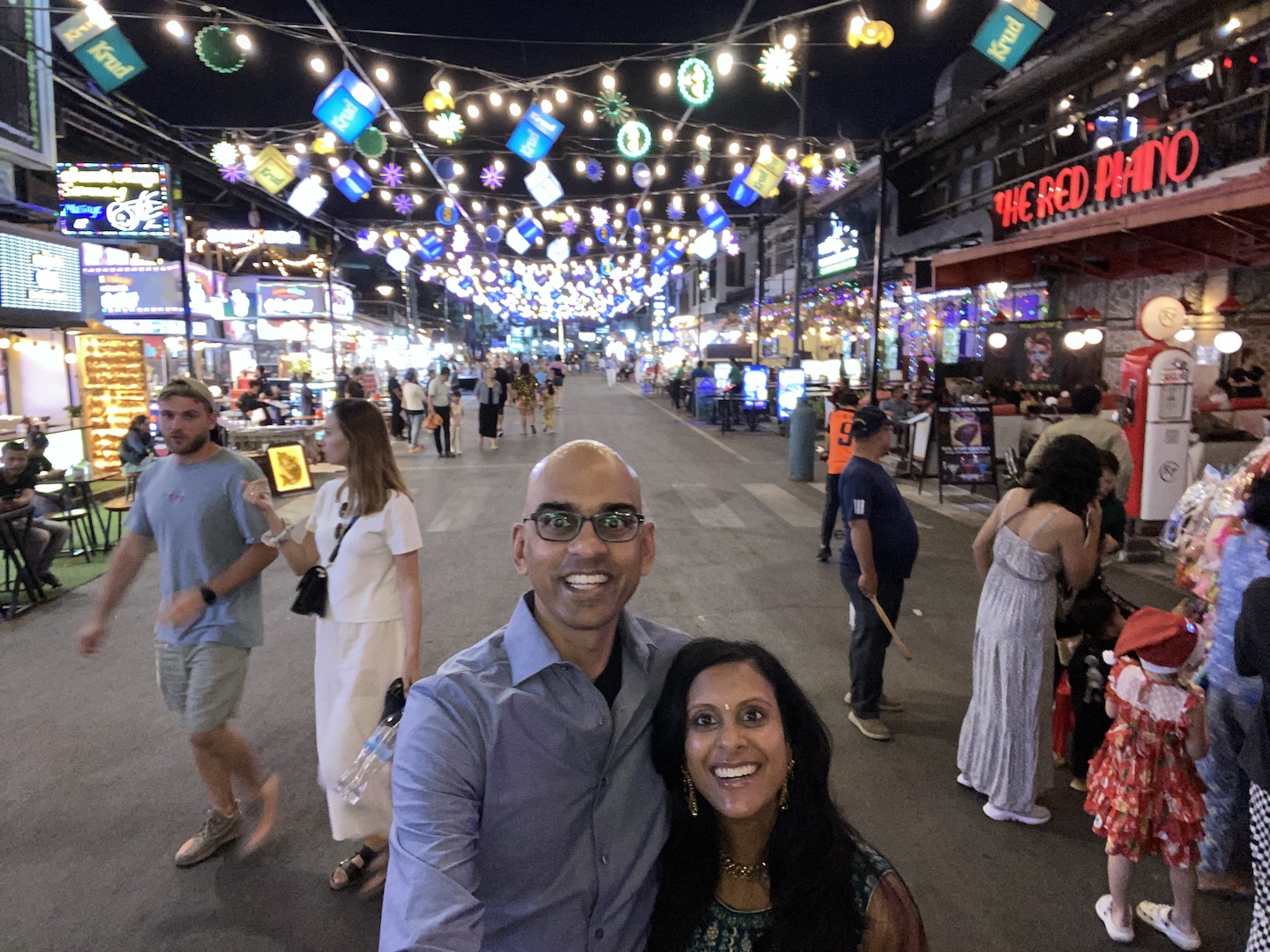
What You Can Expect From This Blog
This article is LONG. Use the contents below to jump to sections.
Honesty. I am very grateful for all of my travel experiences but it’s not always rainbows and unicorns. You can expect me to keep it real. I share things that I liked as well as things that I didn’t like…in detail. Additionally I talk about whether I felt things were worth it, and share mistakes we made. Throughout the article there are tips and recommendations.
You will not find Instagram-worthy perfectly planned photos. But you will find authenticity.
No affiliates/compensation etc. There are no affiliate links in this article or anywhere on this blog. I am not compensated in any way and I am not associated with any of the companies, restaurants, websites, products etc. that I mention.
I created this blog because I enjoy writing about my travel experiences. Whether you purchase items I recommend or not – makes no difference to me. What does mean a lot to me, is if you found the info helpful – to let me know. Helping others is fulfilling.
Contents (Jump to a Section)
Laos
Cambodia
Deciding How To Split The Time
Between Laos and Cambodia
I wish I had more time like the full time travelers and backpackers whose blogs and YouTube channels I follow. For this trip I had about 2.5 weeks including travel to/from Los Angeles. I spent a lot of time working through itineraries that included Laos-only and Cambodia-only and ultimately decided to do a combo of the two. Ideally I’d have 3-4 weeks in each country… but alas time constraints are a thing, so I did a lot of research to optimize within the time we had.
In Laos the waterfalls and hiking were most interesting to us. I really wanted to go to Pakse and do the 4 day waterfall loop as well as go to Khone Falls, but we also really wanted to visit Angkor Wat, so I resigned that we will have to do another trip to Laos to visit the southern part of the country as well as the Thakhek Loop.
We decided to skip the beaches in Cambodia. They’re nice but being from SoCal we don’t have a shortage of beautiful beaches. I wanted to go to Battambang but we just didn’t have the time. We decided to focus our visit in Cambodia on Angkor Wat and a chance to see the river dolphins.
This was our second trip with Mr. Linh’s Adventures and they did a fantastic job arranging the hotels, guides, drivers, seamless entry/tickets at destinations, accommodating our dietary preferences. In 2022 we booked our two week Vietnam trip with them and that was also fantastic.
Who Would Like Laos?
If you like getting off the beaten path, temples, nature, wildlife (Asian elephants and primates), hiking, would like to stay in the highest treehouses in the world, waterfalls, beautiful blue lagoons, and exploring caves – then Laos will be your cup of tea.

Who Would Like Cambodia?
If you’re interested in beaches, temples, and wildlife then Cambodia will be your cup of tea.
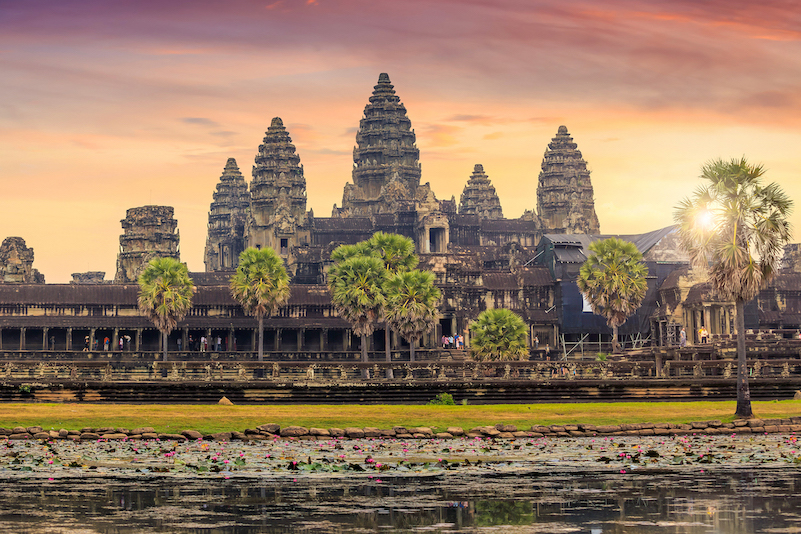
Exposure to a Different Lifestyle and Way of Thinking.
Laos and Cambodia are Buddhist countries. For travelers, particularly from Western countries, visiting these places is a great way to get exposure to a very different lifestyle and way of thinking – especially in December when Western countries are lit for Christmas and these countries are not.
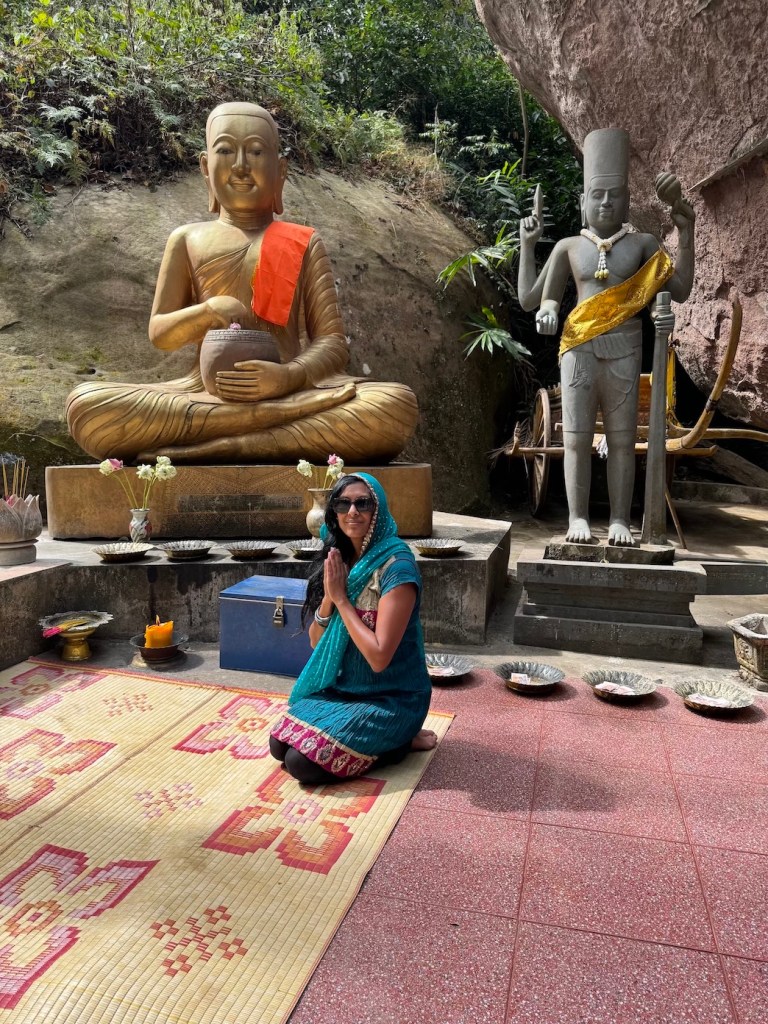
Are Laos and Cambodia Different From Thailand
and Vietnam? If yes, how?
Yes – they are each different. Sure, all of the countries of Indochina share some cultural similarities. But still, they are all different from each other. For one, the population of Laos is so much smaller compared to its neighbors and that alone gives the country a very different feel compared to both Thailand as well as Vietnam and Cambodia.
Cambodia, Vietnam and Thailand all have bustling cities whereas even Vientiane, doesn’t have that same hustle and bustle. Laos is the only landlocked country in southeast Asia. As a result Laos can often be more expensive compared to its neighbors as it relies, heavily, on trade with Thailand and Vietnam.
Tourism is much more developed in Thailand, Cambodia and Vietnam compared to Laos.
In Vietnam the majority of the people practice Mahayana Buddhism. In Thailand, Laos, and Cambodia, the majority of people practice Theravada Buddhism and you can see the difference. In Vietnam we saw a lot of pagodas as well as temples whereas in Laos and Cambodia more pagodas. What’s the difference between a pagoda and a temple?
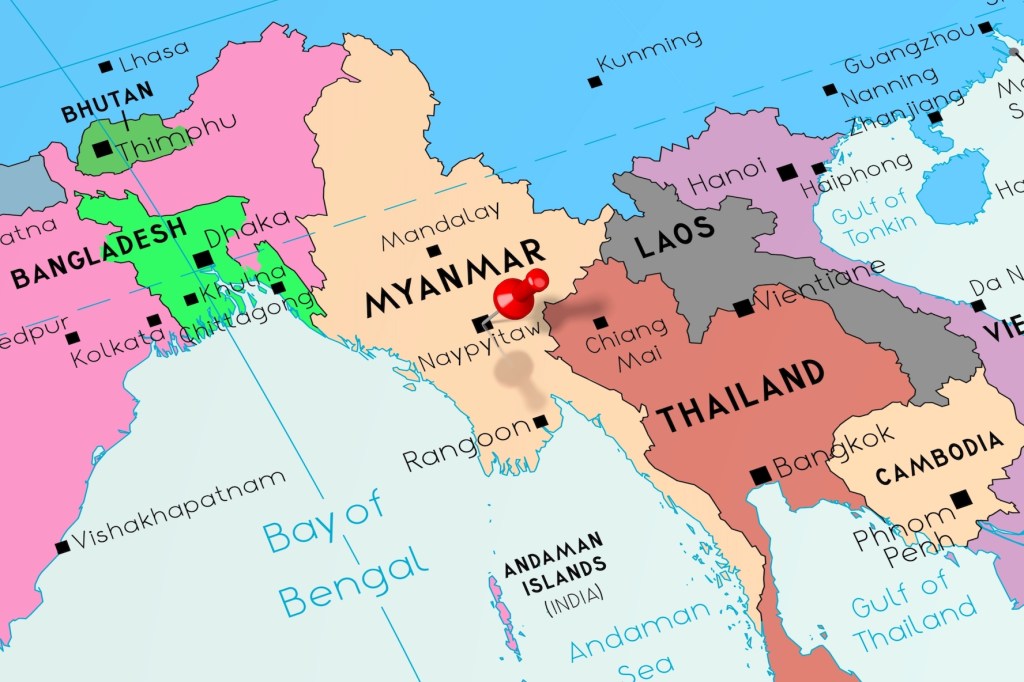
Additionally, centuries ago, Cambodia was a Hindu country and the remnants of that are significant and obvious in Cambodia. We saw some of that in Laos, Thailand and Vietnam as well, but in that order. For most tourists that’s not obvious nor significant – but for me it was, as being of Indian heritage – it was something I noticed.
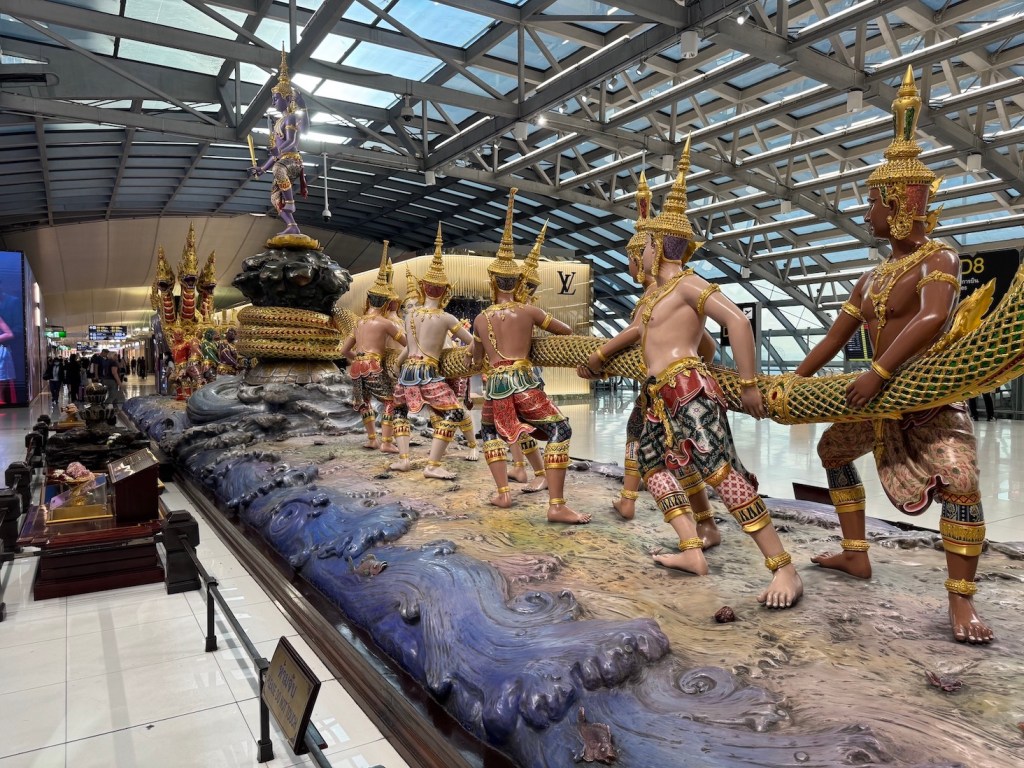
Hinduism In Thailand. If you’ve ever been to the Suvarnabhumi Airport in Bangkok, you may have seen this huge art installation. This is the famous Churning of the Ocean story from Hindu mythology where the demons and demigods join forces, in a rare moment of cooperation, to retrieve amrita – the elixir of life – from the depths of the milky ocean. They are engaged in a sort of tug-of-war using Hindu God Shiv’s serpent, Vasuki, as the rope. You can see Vasuki wrapped around Mount Mandar with the God, Vishnu, – the Protector of the Universe standing a top overseeing the whole event.
And….after you engage in a bit of culture, head on over to Louis Vuitton right behind this.
Hinduism In Laos. At Wat Xieng Thong – the most famous temple in Luang Prabang the entrance door shows depictions of the Hindu epic Ramayan.
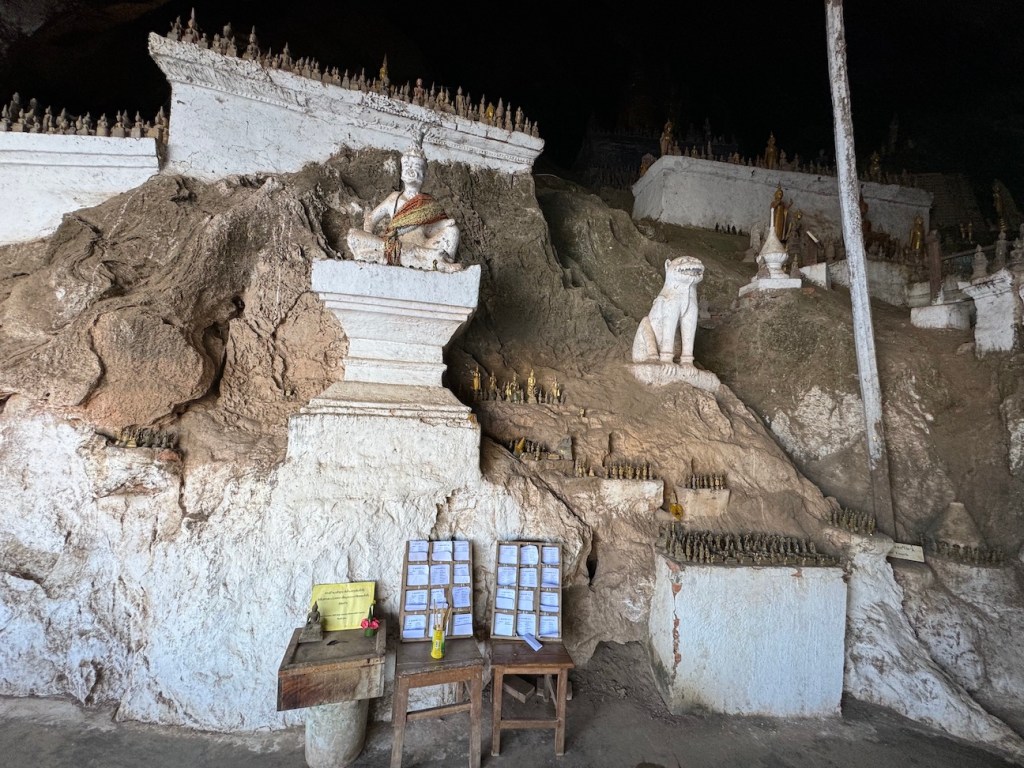
And at the Pak Ou Caves in addition to thousands of Buddha statues there are Hanuman statues as well.
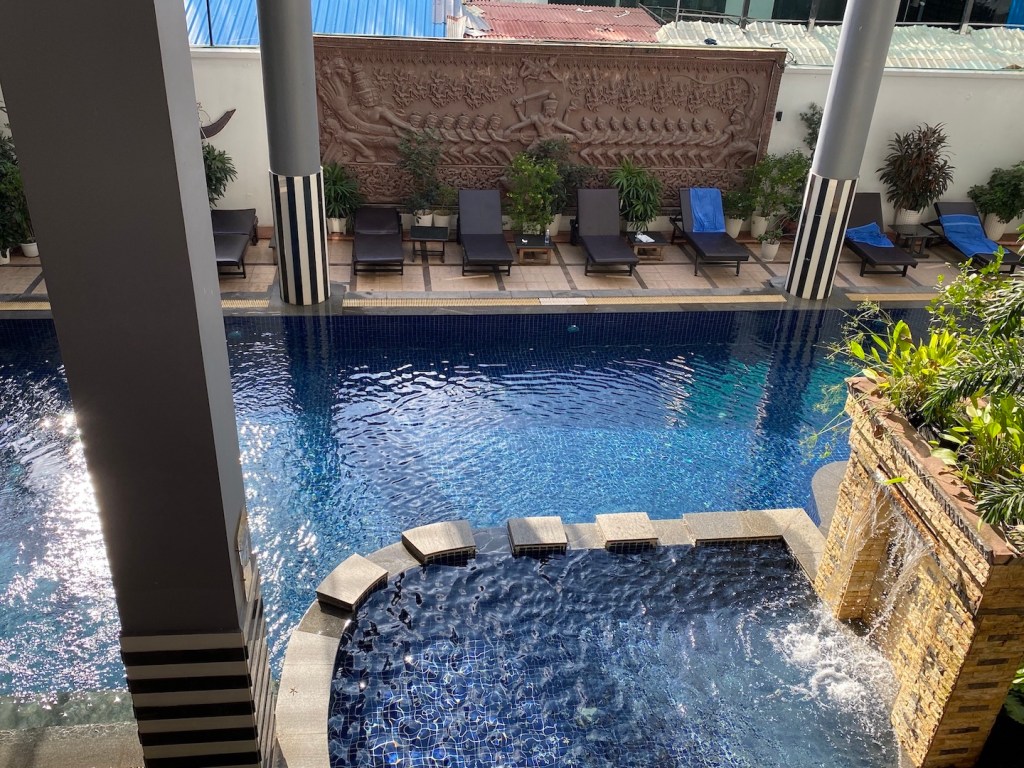
Hinduism In Cambodia. In Cambodia the Churning of the Milky Ocean was very prominent throughout the country – even the wall decor for the pool at our hotel in Phnom Penh.
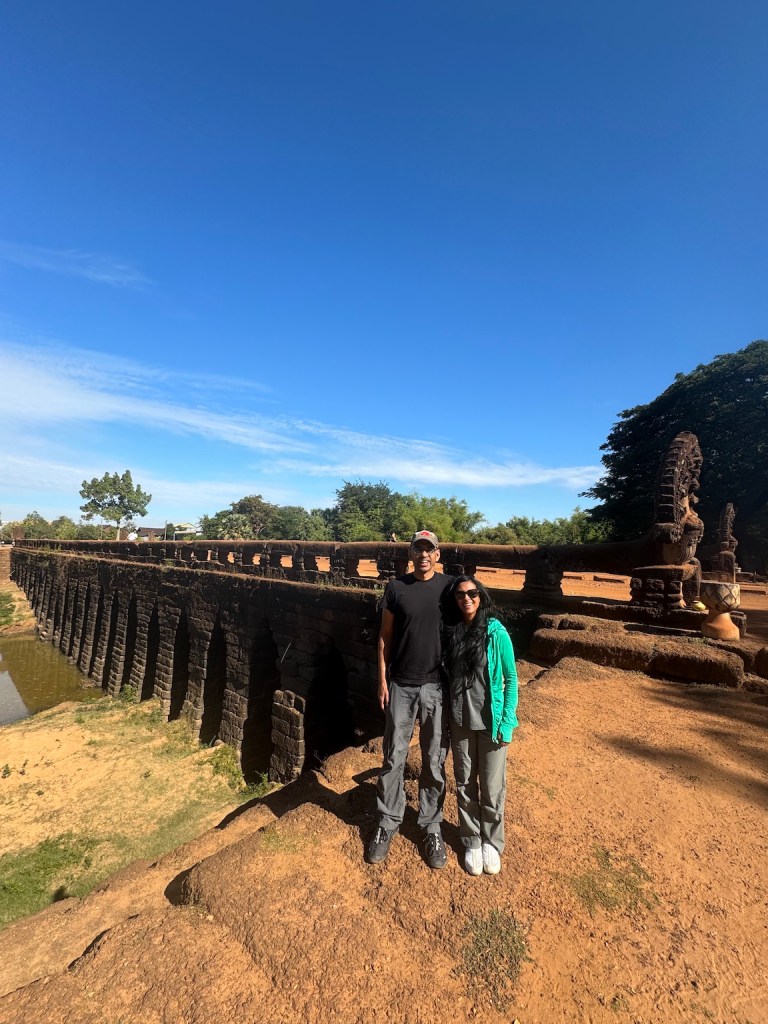
The Hindu influences were most obvious at Angkor Wat. The walls tell stories of the Hindu epics Ramayan and Mahabharat including Kurukshetra. And there are depictions of Shiv and Paravti as well as Krishna when he lifted Govardhan Hill. And, of course, Goddess Lakshmi who was Vishnu’s consort. Since Angkor Wat was originally a Vishnu temple – you can’t really have a temple dedicated to him without mentioning Goddess Lakshmi.
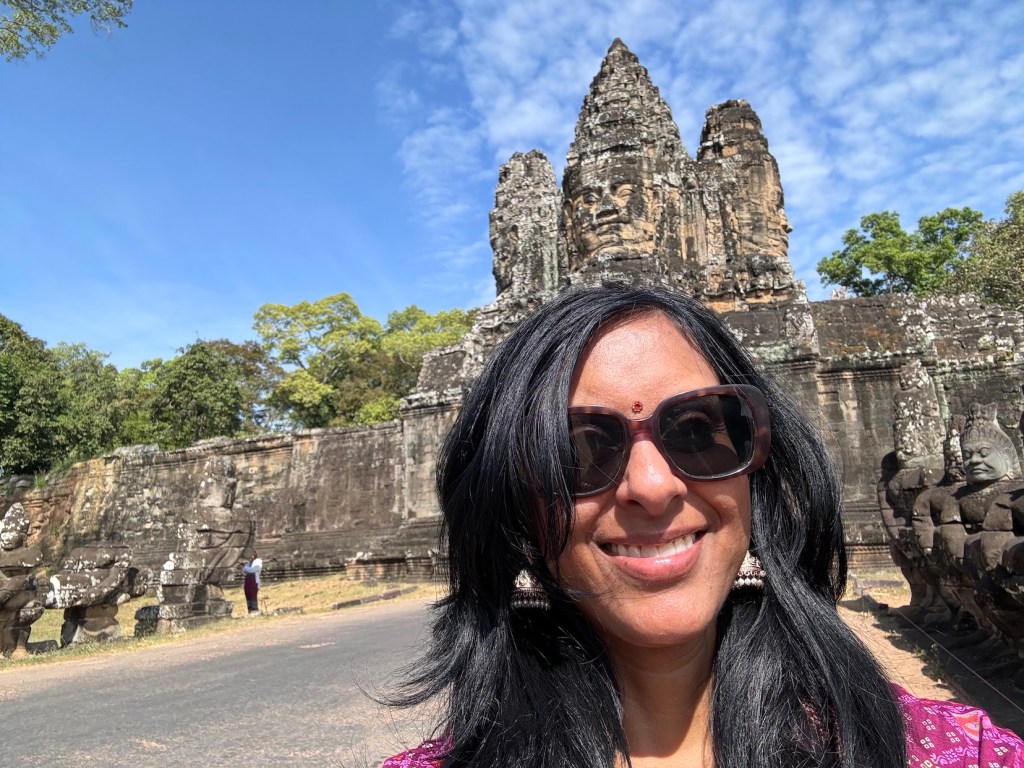
(Below). At first, I thought the 4 heads at the entrance of the Bayon Temple were the Hindu God Brahma. But no, they are depictions of the King.
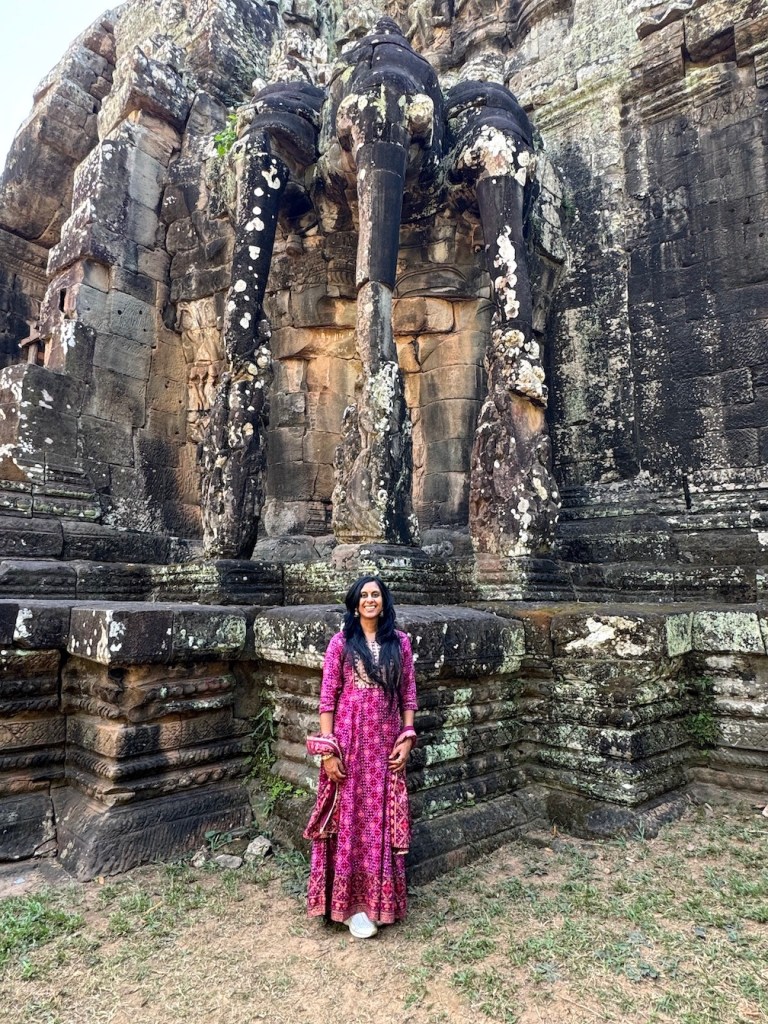
(Below) Me and Airavata, the 3-headed divine, white elephant of Hindu God Lord Indra. In other parts of southeast Asia, Airavata is called Erawan i.e. Erawan Falls in Thailand. Erawan has huge cultural and religious significance in Thailand.
Knowing a little about these Gods will enhance your experience at Angkor Wat. Jump to this section for – short and simple info about each.
Thailand and Vietnam Are More Developed. Other differences are that Thailand and Vietnam are a lot more developed than Cambodia and Laos – especially Laos. Siem Reap is a bustling city but it revolves around tourism so it has a much more Western feel than Hanoi, which has retained its local heritage more. Laos feels like stepping back in time.
In terms of how touristy each country is here’s how I’d rank-order them:
Thailand
Vietnam
Cambodia
Laos
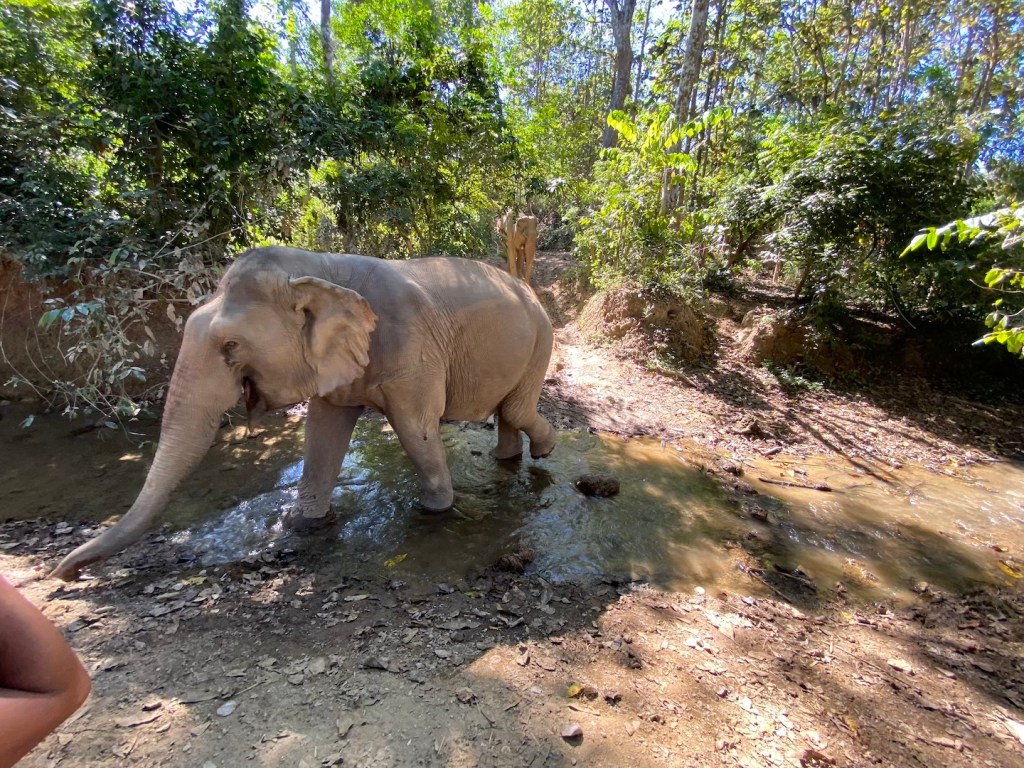
True Elephant Sanctuary in Laos. We experienced a true elephant sanctuary in Laos. No offense to the sanctuaries in Thailand but did you know that bathing elephants, on-demand, is actually harmful to them? Think about it – what if you had to bathe a few times a day – constantly scrubbing and rubbing soap/body wash all over? Wouldn’t your skin get dry and sore? Elephants need the dirt that accumulates on their bodies – it’s a protective coating and having it washed off constantly is harmful. At Mandalao Elephant Conservation, we simply went for a walk with the elephants. The guides said, “you are here to entertain them”. When the ele’s stopped to eat, we stopped and observed. When they sped up, we sped up. It was fantastic.
Because Laos is often overlooked as a tourist destination, especially relative to its neighbors, we felt that it was easier to talk to local people and there was an overall sereness to Laos that we didn’t find in Thailand nor in the big cities in Vietnam. We did find that in the smaller cities in Vietnam.
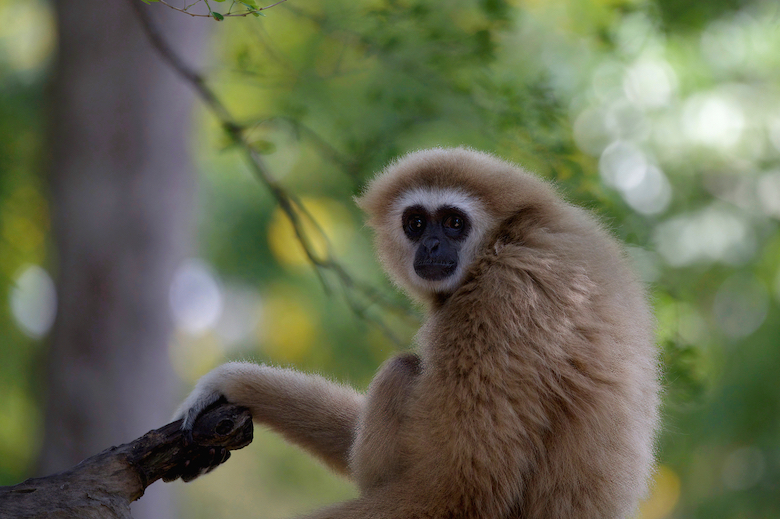
Wildlife in Thailand, Vietnam, Cambodia, Laos. Vietnam isn’t known for wildlife the way Thailand and Laos and even Cambodia are. Laos has gibbons, which are primates, that are difficult to see but easy to hear, elephants, and tigers though it is extremely rare to see tigers. Cambodia has elephant sanctuaries as well as the endangered and elusive Irrawaddy dolphins (recently extinct on the Laos side of the Mekong River) and some great birding experiences.
And in Cambodia most people go to Siem Reap. Not nearly as many people travel around the rest of the country but there’s quite a bit to see and varying terrains from jungles to beaches to river towns.
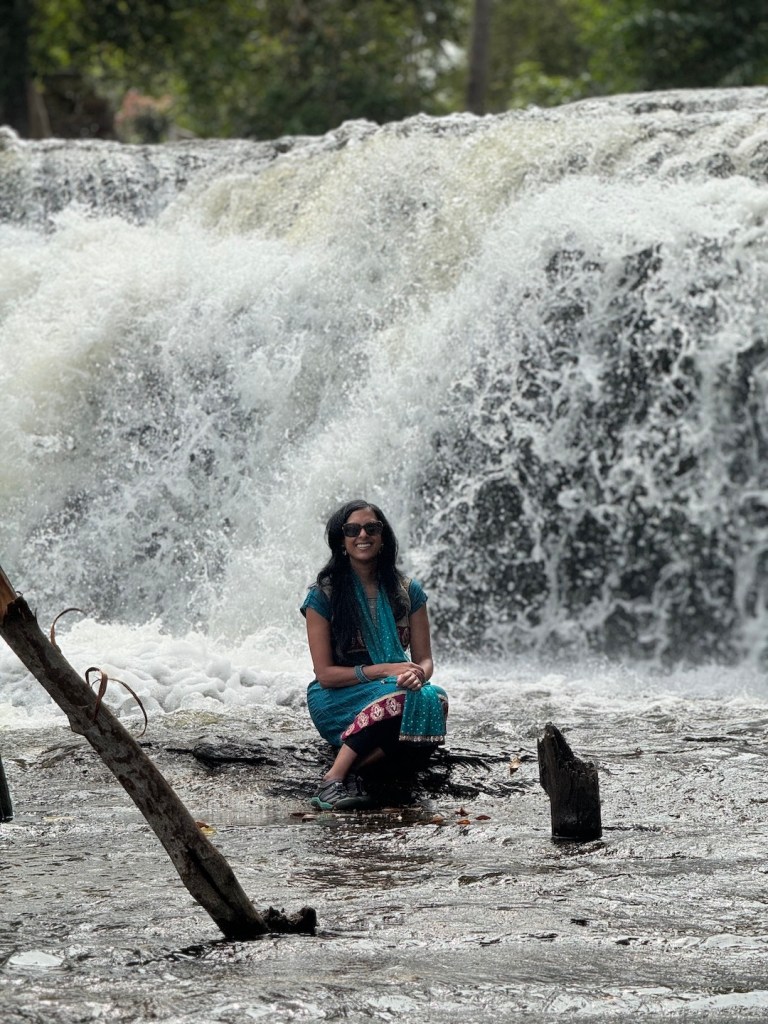
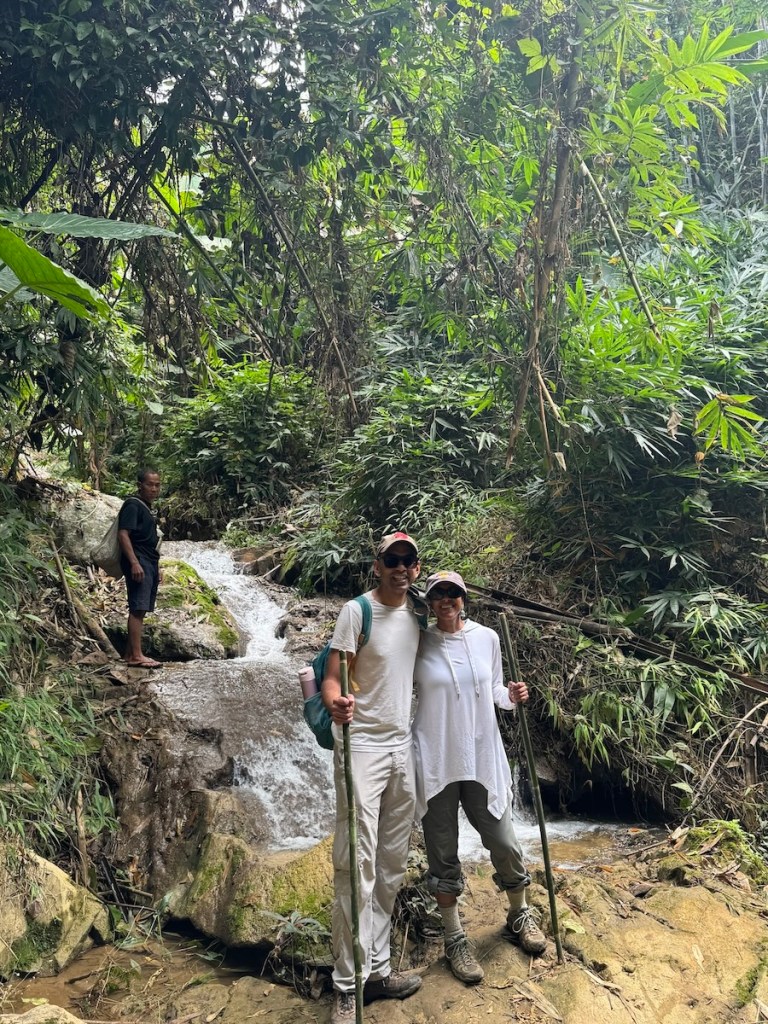
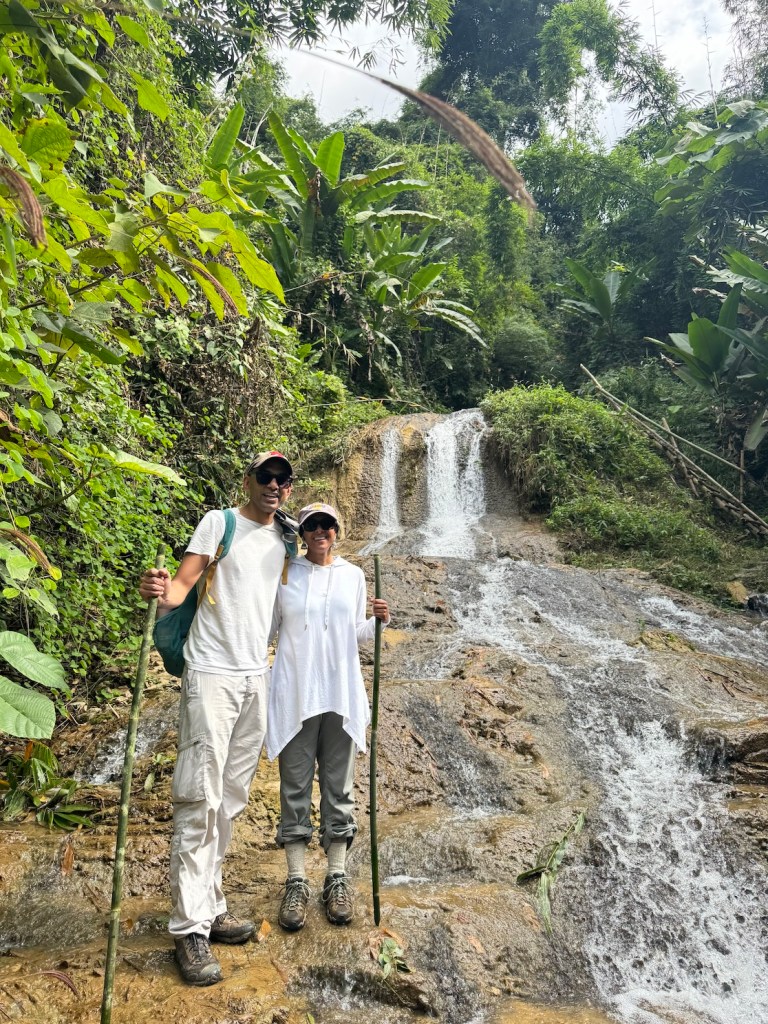
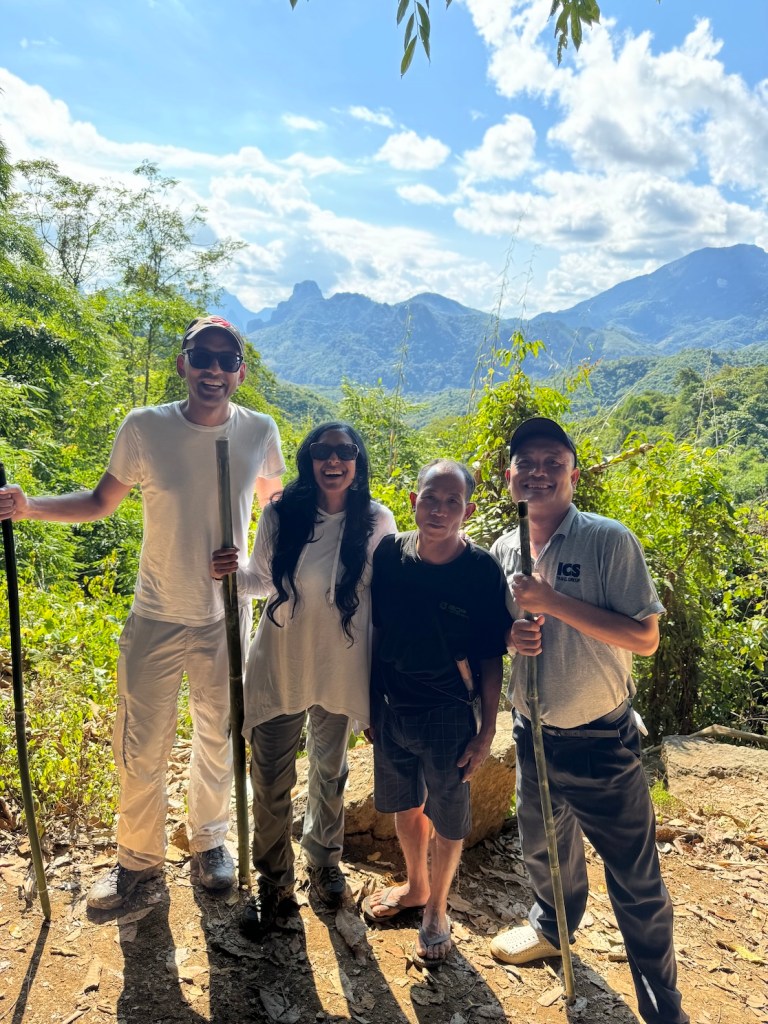
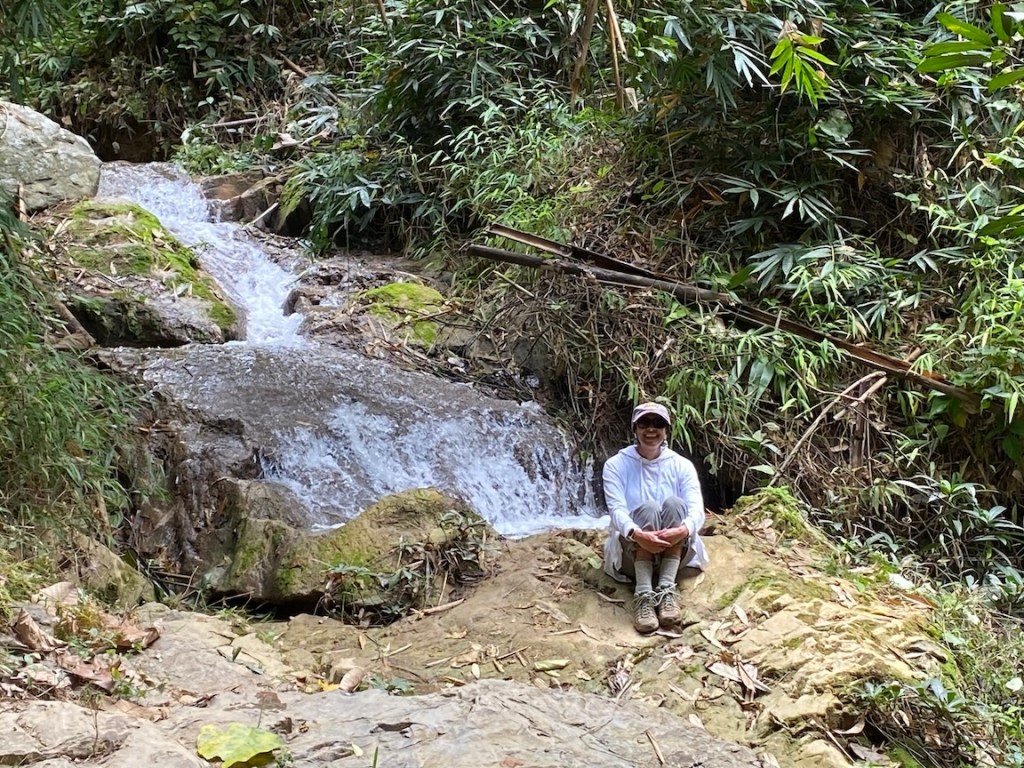
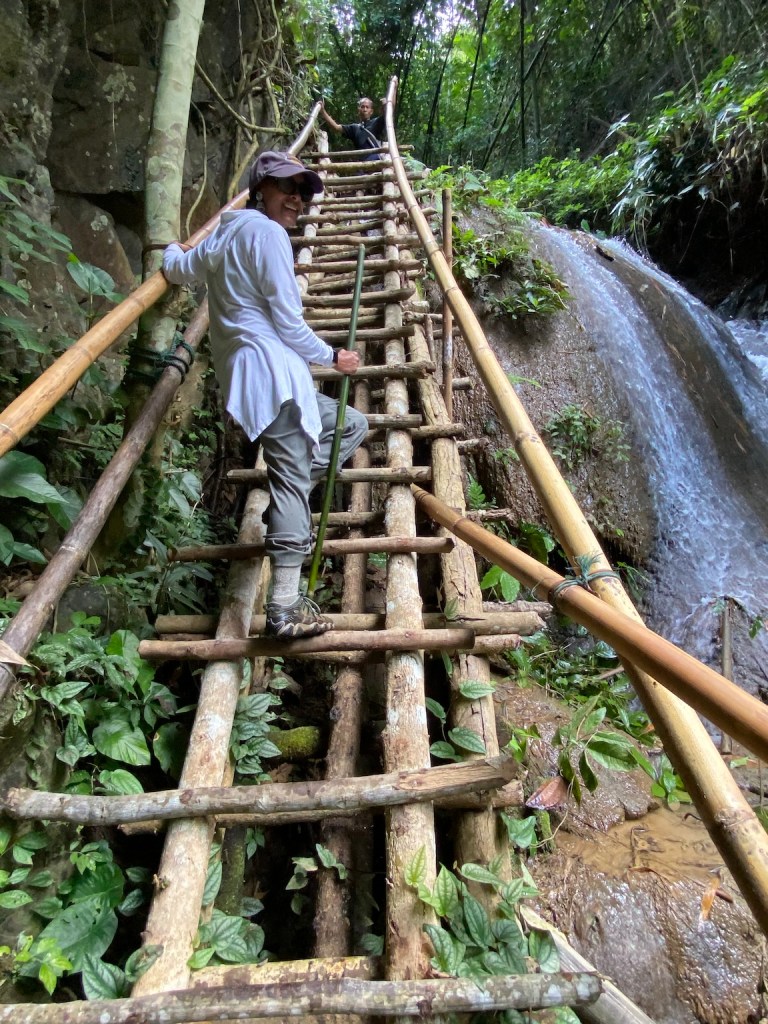
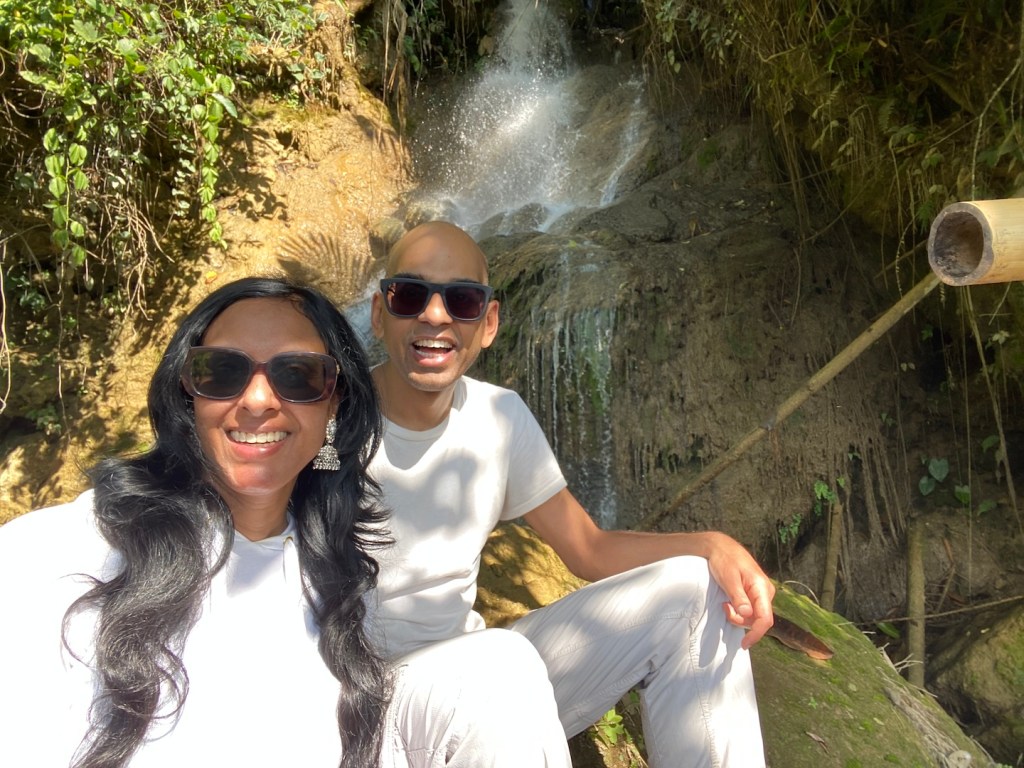
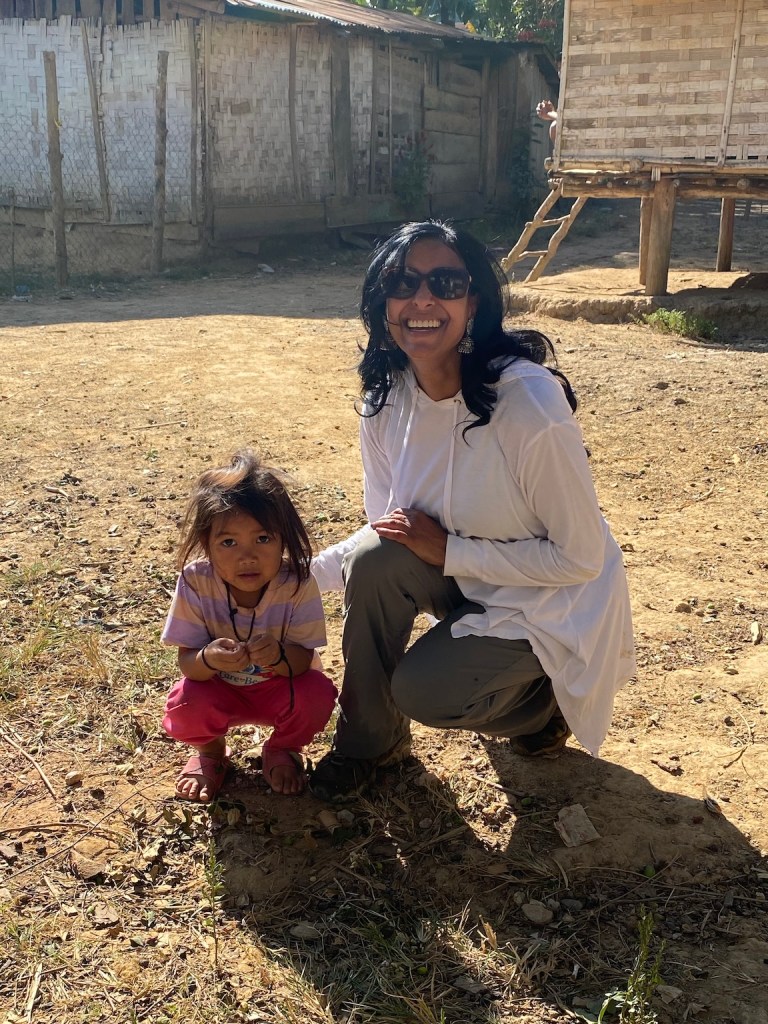
The day starts around 8am drifting down the Nam Ou River passing by Lao ladies washing their clothes and fishermen enjoying the calm water. You’ll stop at the Don Khoun village and can explore around there for about 20 minutes and then the hike will start.The hike is not really physically grueling nor steep. It’s beautiful and peaceful. You’ll trek for about 45 minutes until you come to the base of the waterfalls. The name 100 Waterfalls is a bit misleading because with all the intertwining streams it’s difficult to know exactly how many waterfalls there are. Stop and enjoy, jump, climb and bash in the falls before you start the 90 minute ascent to the top. When you reach the top, stop and take in the gorgeousness of the falls beneath. Then you’ll remember you’re hungry and enjoy a nice lunch with a spectacular view.
Bottomline: Are Laos and Cambodia Different Than Thailand? Each of these 4 countries are visit-worthy. However, I can see why most people include Laos and even Cambodia in their “I’m already in southeast Asia so might as well go” itinerary vs. Laos being the primary destination. The beaches in Cambodia are nice but don’t compare to Thailand. The same goes for snorkeling in Cambodia. The beaches in Vietnam are nicer compared to Cambodia and they have invested in infrastructure and resorts to attract tourists.
Cambodia and Laos Are Changing
China is investing heavily in both countries – developing infrastructure that is making it easier and better for tourists and locals to travel to and within each country. A couple weeks before we arrived in Siem Reap, they opened a brand new airport. It’s about 40 minutes away from the city, whereas the original airport was only about 20 minutes away. But the new airport is spacious and modern, though not so modern as to install facial recognition for contact-less Immigration like they have in Singapore and Dubai. The Immigration line still took a long time and the visa and pages in the passport took up a lot of space.
In Laos a new high speed, modern train was opened recently that connects all 3 major tourist centers – Luang Prabang, Vang Vieng and Vientiane. While they piggyback on the attention of their neighbors they are optimizing to become attractions on their own.

Is December a Good Time To Go To
Laos and Cambodia? (Weather)
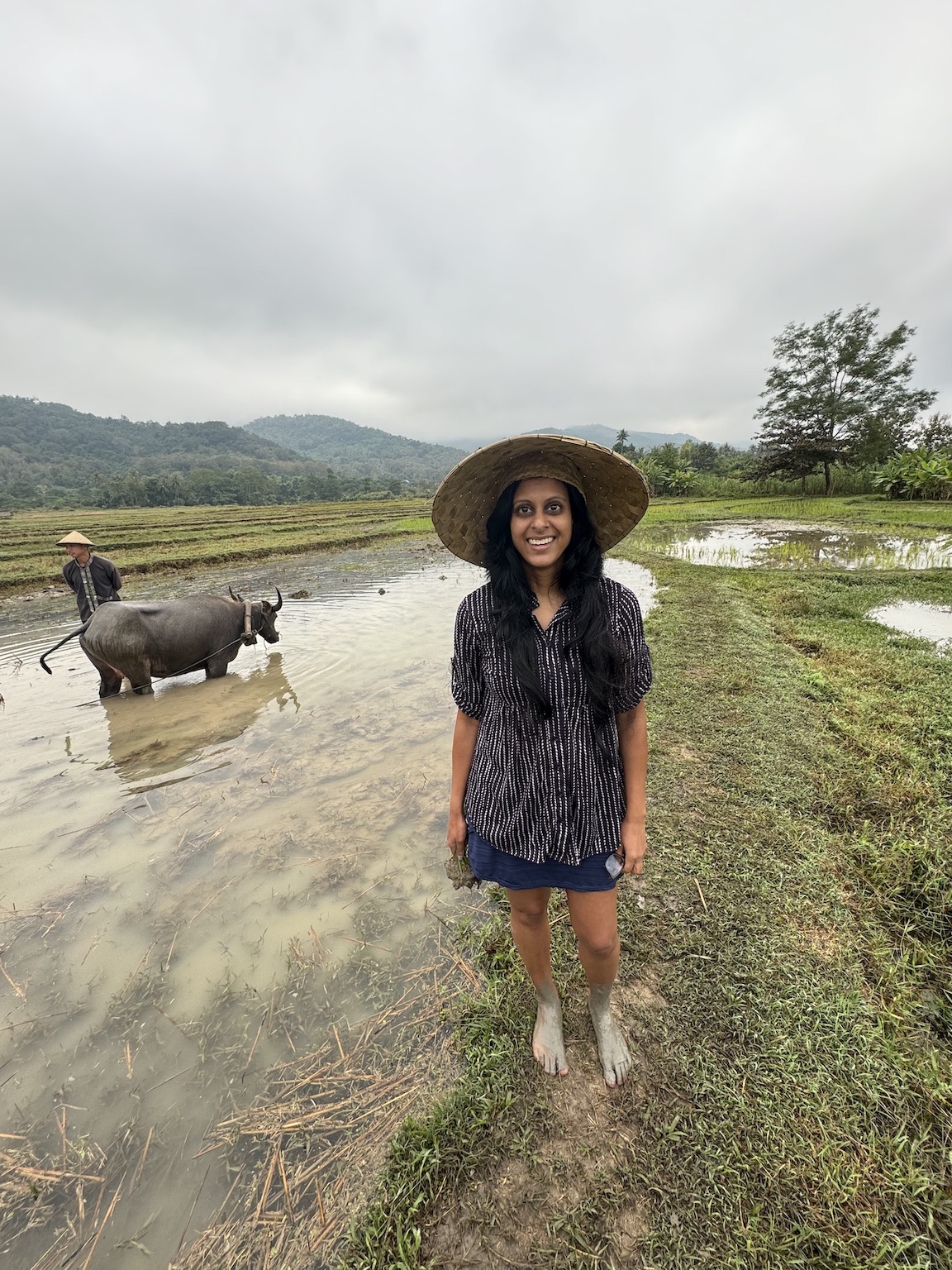
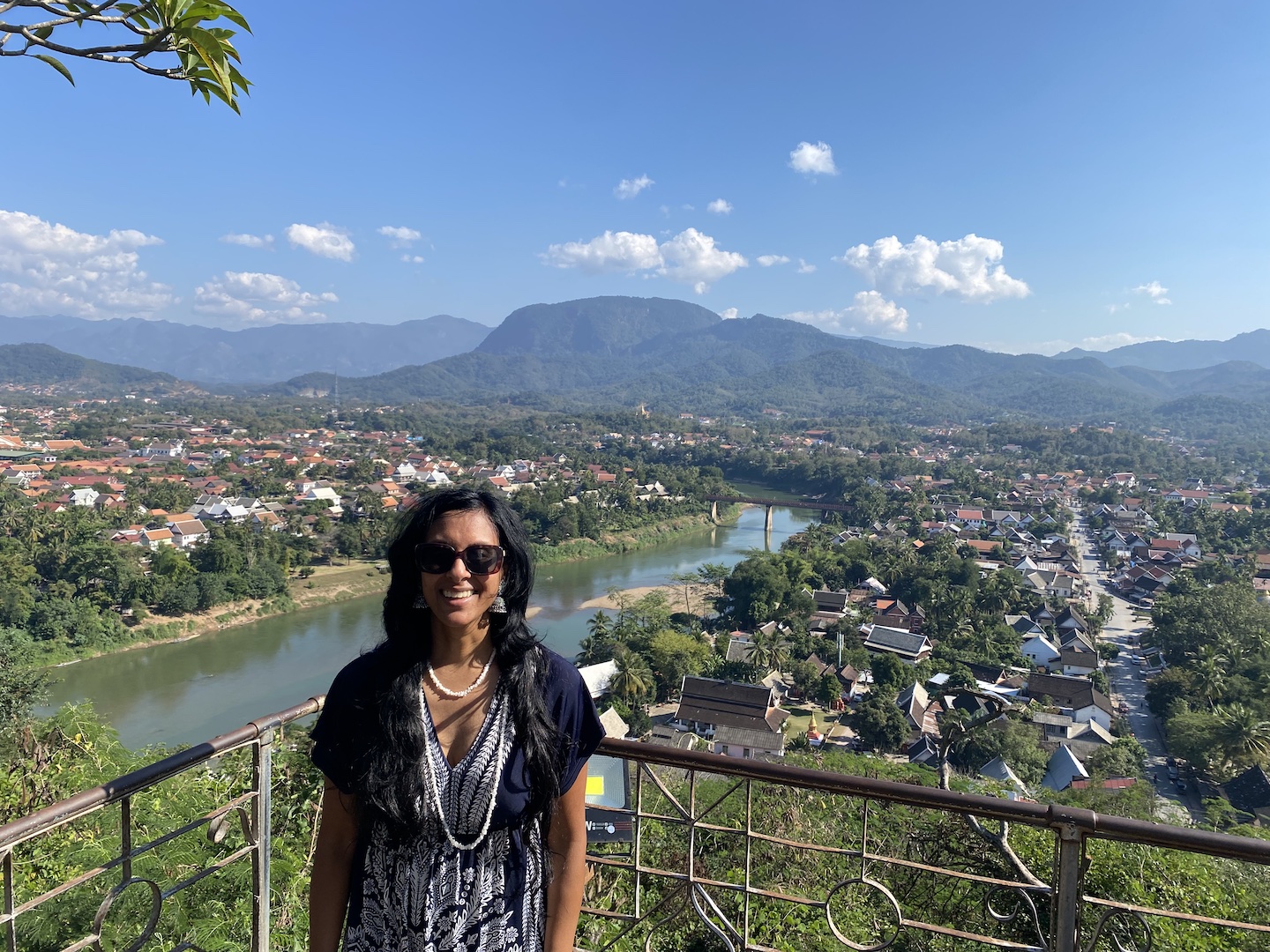
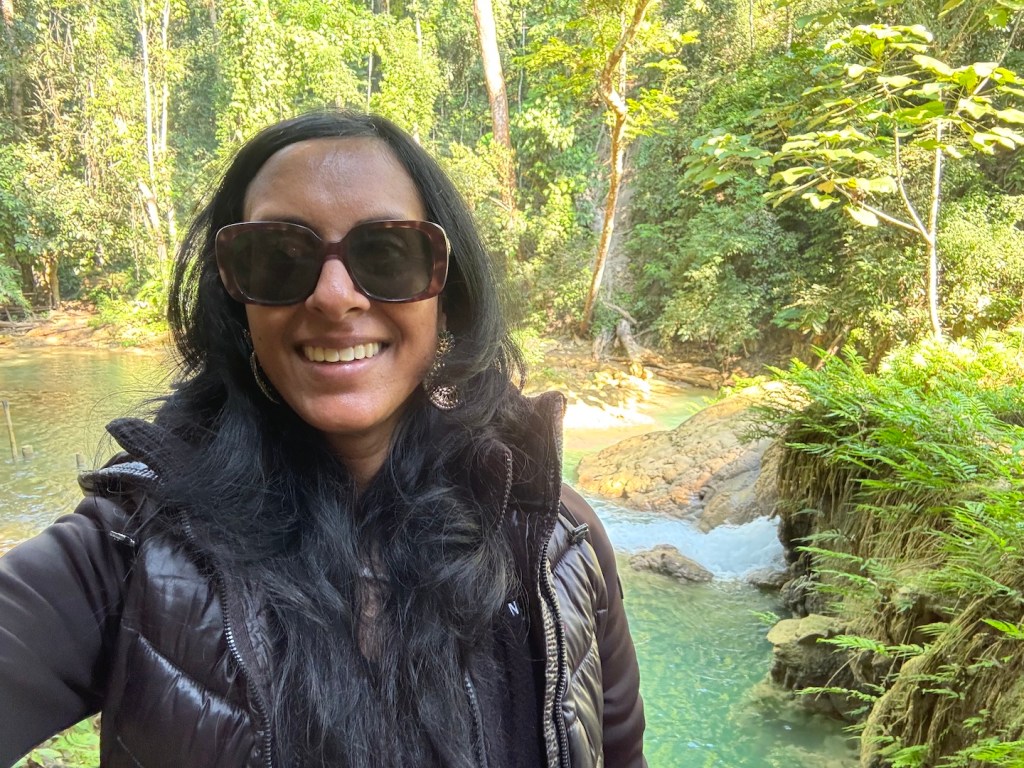
Yes! From a weather standpoint it’s the cool, dry season which is from the beginning of November thru February. It was still warm and hot in December but the day would start overcast and chilly, as you can see from the photos below. ProTip: Take a light, warm layer as the mornings can be chilly.
Mornings generally started off at around 57-60 degrees and overcast. I had a light warm layer on as our hotel and its restaurant were right on the Mekong River and it was a little chilly by the water in the morning at breakfast. It got warmer and then hot throughout the day ranging anywhere from 70-79 degrees. It was not humid. ProTip ladies: take leave-in conditioner/hair oil.
6am-7am: 50s-60 degrees, mostly overcast
7am-10am: 55-65 degrees, mostly overcast
10am-2pm: 65-75 degrees, sunny
2pm-5pm: 70-75 degrees
6-8pm: 65-70 degrees
10pm-6am: gradually decreases 45-65 degrees
In general, the cool season in Laos is defined as 66 degrees to 80 degrees in the northern part of the country, for example in Luang Prabang and Vientiane. In the southern part of Laos i.e. Pakse, it’s hot, averaging around 85 degrees. And in the far far north, it’s a consistent cold to cool – meaning in the early morning in the mid 40s and warms throughout the day to the mid 60s.
Takeaway: take a warm layer – you’ll be glad you did. How thick of a warm layer? You know you. I took my light puffer jacket that I could layer over my North Face fleece. They both came in handy for long flights, long drives, long boat rides, and if one was dirty or off at the laundry, I had a back up.
Communication and Transportation in Laos and Cambodia
You can buy a SIM card upon arrival or set up an international plan through my your phone carrier before you leave.
Download the Grab App as well as the Pass App. Grab is the Uber for most of southeast Asia while Pass is a Cambodian competitor available in Cambodia only. While it’s nice to support local businesses, Grab is much more user-friendly. This is a very detailed article about how to use both apps. The Grab App is not available in Laos. In Laos download Loca.
Bathrooms in Laos and Cambodia
Traditionally, there are squat toilets throughout southeast Asia. But in hotels and touristy restaurants you will find at least 1 western toilet. There may or may not toilet paper or hand soap. I recommend traveling with a bathroom kit.
- toilet paper
- hand sanitizer
- soap sheets
- compressed towelettes
- disposable toilet seat covers
- travel door hook or carabiner so you don’t have to put your bag on the bathroom floor.
- small quick dry travel towel
Tech Gear for Laos and Cambodia
Laos and Cambodia operate on 230v and 50Hz. The US is on 110-220v and 60Hz though most homes and businesses have access to 120-240v. Thankfully, most modern devices (purchased from the US) are 120-240v so you should be ok in Laos and Cambodia without needing a converter. But still, check each of your devices. If your devices are rated for up to 240v then you will likely not need an electricity converter. You will only need a power adapter. Note: this foes not apply to all devices and you should read the usage manuals for each device. For example, hair dryers are often a problem.
A power adapter, like the one pictured below, is a tool that you plug your device into, to adapt to the country’s plugs. Again, adapters do not convert electricity they just adapt the prongs so you can plug your device into a socket in the country you’re in.
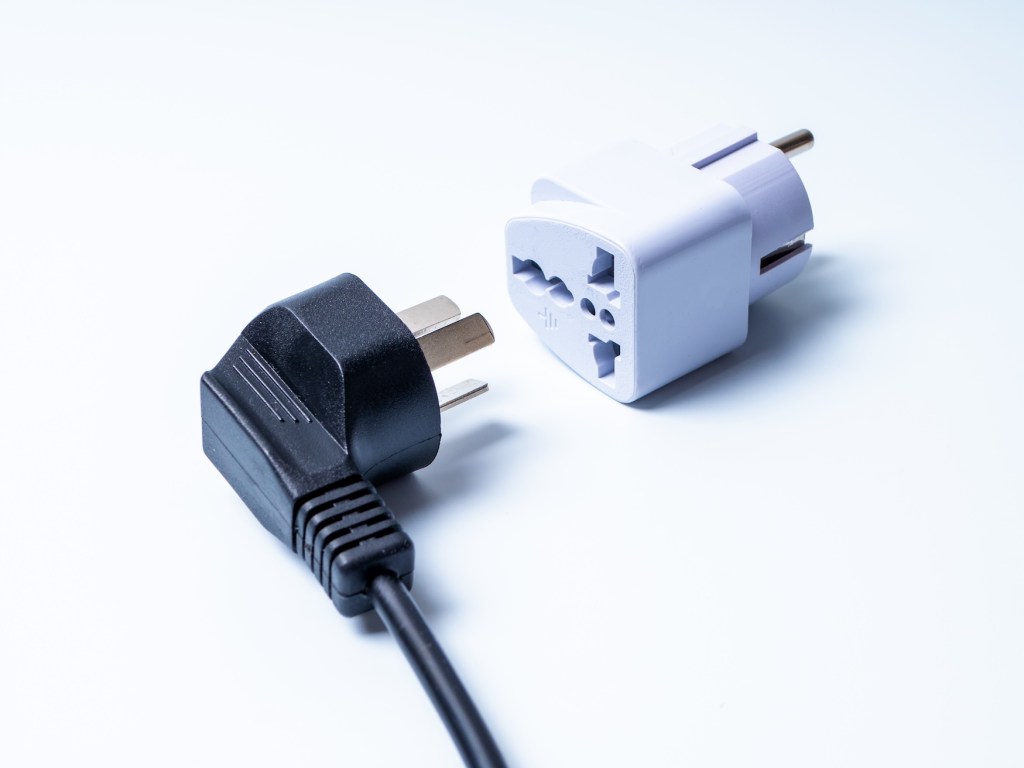
Here is a guide to worldwide power outlets.
Universal International Adapter. A universal adapter is a great tool for your travel tech pouch. You can use it pretty much anywhere in the world as it has prongs for most electrical outlets across the globe. Sometimes there are different types of sockets even within a country.
Long Charging Cables. I bought this 16ft. long charging cords for my phone and tablet about 6 months ago and have found it to be a fantastic addition to my travel tech kit.
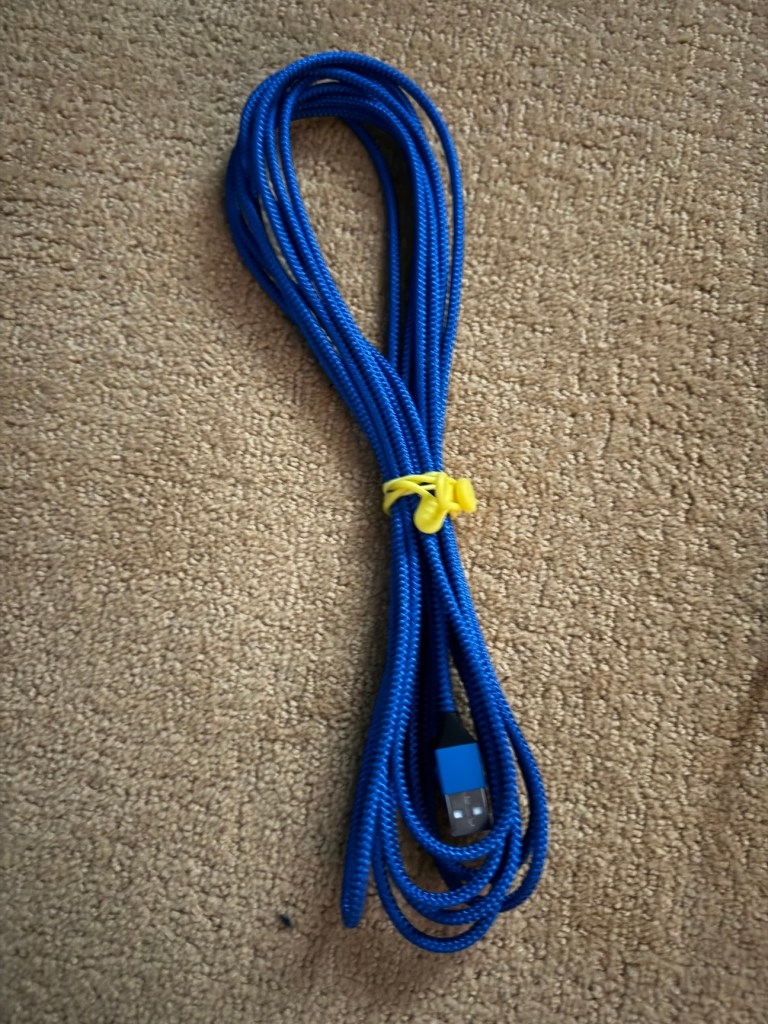
Scenario We Can Pretty Much All Relate To. It’s night time. You’re laying in bed, winding down after a fun and memorable day at a 4 tiered waterfall with the most incredible azure-colored waters you’ve ever seen. You’re scrolling through the gazillion photos you took. Your phone is on its last legs of battery, so naturally, you want to plug it in while scrolling…but the socket is like 10 feet away….and your charging cord is not long enough. SO annoying!
Enter long charging cords. There are 6ft., 10ft., and 16 ft. cords. From my own experience I have found them very useful. Whether you’re staying in an older boutique hotel, an AirBnB or a hostel, you’ll be ready for whatever type of setup the accommodation has. It won’t be something you even think about.
ProTip for long cords. Long cords can get cumbersome to pack. I bought these fasteners to stay organized. These have a ‘button’ that’s very easy to clasp and unclasp. Velcro ones are a pain as they stick to everything – clothes, bags, etc. and they’re cumbersome to clasp and unclasp.
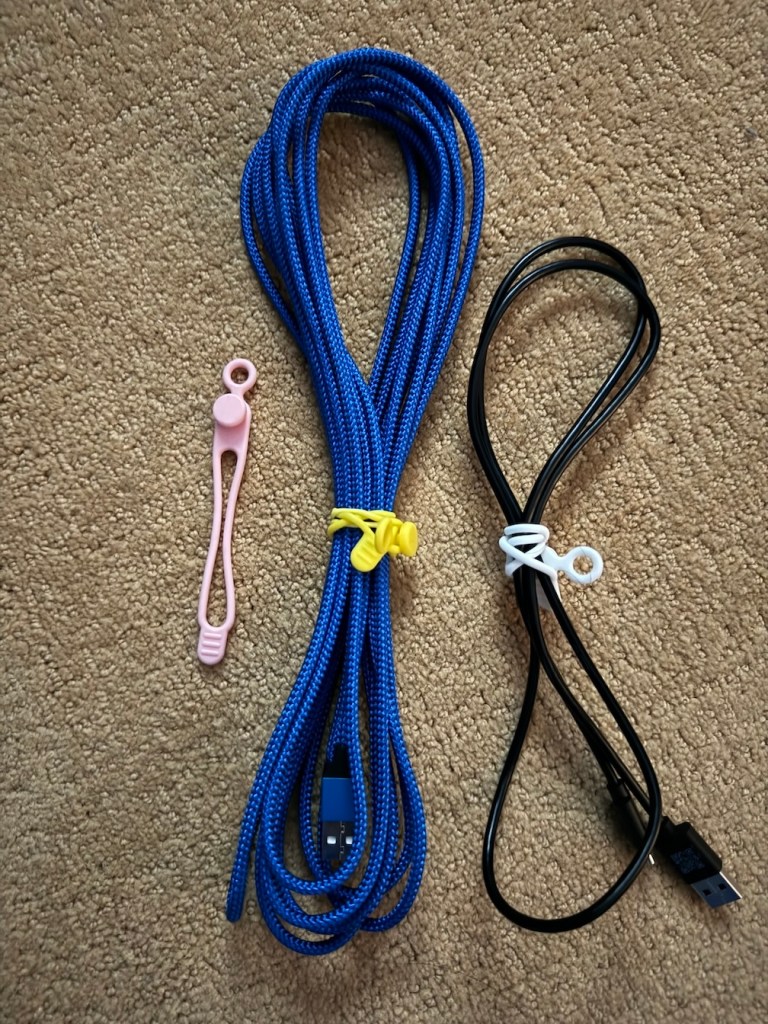
These magnet ones seemed cool, at first, but after reading multiple reviews that said you have to fight with it to get the magnet to unstick, I thought ‘nah’.
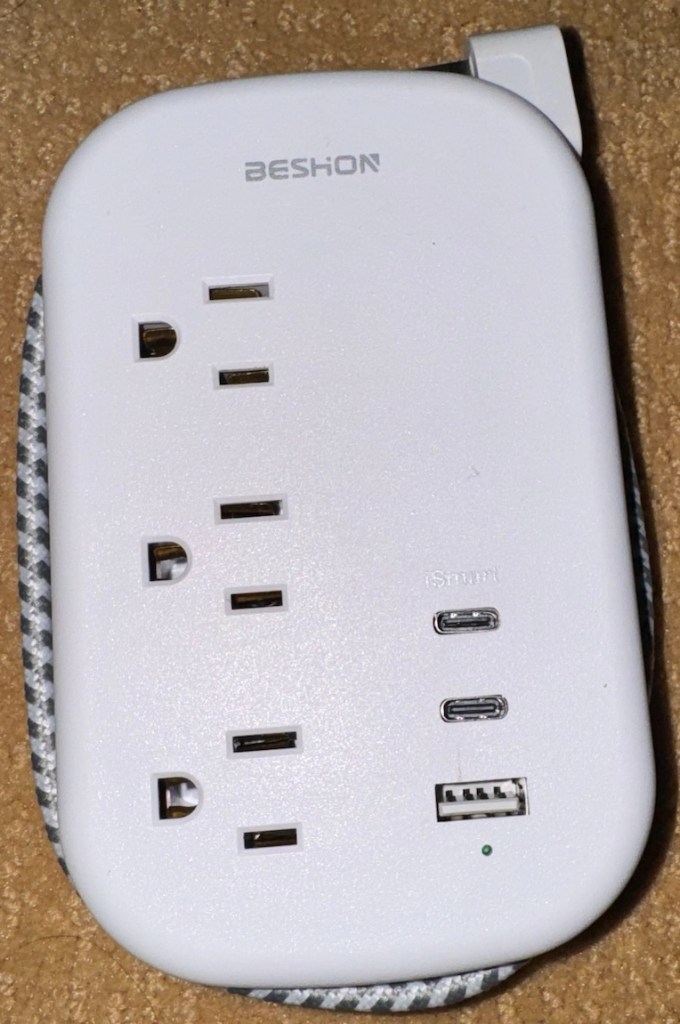
Travel Power Strip. This travel power strip is a great addition to my travel tech kit as well. Between the DSLR, computers, tablets and phones, like many people, we end up traveling with a fair number of devices and it becomes a challenge to charge all of them if the accommodation only has 1 power outlet. This travel strip is pretty compact and easy to travel with.
Phone Gear For Planes and Airports
These days you never know what, if any, type of charging ports you’re going to find in planes and airports — so I try to be prepared for anything.
Multiport USB A Wall Charger brick. In addition to long cords, I recently purchased this multiport USB A charging brick that allows me to plug in and charge up to 4 devices simultaneously — and what a game changer. Just like the long cords, I don’t think about where/how I am going to charge my devices anymore. This brick is small and light – perfect for travel.
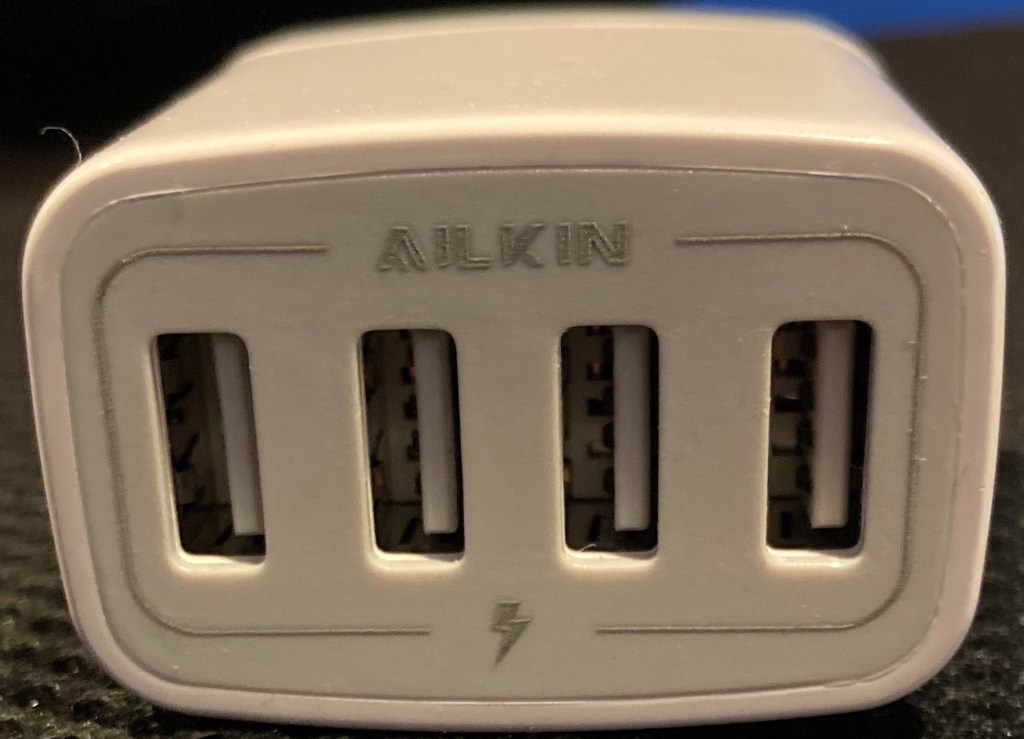
Multiport USB A to USB A Strip. This skinny little power strip is very handy for long hauls. I can plug in my computer and my phone or, whatever else, simultaneously as opposed to one-at-a-time. Mine has 4 ports but you can find others with more.
Portable Battery Bank. I like the iWalk portable battery bank because it’s compact and I can still use my phone while it’s charging.
USB Hub. For some this might be overkill, but sometimes plane seats only have a USB port and for those long haul flights this comes in handy. Plus it’s very small and light.
Wired and Wireless Earbuds. I always travel with wired as well as wireless earbuds. Sometimes bluetooth can be finicky. And I haven’t bought an AirPlay because the battery can run out on wireless earbuds. I prefer to have wired earbuds. It’s old school but it works.
Here are some selfie sticks and useful camera gear useful as well:
DJI Osmo Gimbal
MagSafe Selfie Stick
MagSage Selfie Stick Tripod
What To Wear In Laos and Cambodia
In this section of the article I have detailed what to wear:
- temples
- walking around town
- waterfalls/bodies of water
- hiking
There is also a separate section on what shoes to take.
In general these are more conservative countries. We saw plenty of tourists and locals wearing shorts and tank tops. But we didn’t see revealing nor suggestive clothing.
What To Wear At Temples (not including Angkor Wat; jump to the section on Angkor Wat). Cover your shoulders and knees. As you can see below, I wore leggings with a tunic aka a salwar (Indian clothes). Go for no cleavage, no mesh, no strappy, no skin tight, nor super transparent clothing. Think breezy and covered. With the heat, you’ll be more comfortable in that anyway.
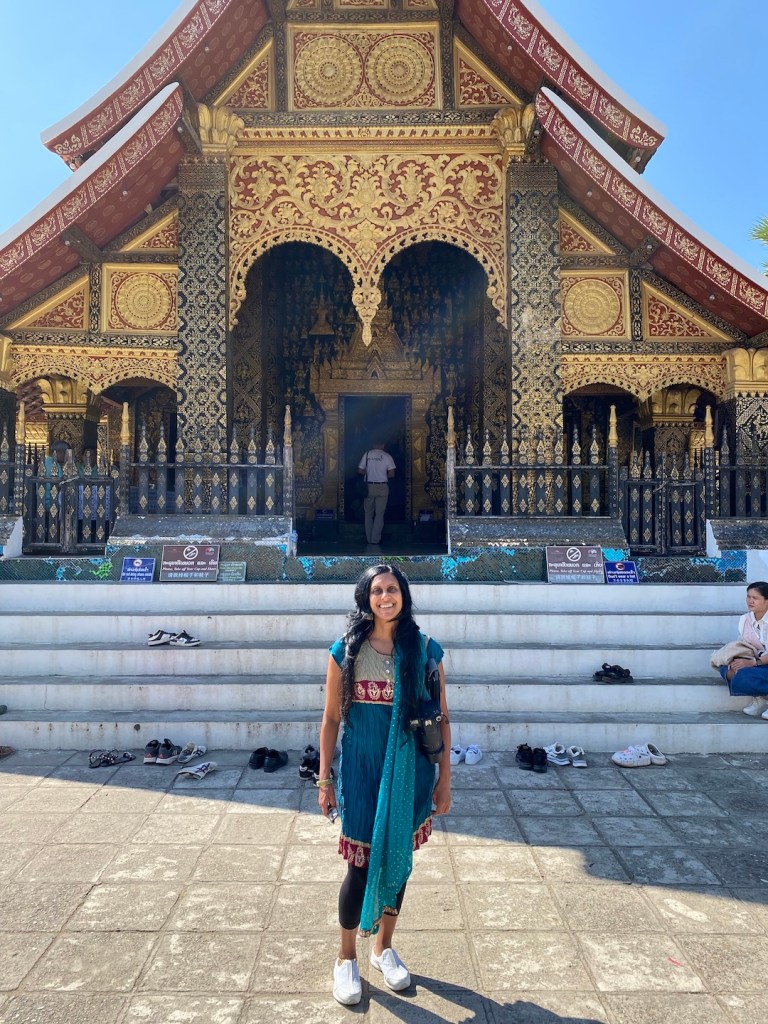
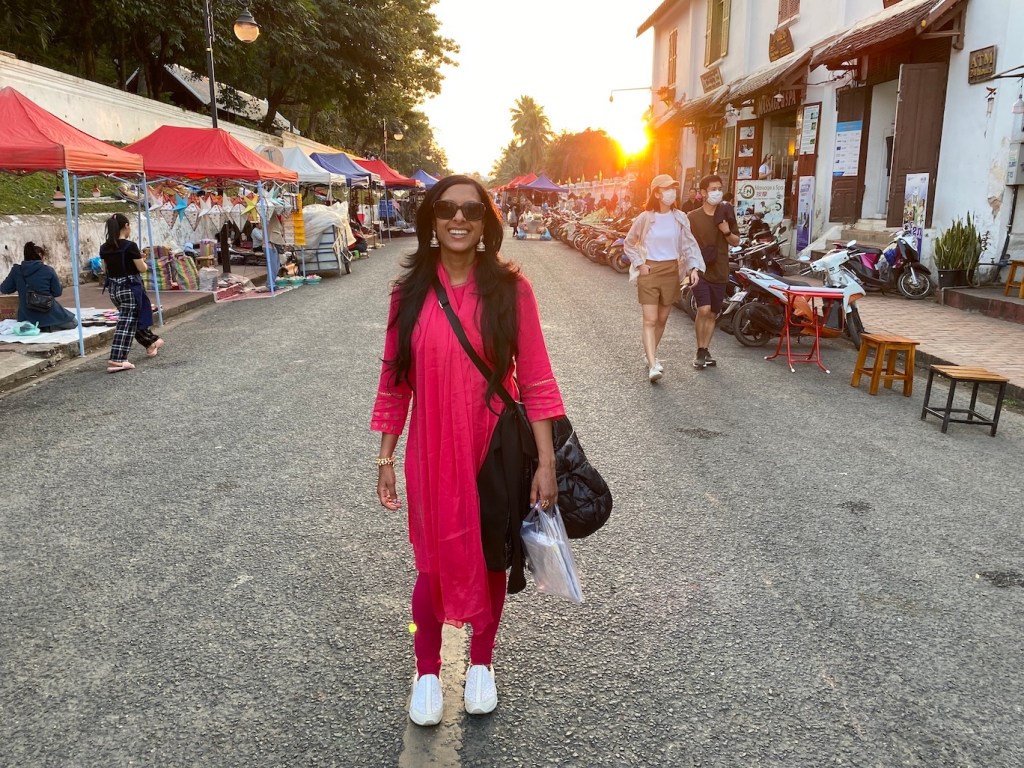
I wore my casual Indian clothes. I don’t get many occasions to wear them, they’re pretty, light, and comfortable so it was kinda perfect. My husband wore cargo pants or hiking pants and t-shirts pretty much the whole trip.
Assuming, you don’t have Indian clothes – wear t-shirts, breezy pants, leggings with a tunic, flowy skirts and dresses (avoid long slits and low neck lines).
You might end up going to a temple at any point — they are everywhere, so if you’ve got a sleeveless top on, then keep a light wrap in your day pack, so that you’re always prepared.
Note at Angkor Wat the rules are more strict. They are likely to deny you entry with just a wrap. Your top itself has to cover your shoulders. More details about Angkor Wat later in this blog.
What To Wear At Waterfalls. If you’re swimming, wear your bathing suit. But it’s recommended to wear a cover up at all times when you’re not in the water. Again, Laos and Cambodia and all of southeast Asia are very different than Western countries – more conservative. It looks odd if you walk around in your bikini.
What To Wear At Walking Around Town. When we were wandering around town, I wore skorts, and dresses. With leggings the top always covered my bum, pants with tank top (no plunging necklines, backless, revealing etc).
In terms of footwear while walking around town, I had the sneaker-mules (below) and honestly they were awesome. They’re called “Traveltime” so the name says it all. I didn’t want open toe sandals because a lot of streets are dirt, have gravel, and uneven, so I wanted something with toe protection. And I wanted something hands-free. We did randomly go into temples – and these slip on/ off while I could walk in them for hours. Since our Laos/Cambodia trip, I took them to Peru and India, and awesome awesome awesome.
The mistake I made was buying white. While it looks nice, they definitely got dirty. These come in loads of colors and styles. I got them cleaned in India but it’s not the same. Oh the other thing is these are my go-to wear-on-the-plane shoes. I take my shoes off during those long haul flights and these are so easy to slip back on, hands free, whenever I need to get out of my seat.
PI bought these shoes on Amazon, but they sell them at Macy’s as well.

What To Wear For Hiking. For hiking I wore hiking clothes = pants or leggings with a breathable top + hiking shoes or Keens.
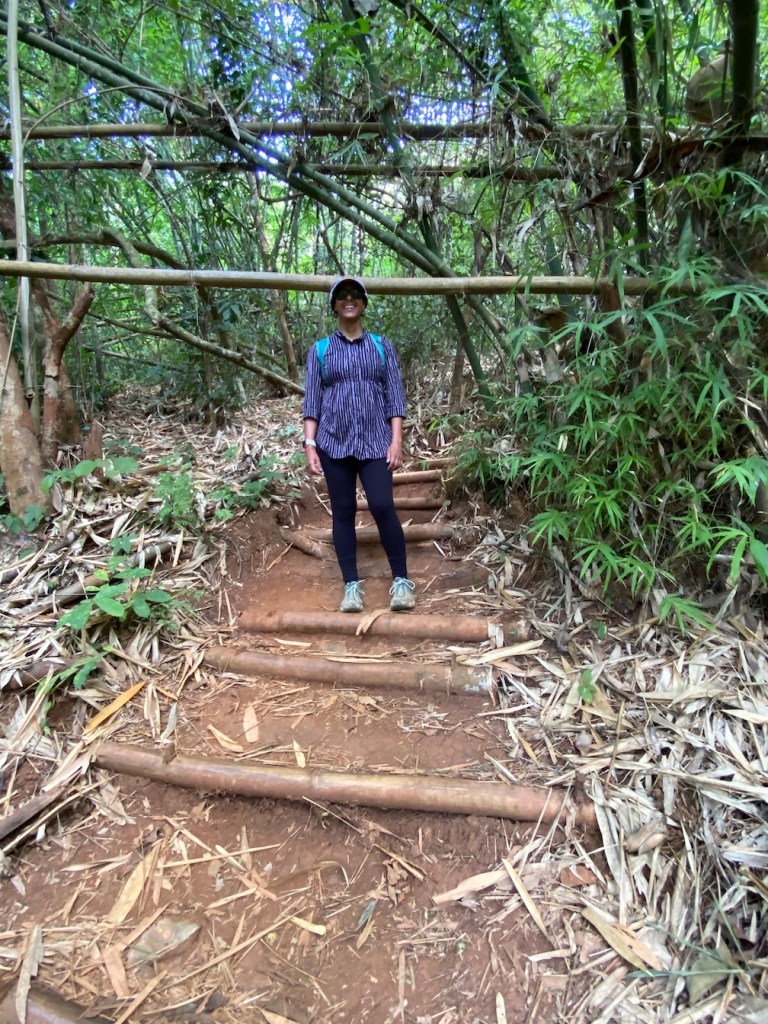
Below are some photos of things we wore to give you a sense. I packed mostly breezy and light clothes as I didn’t wear Indian clothes all the time. I packed hiking pants, a couple pairs of leggings to wear with tunics, and I had three warm layers. A very light jacket, a fleece for long drives and to wear on flights (the only times I used the fleece). And a light packable puffer jacket which came in handy at some of the waterfalls and boat excursions and even at restaurants where the AC was cranking.
Laundry was easy to have done at the hotels we stayed at. If we gave our laundry in the morning we’d have it back that afternoon – nicely pressed and folded or if in the evening, then we’d have it later that night or the next morning.

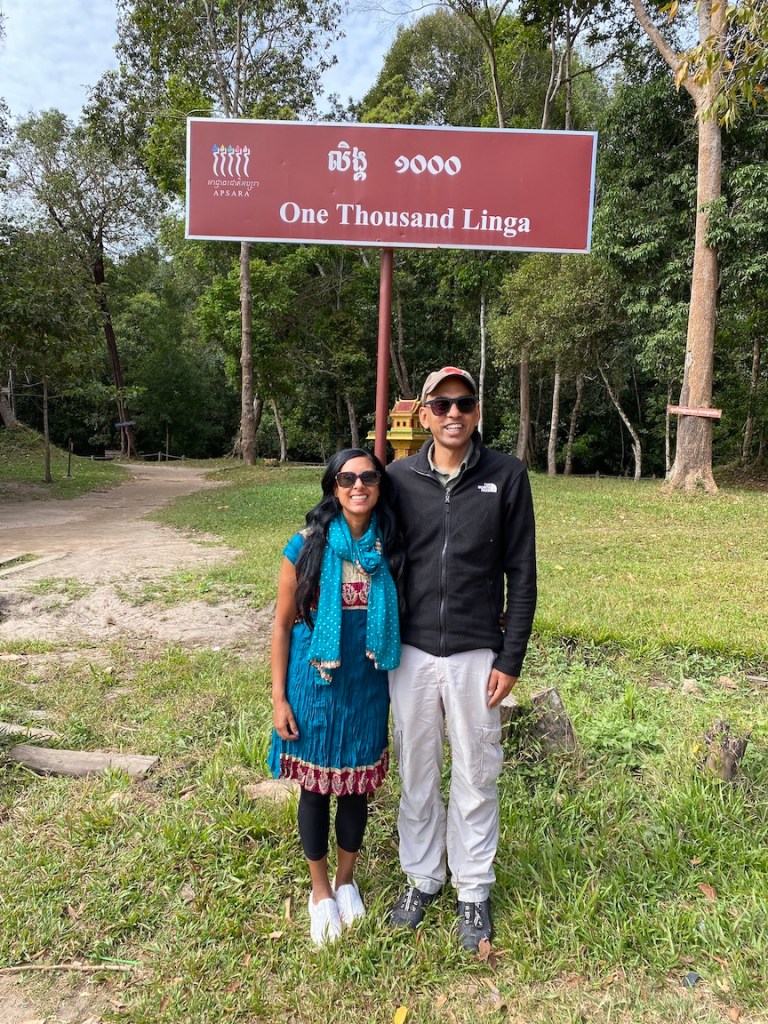
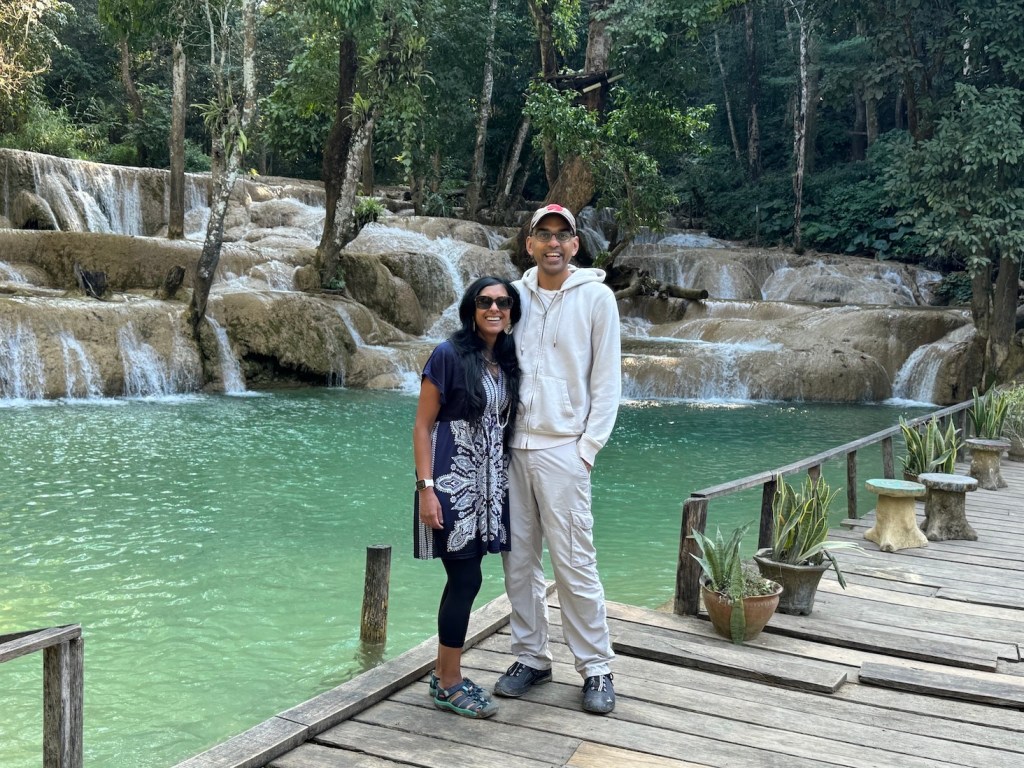

What To Wear At Angkor Wat
They are stricter at Angkor Wat or at least that’s what the website and all the blog posts say. And people abide by the rules as no one wants to go all that way only to be denied entry. I didn’t seeing anyone wearing sleeveless, strappy clothes.
Cover your shoulders and knees. If your top is sleeveless, simply wrapping a sarong around your shoulders will not cut it and they are likely to deny entry. Your top itself must cover your shoulders. A lot of blogs that I read, said to cover your elbows. I disagree. I saw plenty of people with short sleeves – men and women and it was fine.
Don’t wear:
shorts (anything above the knee)
low cut tops
sleeveless
strappy
backless
see-through, mesh
form fitting
skirts/dresses with long slits
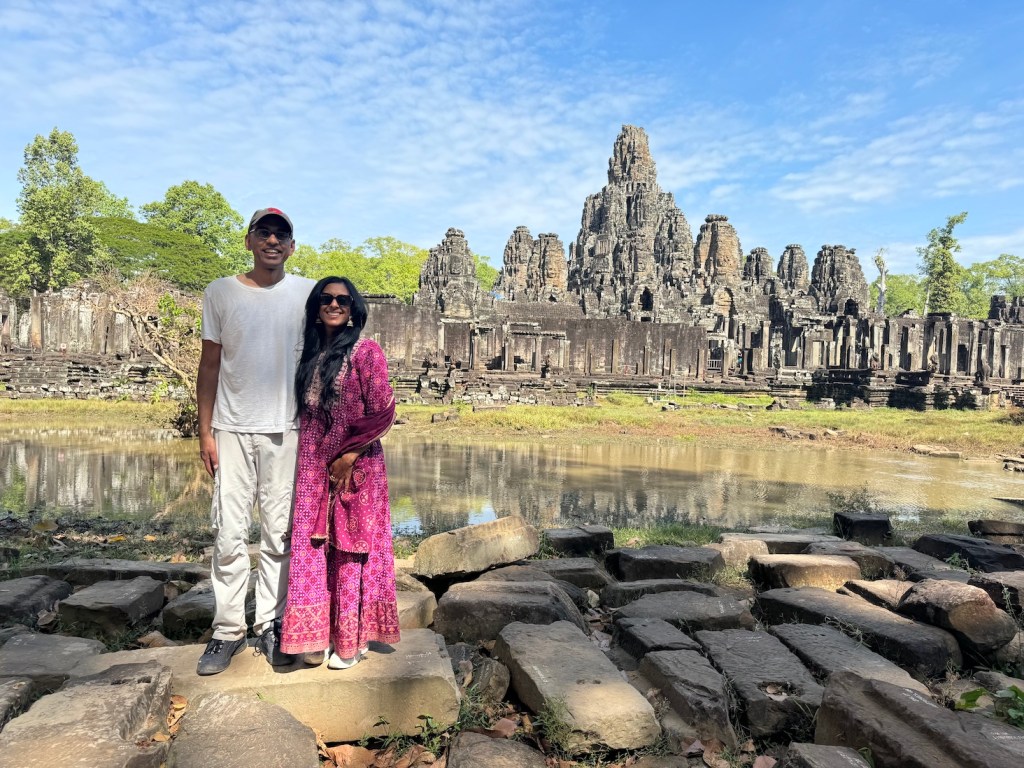
Pants, Midi or maxi skirts or dresses (no long slits), leggings with a top that covers your bum – these are all things you should plan to wear. I wore an Indian outfit as you can see below. Some blogs I read before going, said wearing a long skirt/dress would be cumbersome. I did not find that to be the case.
My Indian outfit (below) is called an anarkali which is effectively a fit and flare maxi dress with matching leggings underneath and a scarf-like matching piece of cloth called a dupatta, which is not as small as a scarf but not as big as a shawl. Below I am carrying across my arms for the photo, but when I was walking around Angkor Wat I had it draped around my neck like a scarf.
Sunrise at Angkor Wat is very popular and I was glad to have my packable puffer jacket. We arrived there at 4:30am and it was not chilly, it was cold. Once it got warm, we put our jackets in our daypacks.
As you can see my husband wore cargo pants and a white t-shirt. He was comfortable.
Shoes For Laos and Cambodia
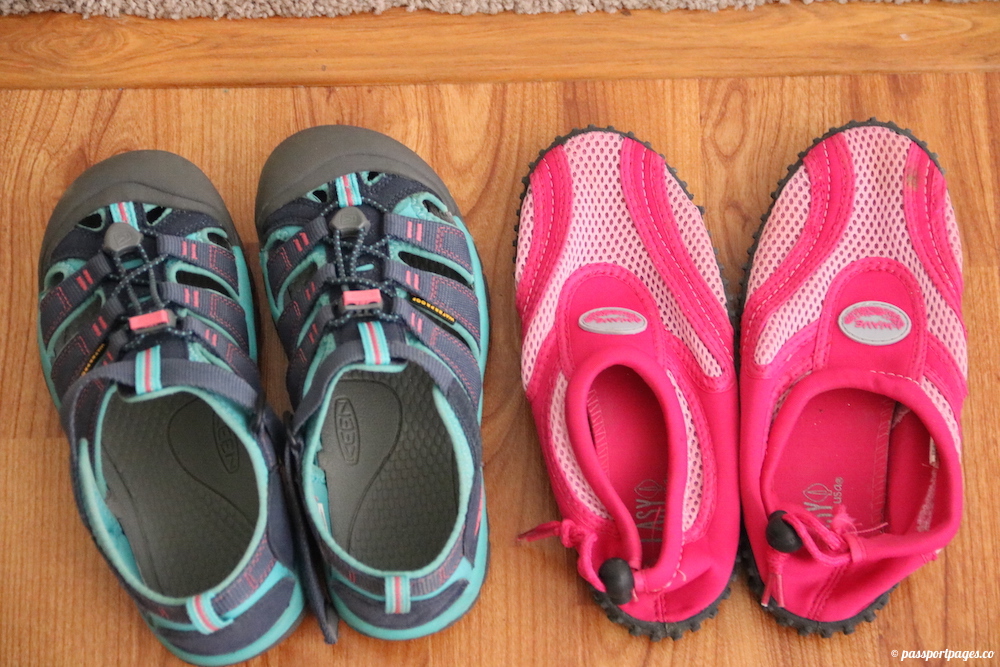
I took 3 pairs of shoes: hiking shoes, water shoes, slip on sneakers. The water shoes are key for any waterfalls or other water activities. You can go barefoot but why not protect your feet? There are sharp and slippery rocks and debris as these are not pristine hotel swimming pools so I recommend water shoes.
Reminder: I have no affiliation with any of these companies nor products and no affiliate links – just my honest recommendations based on my personal experiences.
I have Keen‘s and I consider them an investment piece of travel gear. I’ve had them for 7 years and take them on pretty much every domestic and international trip that I take that involves water.
These slip on sneakers were a game changer. I talked about them above but I’ll mention them here again. These were perfect for toe protection vs. open toe sandals – on dirt, uneven, or unpaved roads and paths. I am certain I would have stubbed my toes at least a few times had it not been for these. I saw plenty of people walking around in open toe shoes so there’s nothing wrong with them – but I preferred the peace of mind. They are called Traveltime so the name says it all. For me, they lived up to their name. I can walk in these for hours and they were perfect for quick and hands-free slip on/off for the many temples we visited.
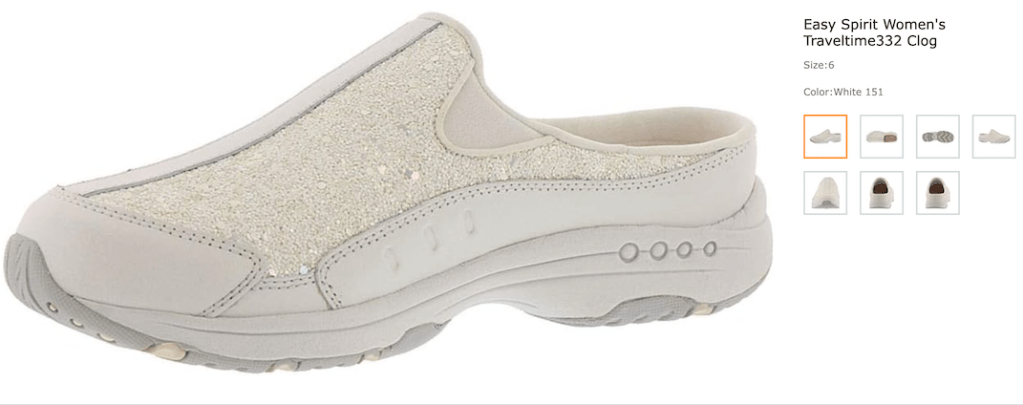
I bought white and while they look nice, they got dirty after everything I put them through and don’t have that same gleaming white look anymore. They come in many different colors and styles and range from approximately $50-$70. I got mine at Amazon but they’re also available at Macy’s.
I have since taken them to India for a 1.5 month trip and they were perfect for that trip too because they slip on/off hands-free which was super convenient for visiting temples or going to someone’s home. I also prefer to wear these for long flights as they’re easy to take on/off. They have become my go-to travel shoes.
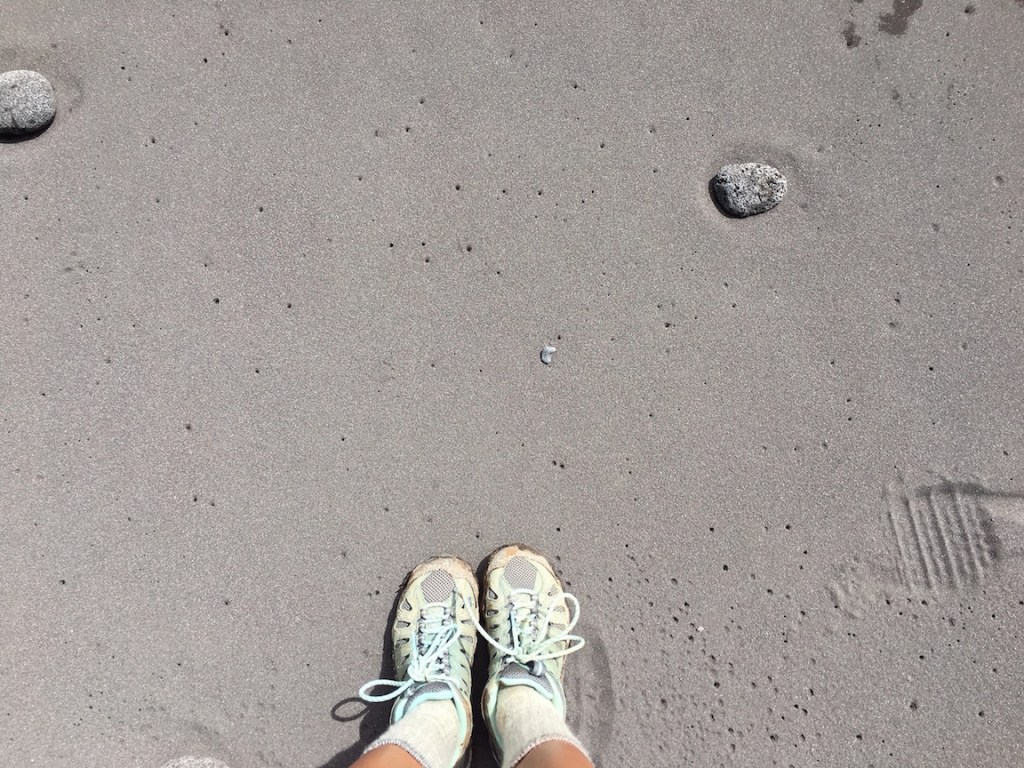
The hiking shoes were necessary for hiking Phaedaeng Point and 100 Waterfalls in Nong Khiaw. I didn’t need them in Cambodia as we didn’t do any hiking there.
Mosquitoes in Laos and Cambodia
Mosquitoes are a nuisance in Laos. In general, there are fewer during the dry season but they are more active at night and near bodies of water. If you’re worried about it, wear long sleeves, trousers, leggings, pants, bring a long sleeve rash guard. We each got bit a few times in Luang Prabang and Nong Khiaw so we were glad to have our DEET with us. We were also taking malaria pills.
Laos
How Do You Pronounce Laos?
Before visiting, I said “Laos” – rhymes with “mouse”. After visiting I say “Lao”, rhymes with “cow”. The Lao people refer to the country, the people and language as Lao.
Part of why Laos is less touristed compared to its Indochine neighbors is that it is landlocked. Actually it’s the only land-locked country in southeast Asia. The Laos economy relies heavily on trade with China, Thailand, and Vietnam.
As of 2021 the population of Laos was approximately 7.4 million. Compare that with its neighbors:
- China approx. 1.4 billion
- Vietnam approx. 97 million
- Thailand approx. 71 million
- Cambodia approx. 16 million
- Myanmar approx. 54 million
Sadly, Laos is the most bombed country in the world – meaning the most bombs per capita. At one point, there was a bomb every 8 minutes. Also extremely sadly there are unexploded ordnance throughout the country, today, that have led to the deaths and/or maiming some 20,000 people.
We saw signs, like the one below, advising people to stay on designated paths due to unexploded ordinance.
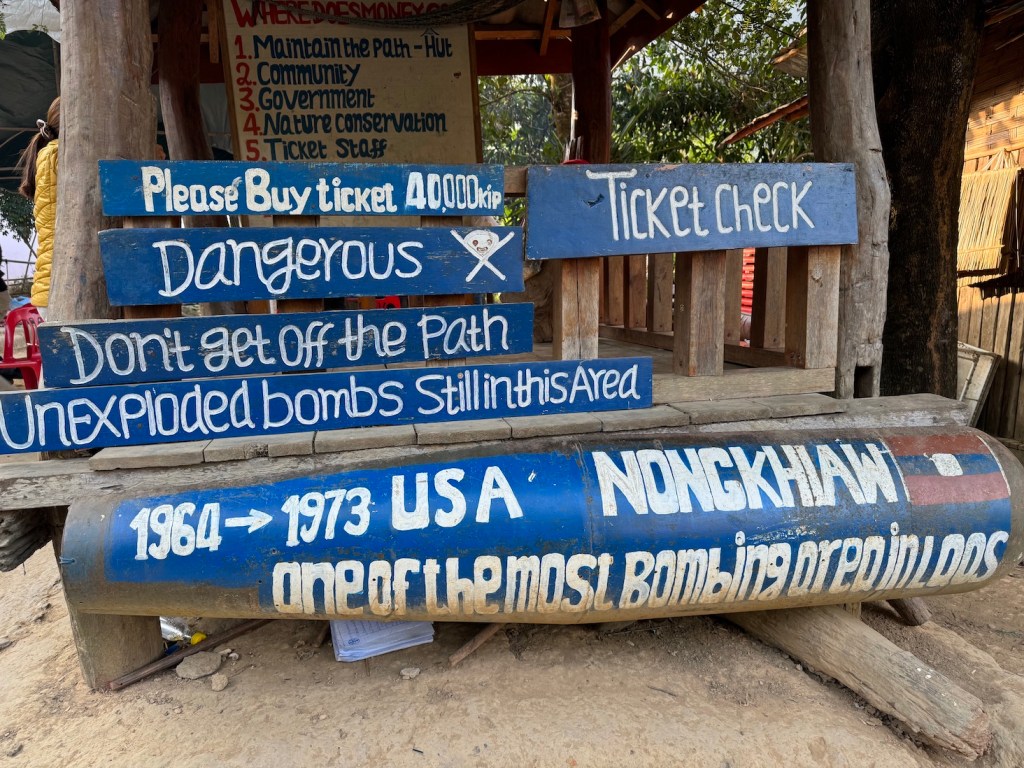
In the capital city of Vientiane COPE is an organization that provides prosthetics and services to Laotians who have lost limbs as a result of these bombs.
Yummy Fun Fact About Laos
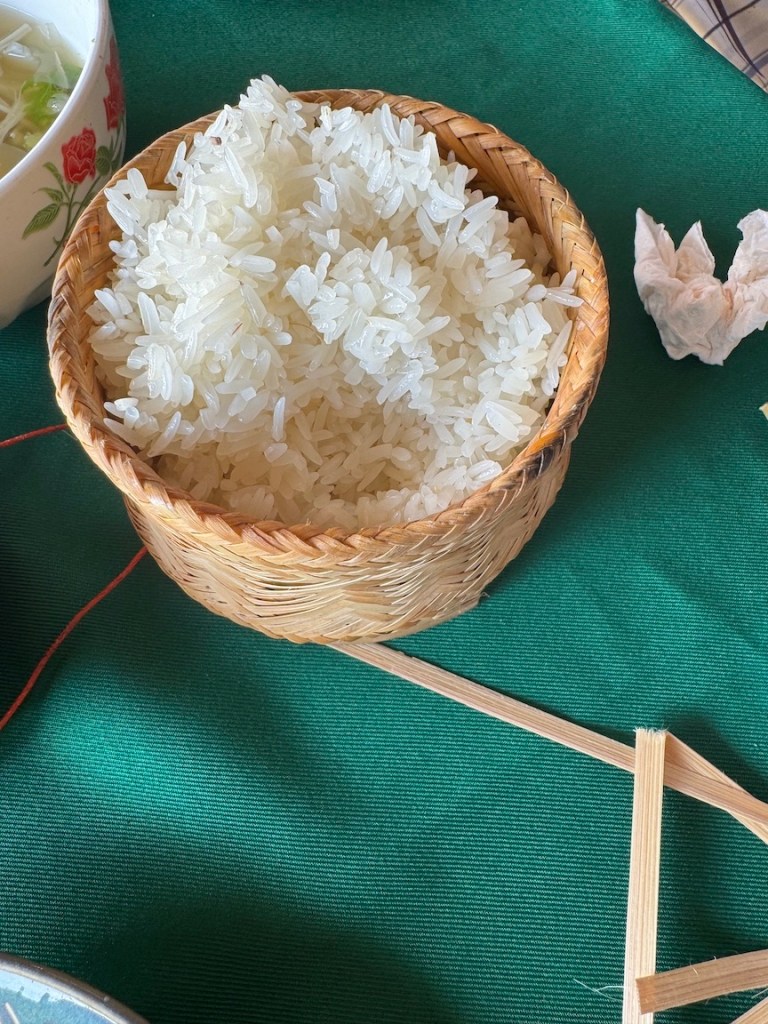
On a yummier note, Laos has the highest per capita consumption of sticky rice. And it was delicious. We really enjoyed Laos cuisine….and we are vegan. More about that later in this blog.
Vegan And Vegetarian Food in Laos
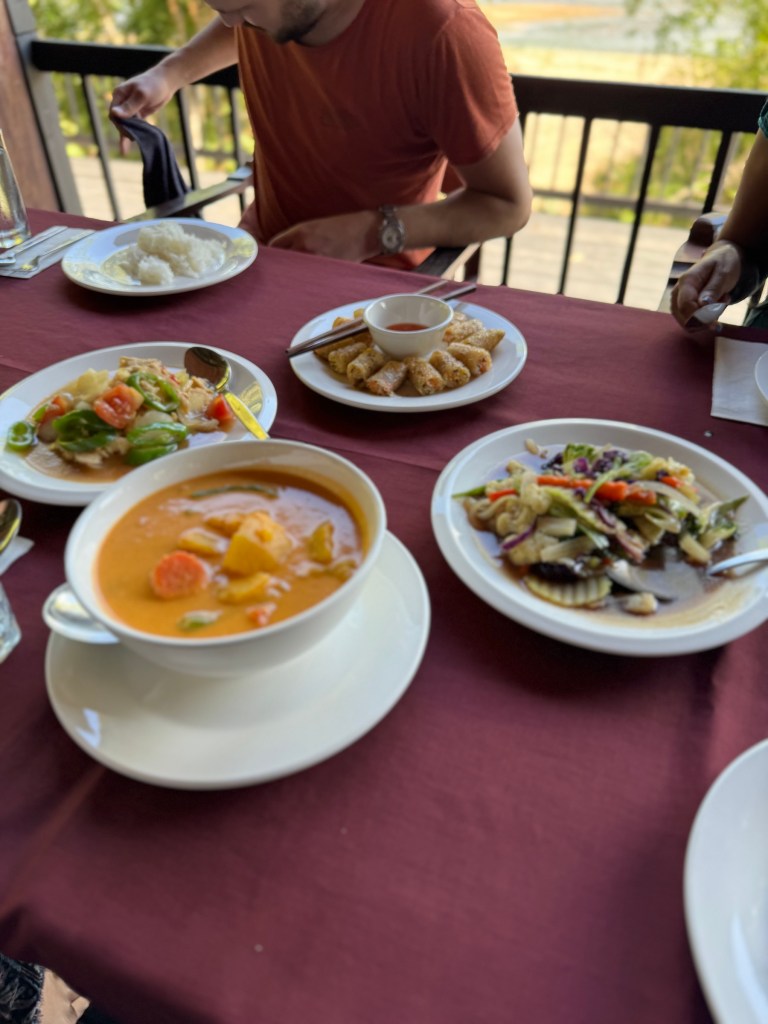
There is a common misconception that because these are Buddhist countries vegan and vegetarian food would be readily available and common – but that’s not true. Hardly anyone is vegan or vegetarian in these countries. But we found delicious food and desserts anyway. First off Laos and Cambodian food can be vegan friendly as the stir fried vegetables, curries and rice are very common.
Secondly even if you’re vegetarian I recommend referring to yourself as vegan because the definitions vary. Many times they’ll still put non-veg sauce on your food or small pieces of bacon or something, or won’t remove fish. You’re safer by saying vegan but even then clarify, communicate and verify.
Our meals broke down like this:
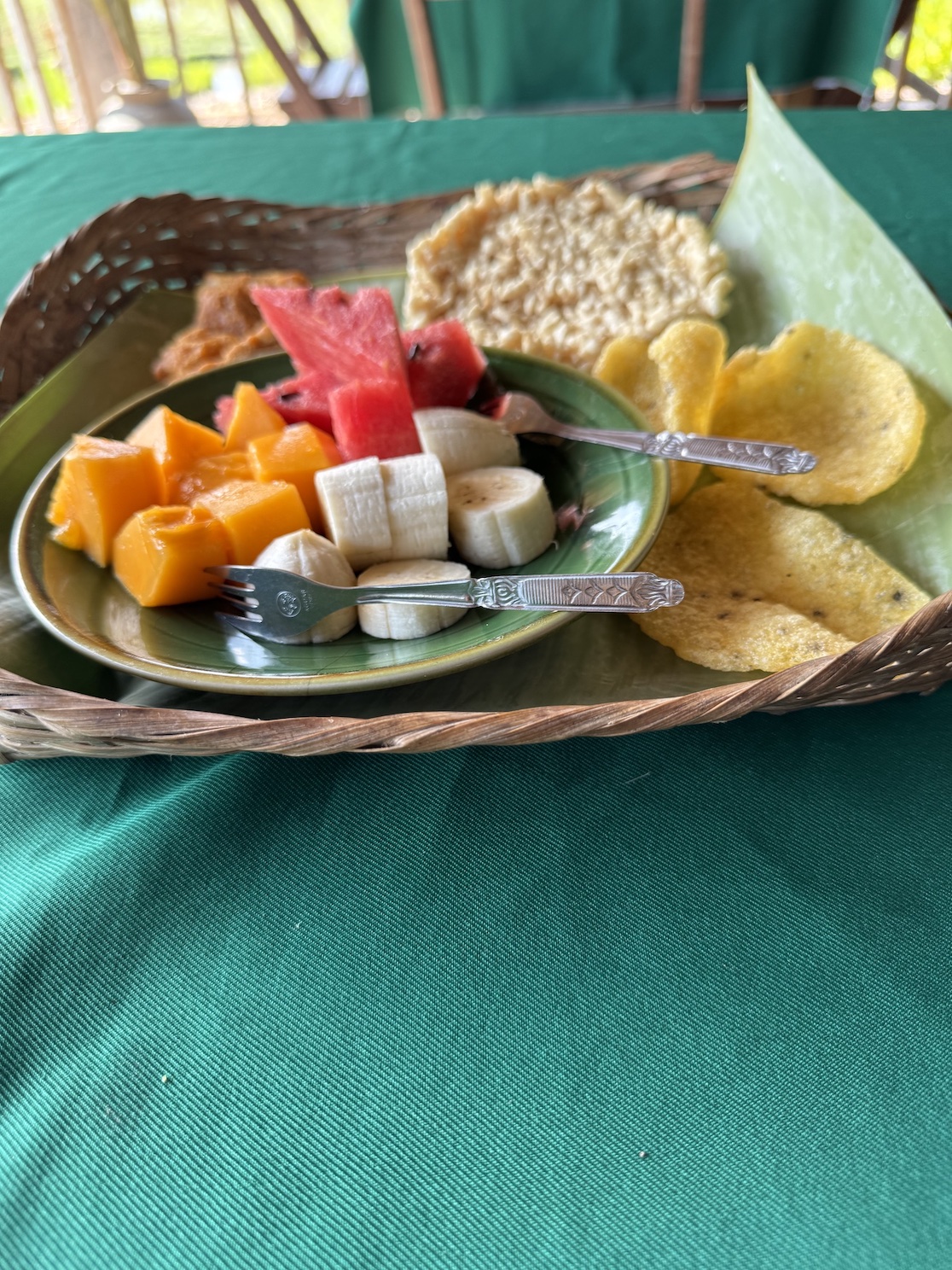
Breakfast was included at all of the hotels we stayed at and our guide explained our dietary needs to them if the staff didn’t speak English. The hotels have buffet breakfasts with bread and fruit being the only vegan options and often we were unsure about the bread. But they made vegetable fried rice or mixed vegetables for us.
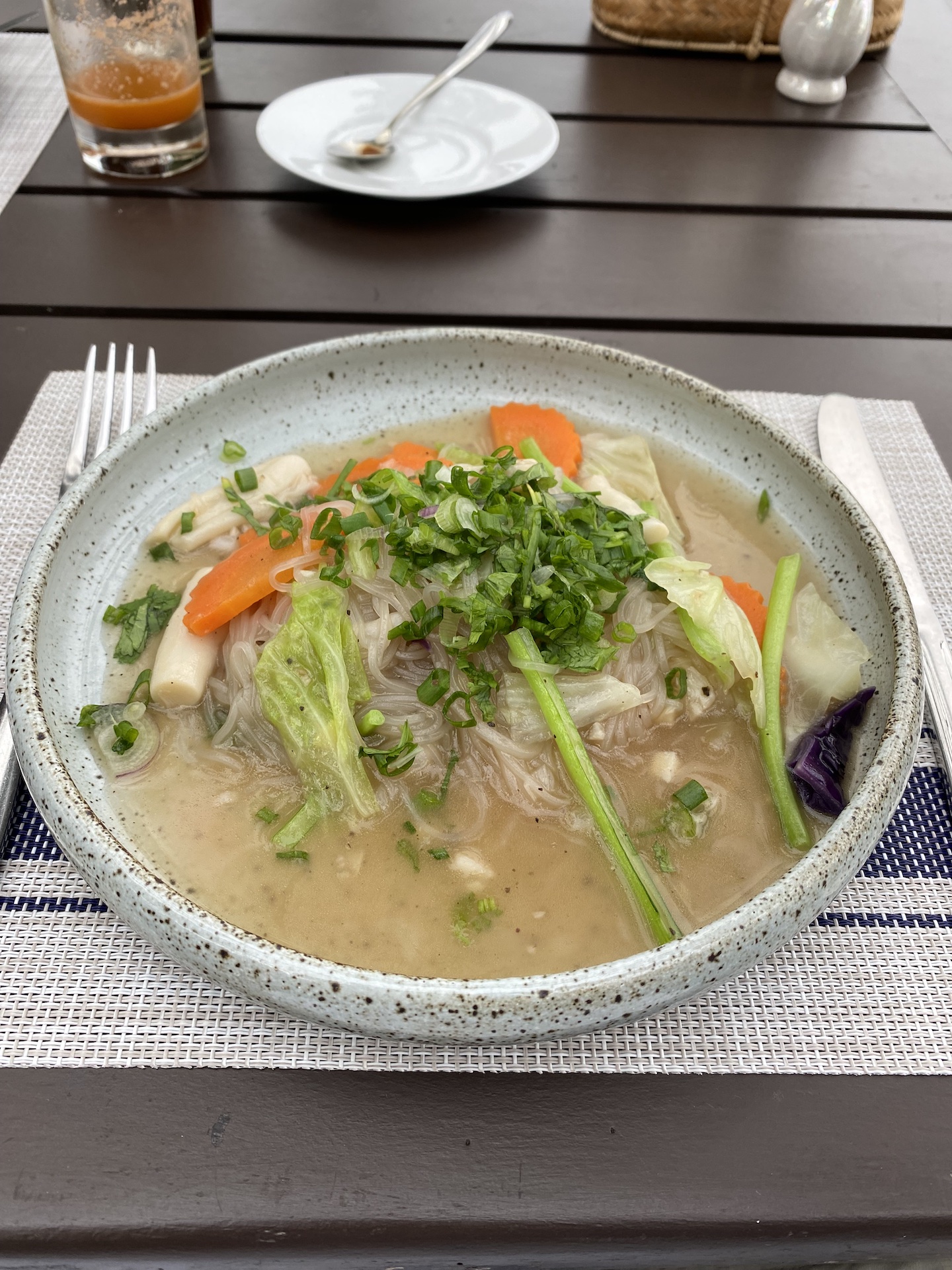
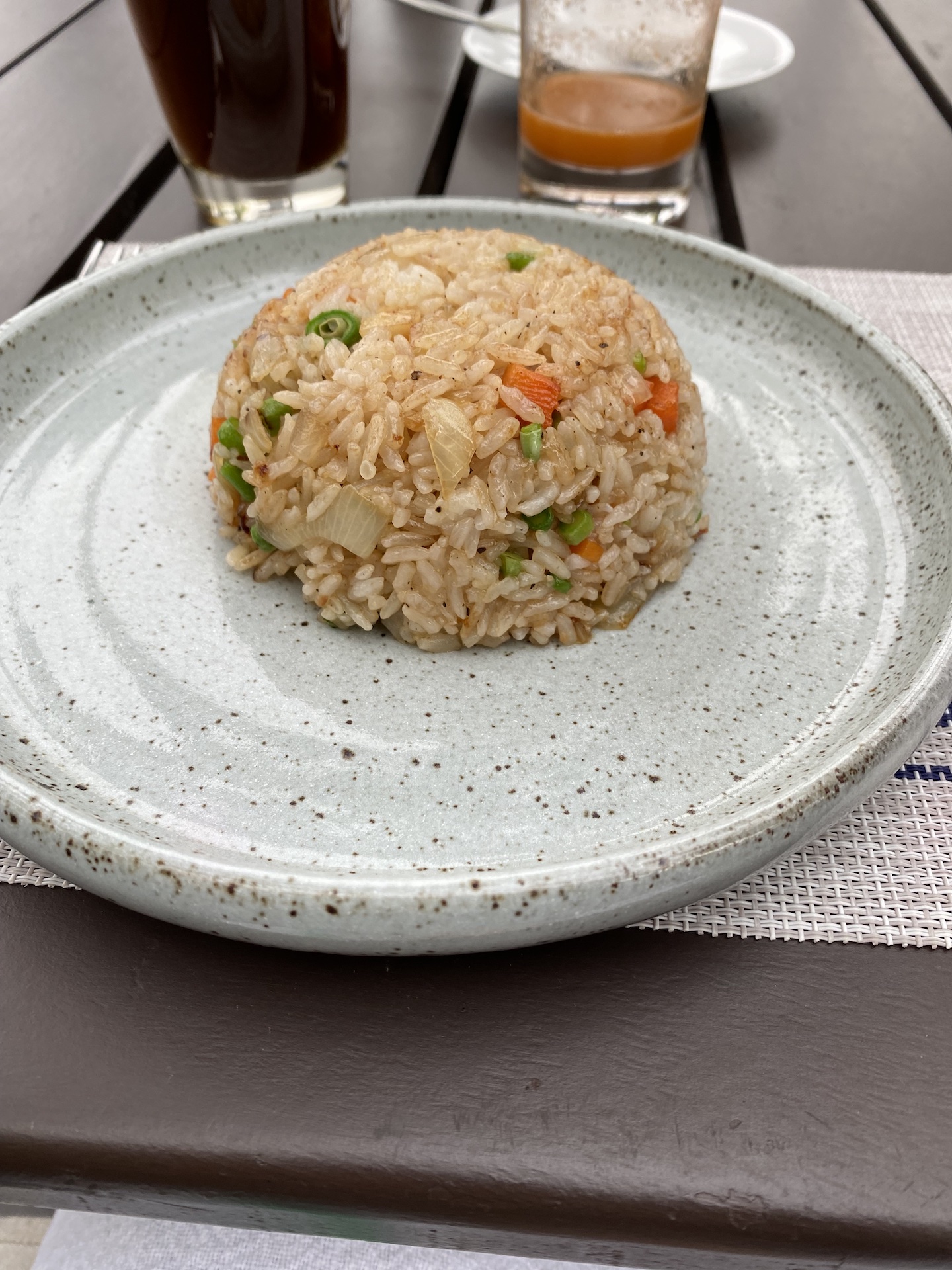
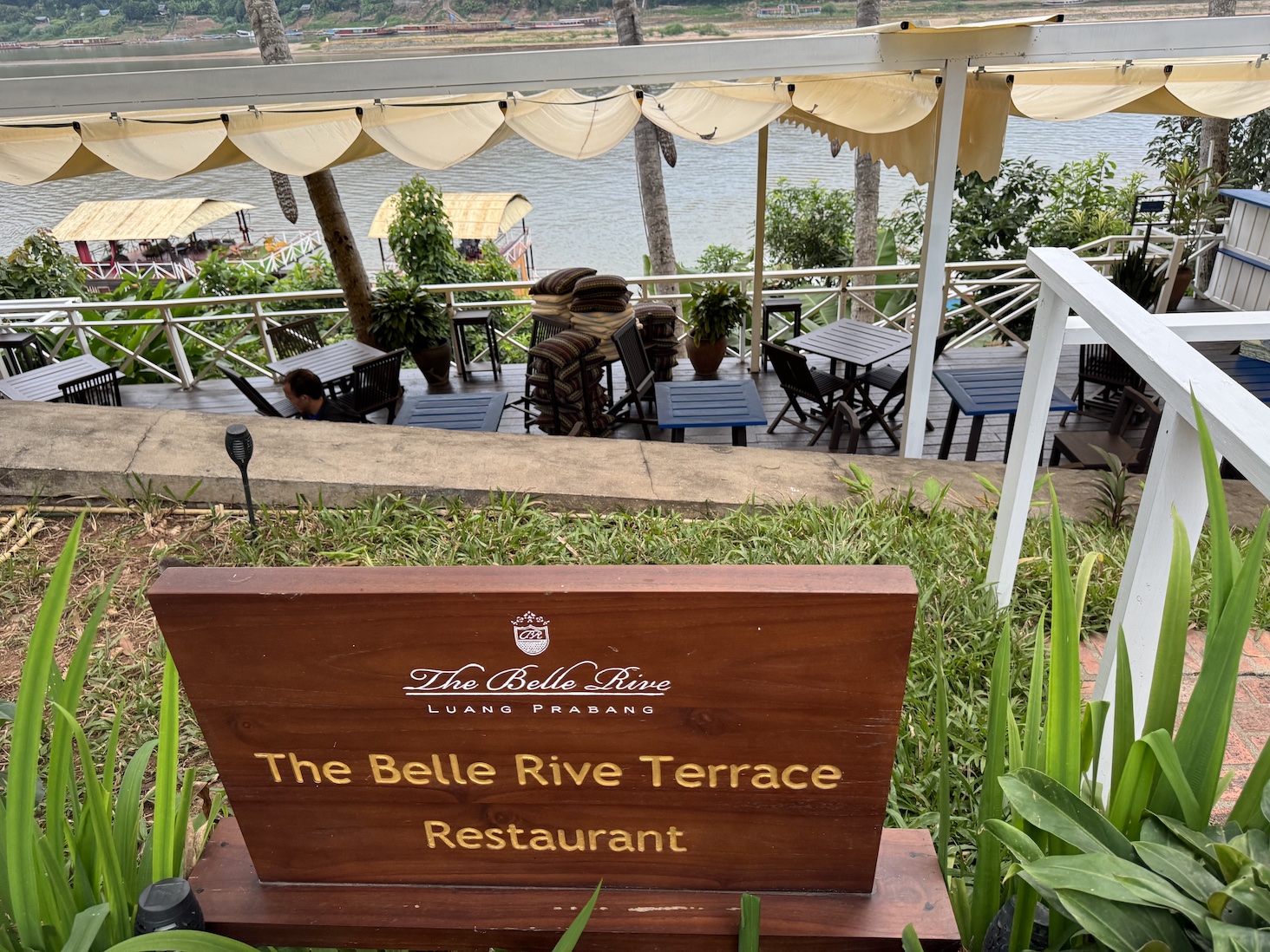
For lunch we were always out on an excursion and stopped at various restaurants or packed lunches where our guide handled everything. For dinners we were on our own. We found a couple Indian restaurants in Luang Prabang where they spoke either English or Hindi and they had plenty of vegetarian and vegan options anyway.
The staff at the Mandala Ou Resort in Nong Khiaw spoke English and had vegan and vegetarian options on the menu and we found an Indian restaurant there as well and the owner spoke HIndi.
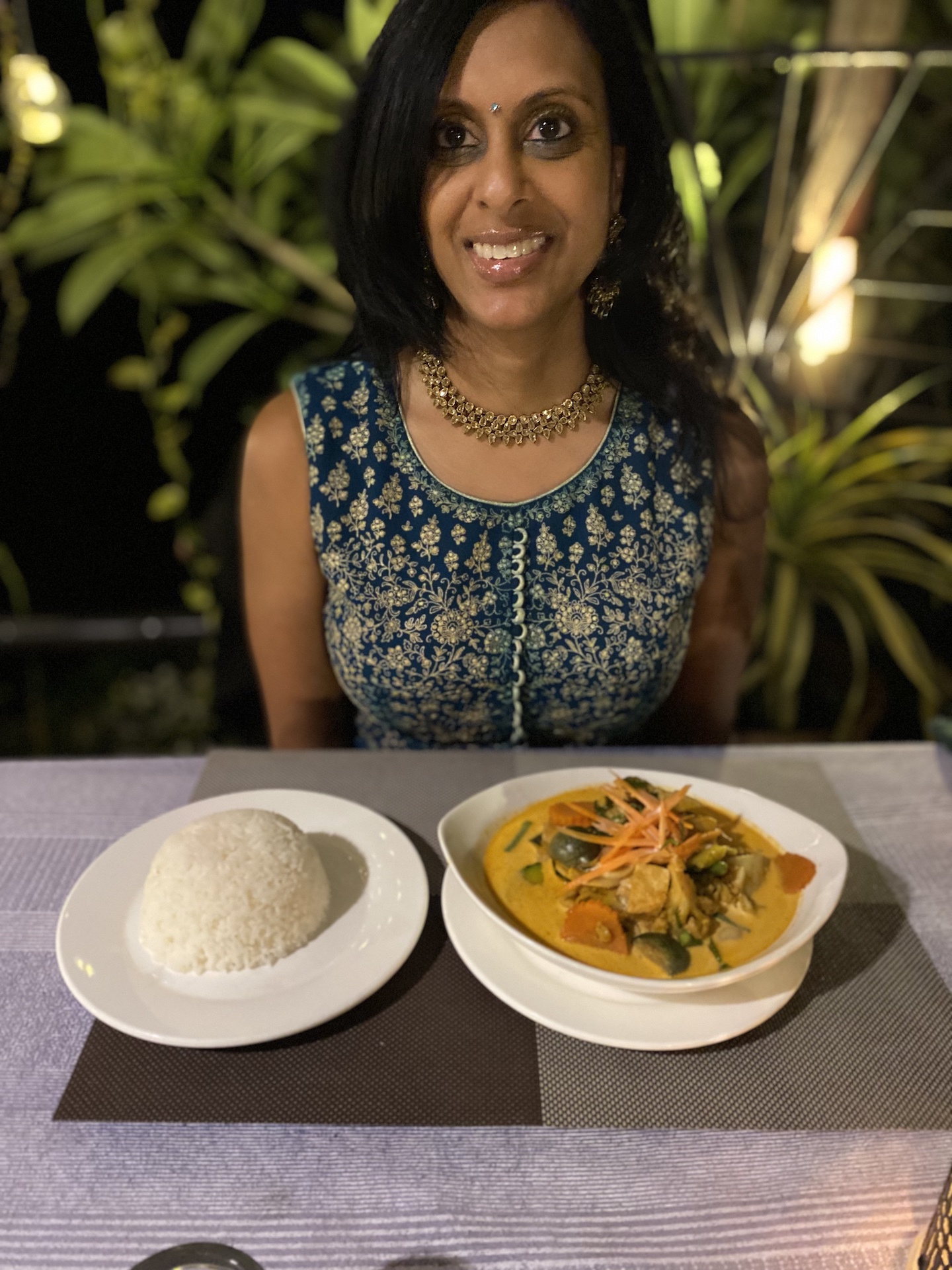
Siem Reap is filled with Western restaurants as well as tons of great Indian food so that was no issue. We lucked out that our hotel in Phnom Penh was across the street from an Indian restaurant and they spoke Hindi so that was no issue. And in Kratie we totally lucked out as we found a 100% vegan restaurant owned by a lovely British ex-pat and the food was delicious – so we ate all of our meals during our 2.5 day stay there.
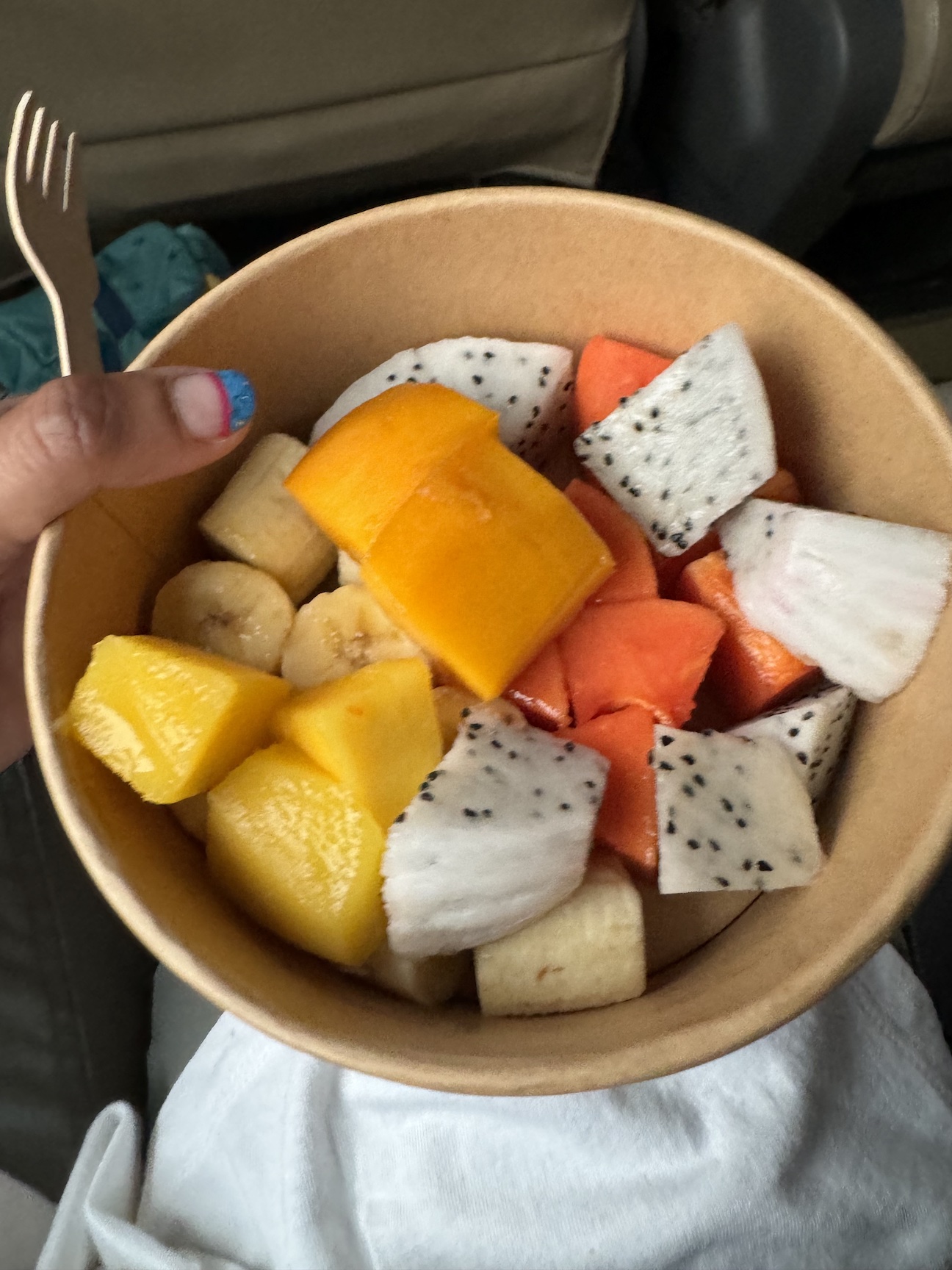
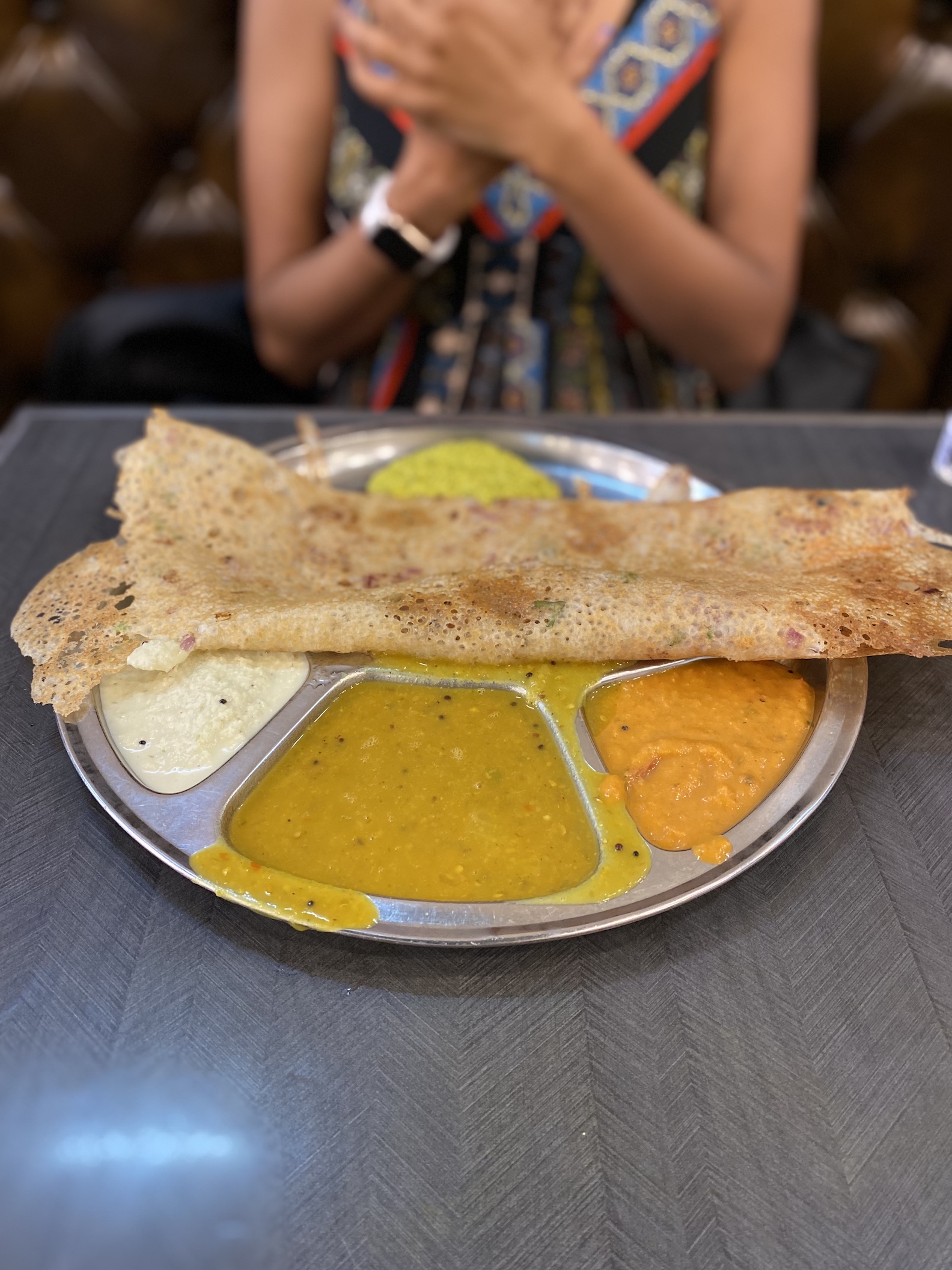


We really enjoyed the food on that trip. And ironically the only time we got sick – food poisoning – was from a very highly rated south Indian restaurant in Singapore’s Little India. We had a layover in Singapore on our way back home, so we stayed for a couple days. You’d think that if we were going to get sick anywhere it would be at some of these hole-in-the-wall places in smaller towns – not in Singapore.
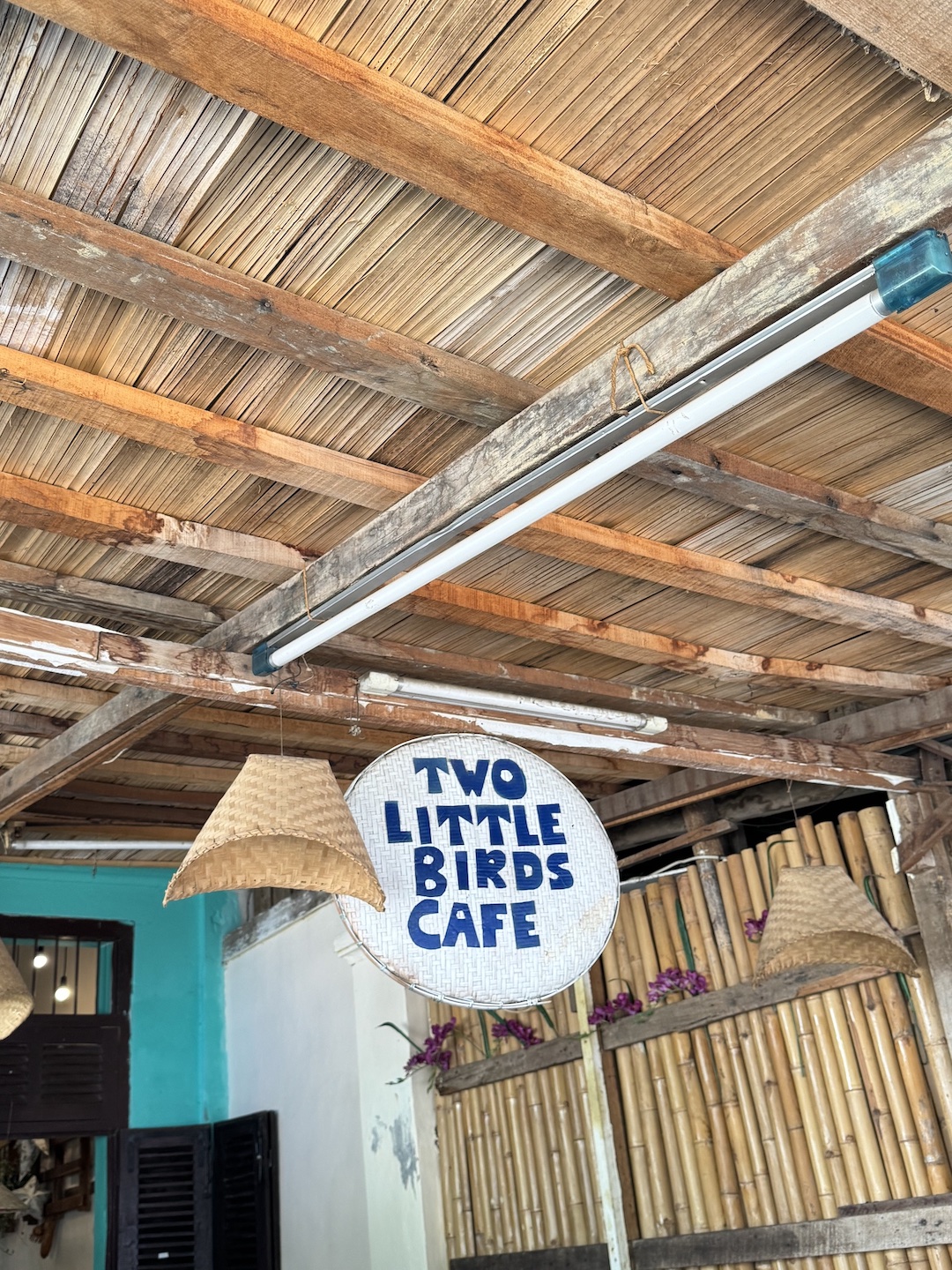
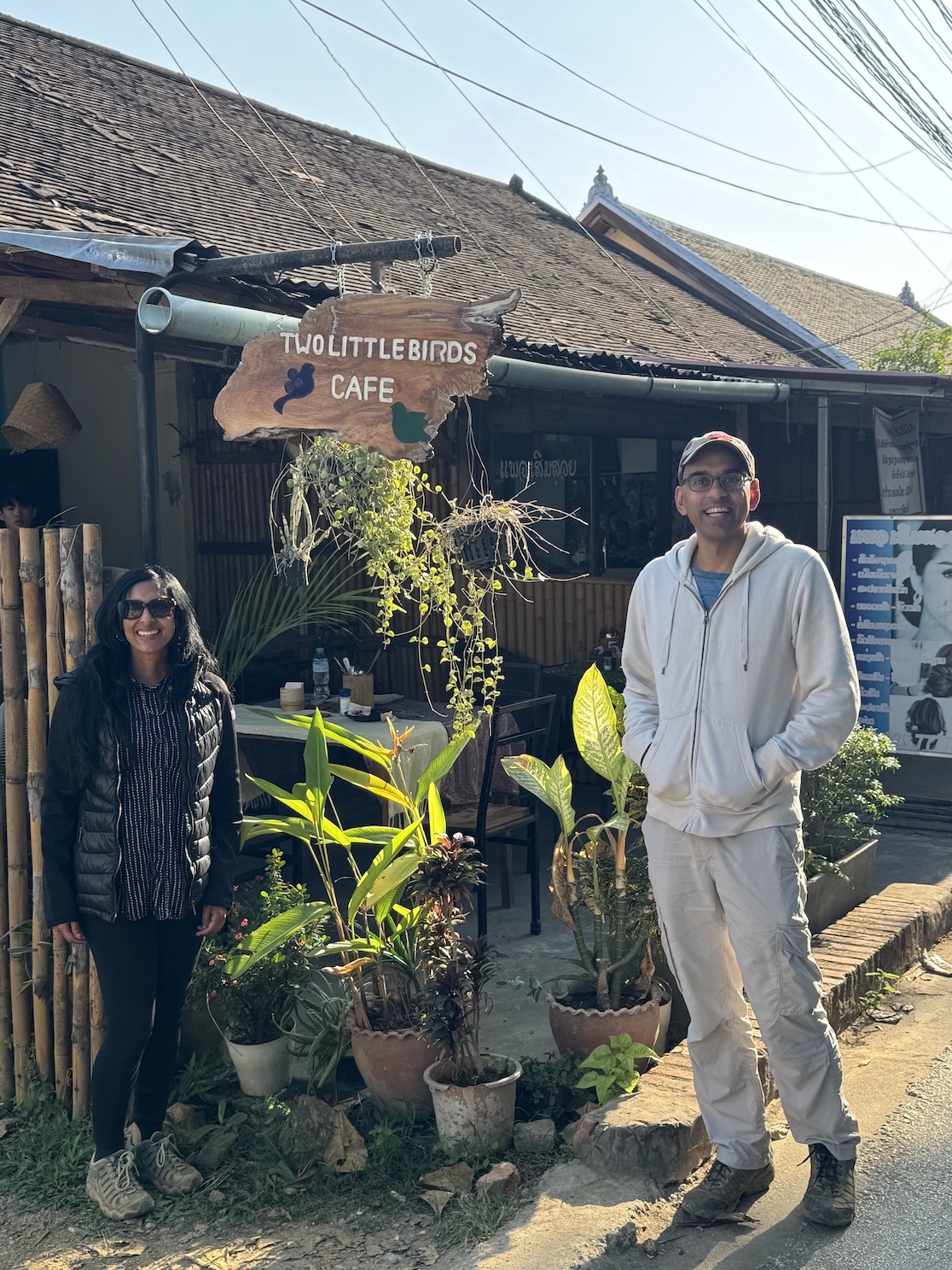
Two Little Birds Cafe in Luang Prabang is a vegetarian restaurant with many vegan options in Luang Prabang. We loved this place. The food was delicious, plentiful and the cafe is really cute.
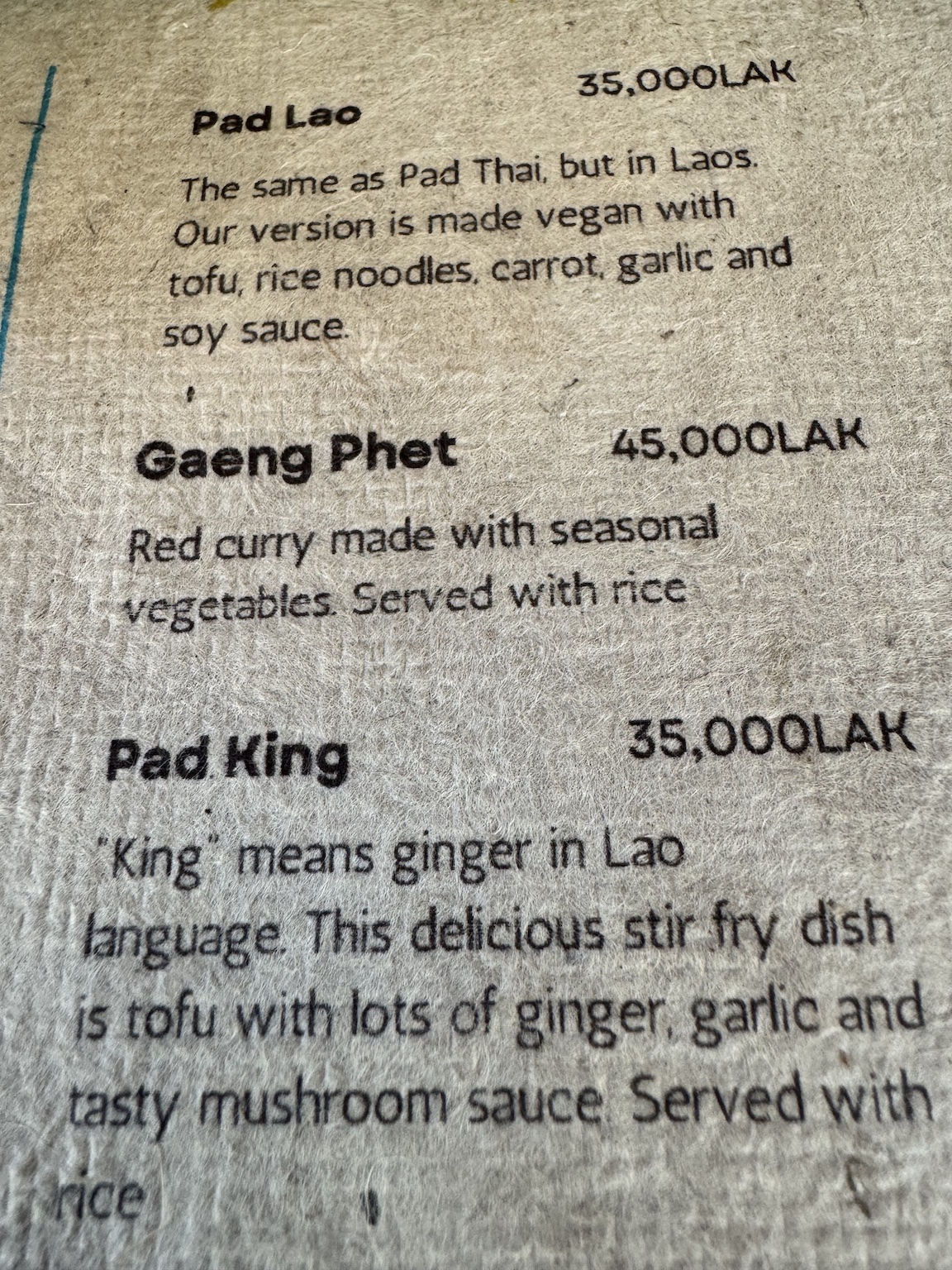

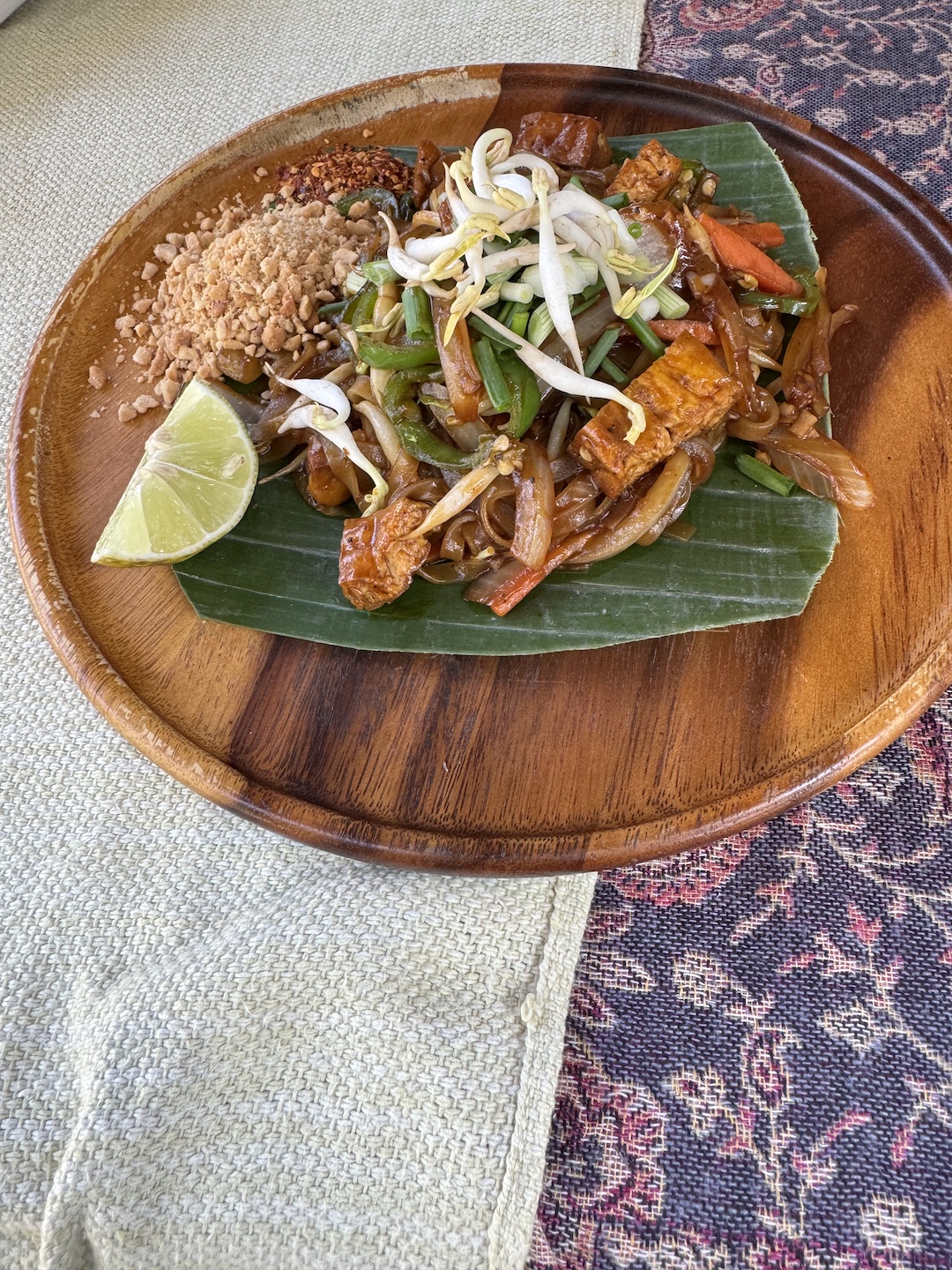
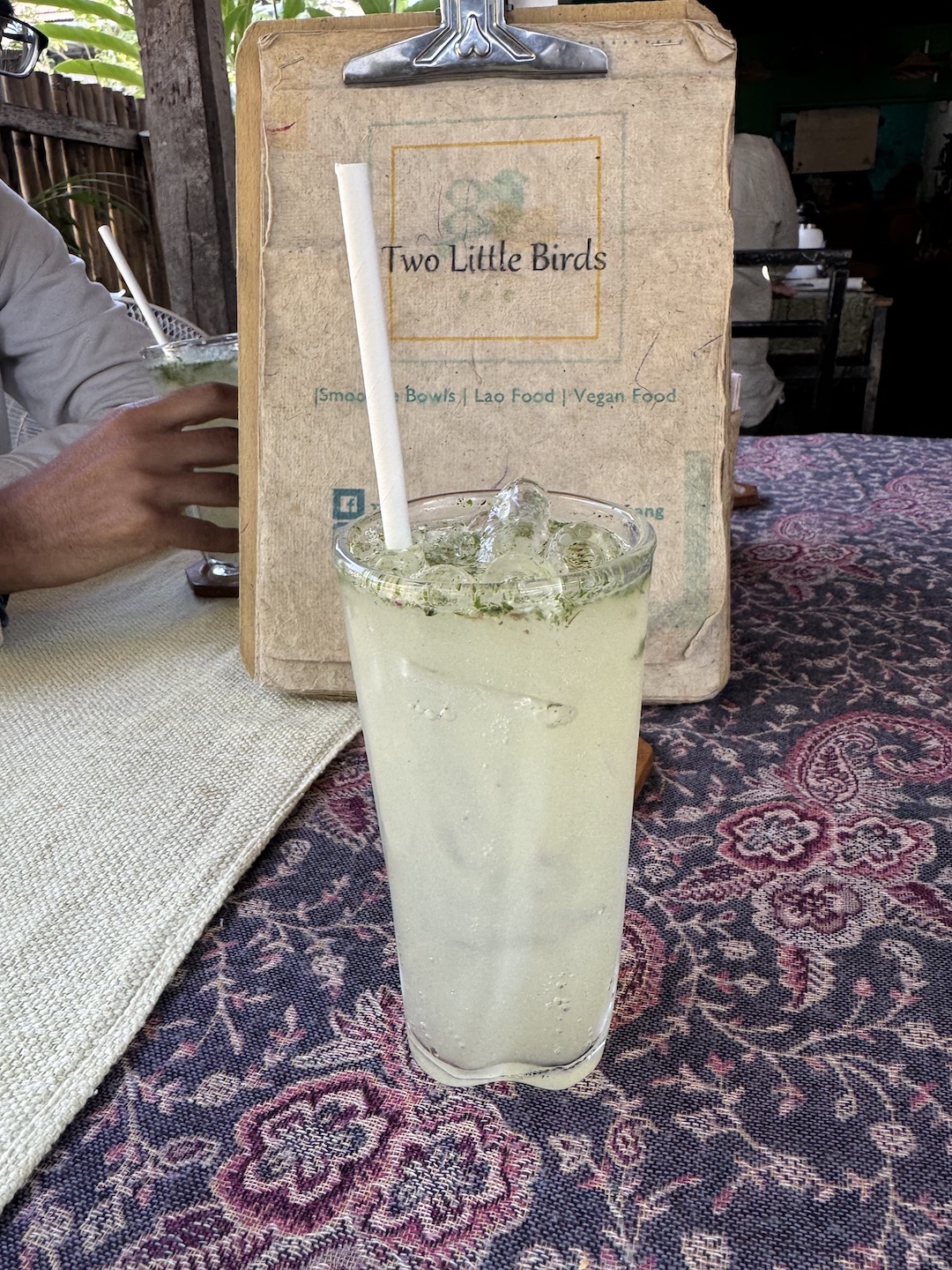
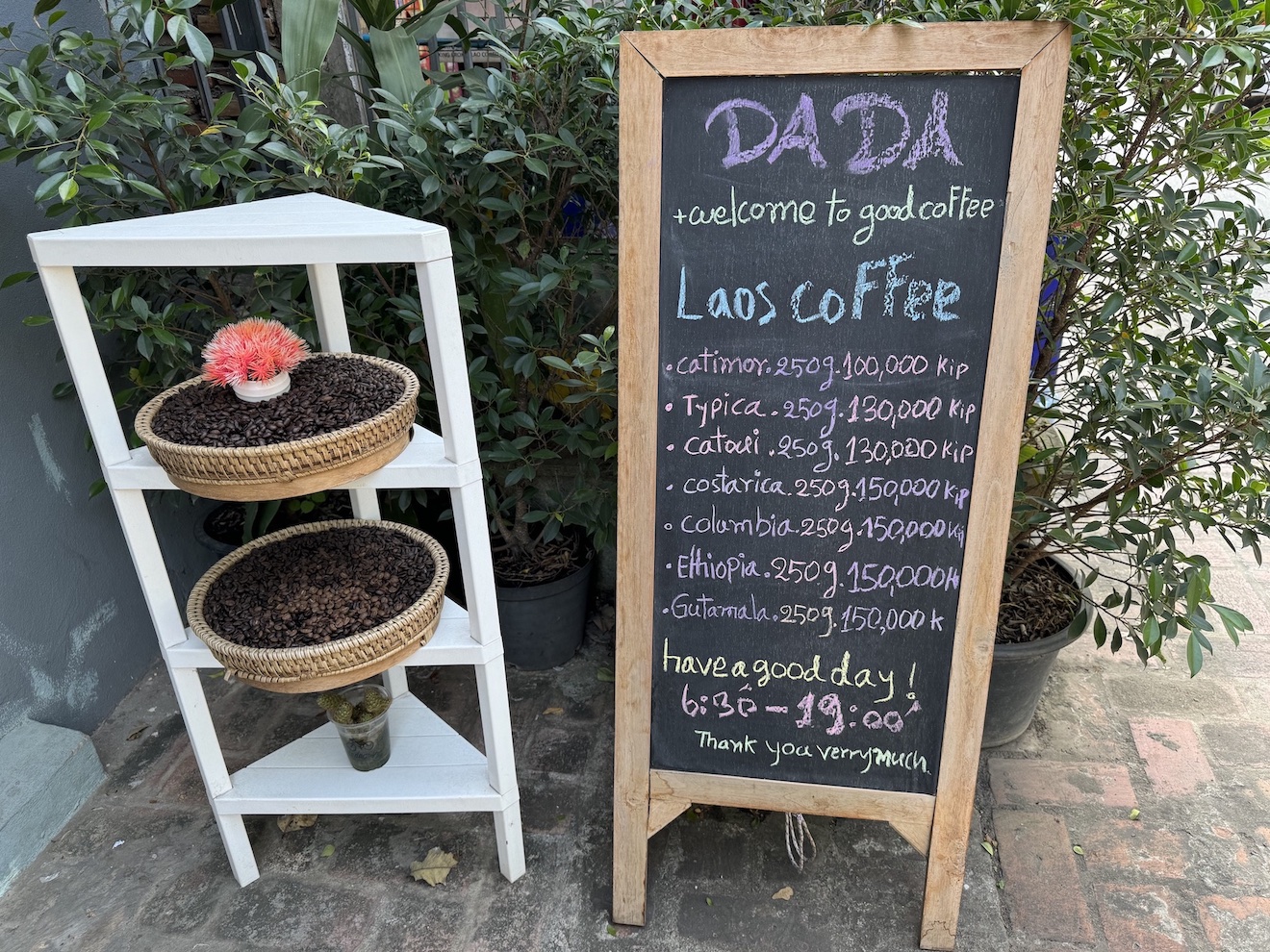
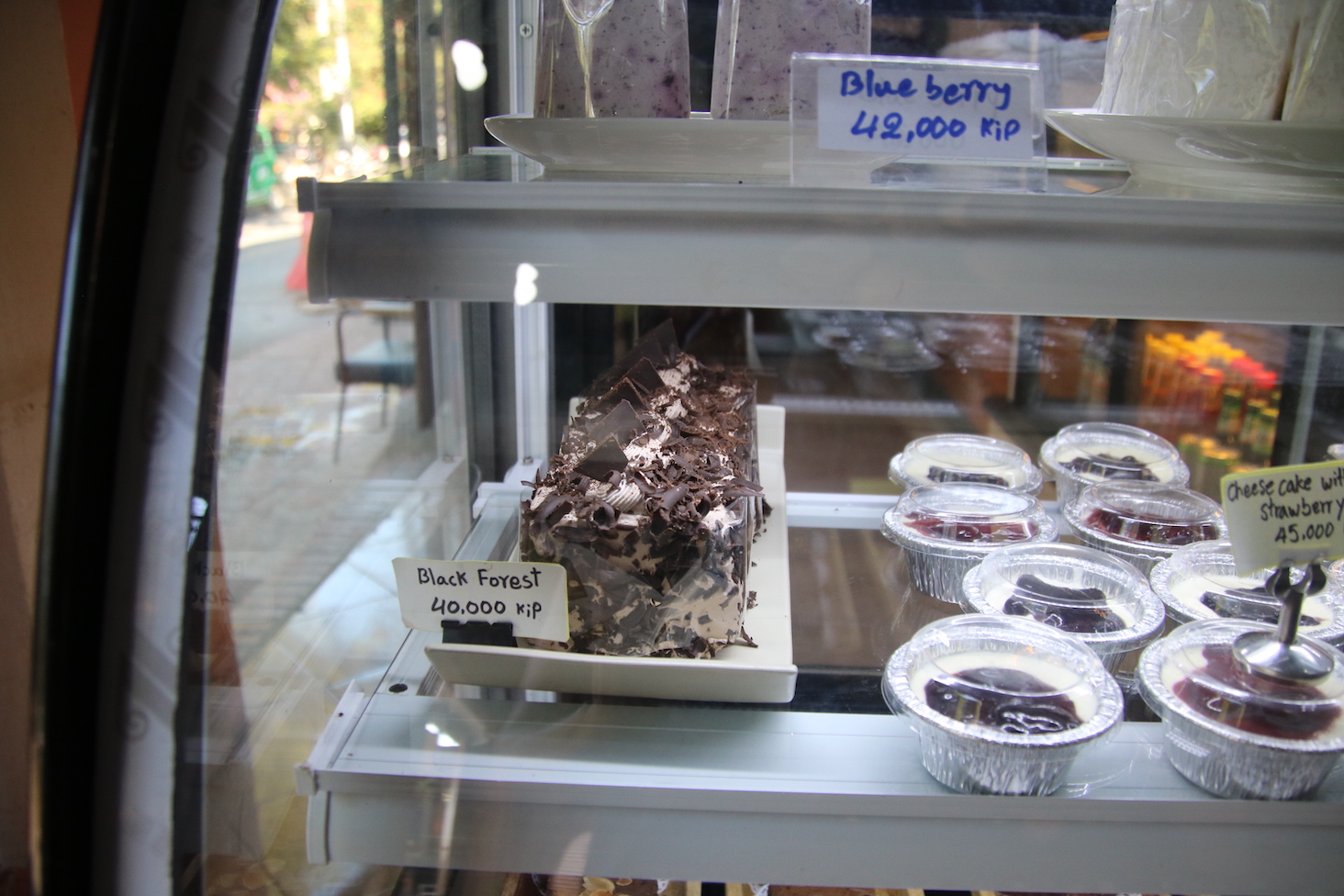
Dada Cafe in Luang Prabang has really good desserts and coffee that we indulged in almost every day we were there.

Visa, Money, Costs in Laos
US citizens are required to get a visa for Laos. The tourist visa is for single entry and 30 days. You can obtain an e-visa ahead of time or a visa upon arrival. BUT note if you get an e-visa there are only certain international airports and border crossings you can enter from:
Luang Prabang International Airport
Pakse International Airport
Wattay International Airport
Boten International Checkpoint
Lao-Thai Friendship Bridge
Getting a Visa on Arrival. The visa on arrival will cost somewhere between $30-$50USD and can be obtained at Vientiane, Luang Prabang and other checkpoints across the country as well. I recommend that you have exact cash – take different denominations so you can pay the exact amount in cash in USD and be prepared to present the following:
Show proof of accommodation
Have 2 recent passport size photos (just in case)
Proof of sufficient to cover the duration of your trip
Passport Requirements. Make sure your passport is valid for at least 6 months after your date of entry and has at least two blank pages. As of December 2023, they stamped the passport with an entry and an exit stamp.
Costs in Laos. The Laos currency is called the Kip and that is the currency that is accepted along with USD. You can exchange money in-country – you’ll get better rates on $100 bills that have no blemishes, folds etc. Make sure to bring crisp notes. When I traveled to Vietnam, India and a few other countries, some places wouldn’t accept even $100 bills that had a few imperfections.
Laos is a budget-friendly country. Your dollar goes far.
Meals. You can eat a sizable meal for two for less than $10USD.
Hotels and hostels are plentiful in all the tourist areas. You can find a range of types of accommodation ranging from hostels to hotels from $10/night – $200/night.
Getting to Laos From The United States
For us, Luang Prabang was our main destination directly from the US. That’s not common. Most people arrive to Laos from Thailand, Vietnam, Cambodia or some other southeast Asian country that they have already been traveling in. We went from Los Angeles to Luang Prabang via two layovers: Narita airport in Japan and Bangkok.
We could have gone to Vientiane instead but we still would have had two layovers plus an overnight in Vientiane. The capital city was not a priority for us, so we would have wasted time by flying into Vientiane. The flight prices to go to Vientiane vs. Luang Prabang were pretty much the same.
The journey to Luang Prabang was long:
LAX to Narita (13 hours)
7 hour layover in Narita
Narita to Bangkok (7 hours)
Arrived Bangkok 11pm
Overnight in Bangkok
Early morning flight Bangkok to Luang Prabang (1.5 hours)
We flew Zipair to Narita and Bangkok and Bangkok Airways to Luang Prabang. Click here to jump to my review on Zipair. Spoiler Alert: it was great.
The airline options were Zipair, Emirates and EVA Air. Emirates is a fantastic airline and it was also at least $1,000 more than the other airlines.
EVA Air had one leg that was through a travel agency. We tend to be wary of traveling with agencies. The people I know who have booked flights with an agency in the recent past all had really bad experiences. So why would anyone book with an agency? EVA Air is popular because of their reasonable fares. However, that airline has NO customer service.
I tried to call them several times, at different times of day and different days, to ask questions about the fare. They don’t have chat support, so calling was the only option. Their default on the automated system is they’re not available – call back later – and then they hang up on you. I called the LA, Seattle, New York, and Houston offices and experienced the same thing at every single one, every time I called. So they were a no-go.
Again, we had a great first-time experience on Zipair.
Passport Stamp Bangkok: we stayed in an airport hotel that was approximately 10 minutes from Suvarnabhumi Airport. So we did go through Immigration and Customs and they did stamp our passports upon entry and exit = 2 passport stamps.
Getting Around Laos and Luang Prabang
Laos has a great network of airports and trains. It’s also easy to rent a car or motorcycle and they have 3-wheelers. Like here in the US, they drive on the right-side (so do Cambodia, Thailand and Vietnam). There are airports in Luang Prabang, Vientiane, and Pakse which connect travelers to the northern, central and southern regions of the country.
Northern Laos has a relatively new train that connects Vientiane, Luang Prabang and Vang Vieng which are three of the most popular destinations in the country. Travelers can conveniently reach each destination within hours. To head to Pakse, which is the gateway to the southern part of the country, one can catch a flight from Luang Prabang or Vientiane.
For the rest of the country, the preferred method of transportation is to drive by car or motorbike. In Laos there’s a mix of good and not so great roads. There are 3 wheelers for hire everywhere around Luang Prabang. It’s also such a small town, that we walked everywhere. If you prefer private transportation, your hotel can help you arrange that or you can work with a tour company like this one or from your accommodation.
To get from Vientiane to Luang Prabang:
Train 2-3 hours
Drive 6-7 hours
Fly 45 minutes
Deciding Where To Go In Laos: 4 Regions
For travel and tourism purposes Laos is divided into 4 regions: far north, north, central, south. Below is a general description of each so you can get your bearings and start thinking about where and how you want to spend your time.
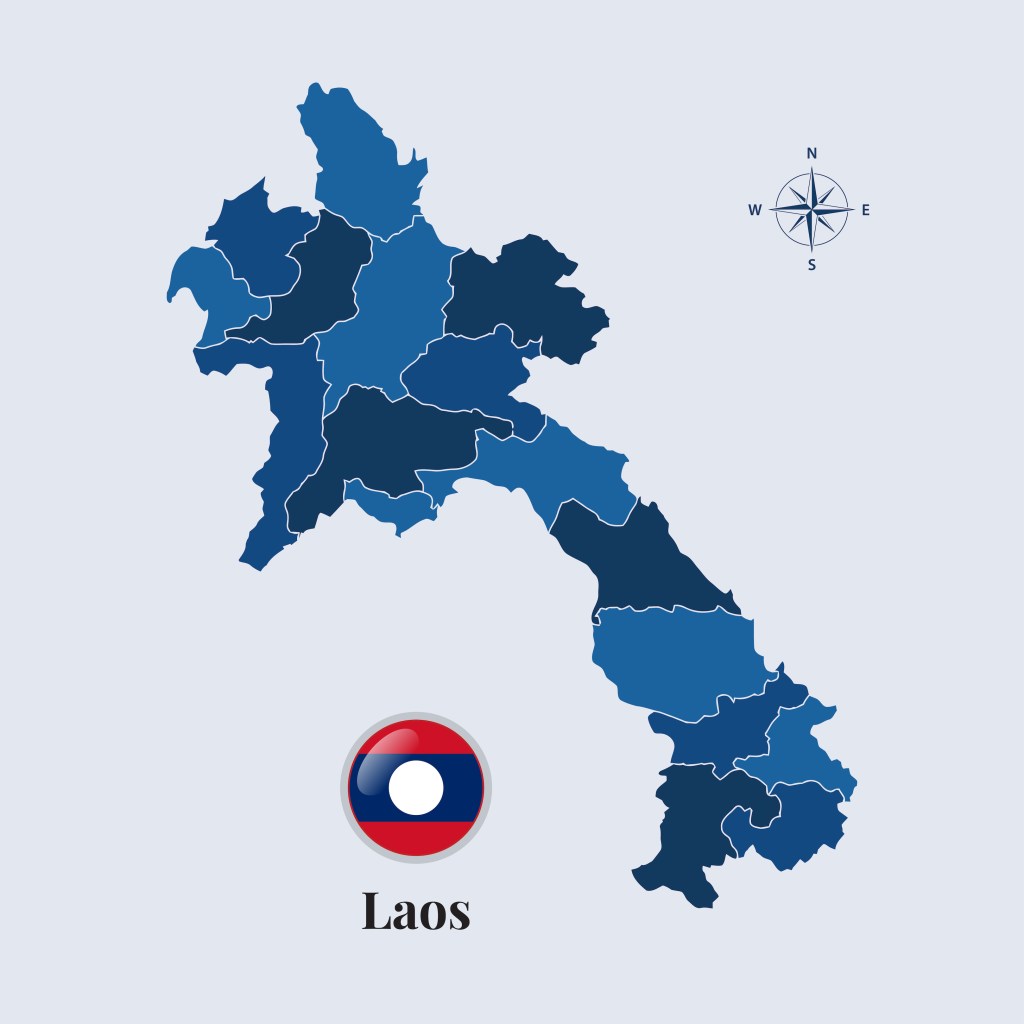
The far northern area in the highlands, is where you’ll find the ethnic groups and tribes. In December this area is cold in the early morning (6am-8am) and warms up to the mid 60s throughout the day. For a taste of village life, experience the ethnic diversity, and scenic hiking head to the far north.
Northern Laos is the most popular region of the country as that’s where you’ll find the commercial hub in the capital city of Vientiane, the cultural hub of Luang Prabang, the adrenaline, party center of Laos in Vang Vieng, and Luang Namtha which is the gateway to the Gibbon Experience, which many consider the best and most unique thing to do in Laos.
Central Laos is famous for the Thak Hek Loop, known for beautiful scenery, hiking, and adventure activities.
Southern Laos is where you’ll find coffee plantations, wildlife, relaxing island, and waterfalls, including the largest waterfall in southeast Asia.
If you like to hike, you’re going to find plenty of excellent opportunities no matter which region(s) you visit.
Now let’s go into each region in detail.
Northern Laos
Phonsavan also known as the Plain of Jars. It is a plain with huge stone urns that weigh thousands of pounds. Nobody knows how they got there nor why. Historians have postulated they were used to store wine and rice. While others have postured that it was a burial ground. There are villages nearby where ethnic Laotians live.
Other things to do in/near Phonsavan
Visit Mulberries Farm which is a silk factory. They will walk you through the entire process of making silk.
The Tham Xang Caves are about 36km away from Phonsavan and were a refuge for fights in the Secret War. During that time there was a hospital inside.
Visit the craft center and the unexploded ordinance Survivors Information Center.
Hike to Tad Ka Waterfall.
Visit a war memorial.
Soak in the hot springs.
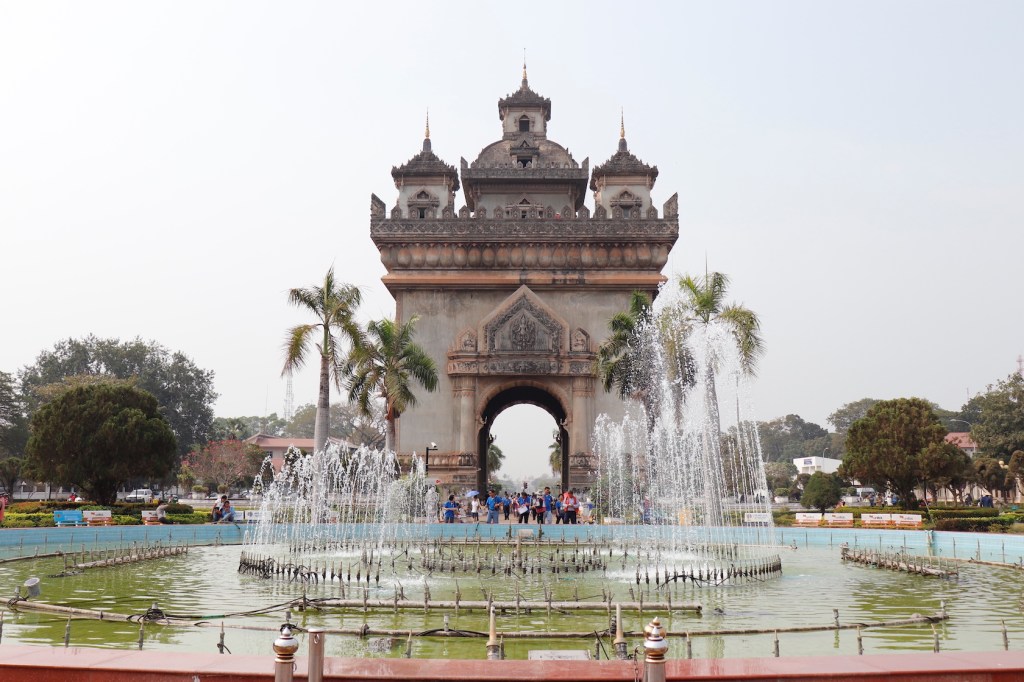
Vientiane. Patuxai is a war monument, the Gateway to Victory, built between 1957 and 1968 and is dedicated to all those who fought into the struggle for independence from France. Seemingly ironically it looks like the Arc De Triomphe, however it is a typical Laotian design. It also reminded me of India Gate in New Delhi, India’s capital, which is dedicated to 84,000 soldiers of the British Indian Army that died during World War I. Patu means “door” and Xai is a derives from the Sanskrit word, “Jaya” which means victory.
In addition to Patuxai there are several wats and the Buddha Park.
Vang Vieng is the outdoor enthusiast and adrenaline hub of Laos. It had (has) a reputation as the backpackers and party hub of Laos, with lots of bars, hostels and loud parties. Tipsy Tubing is a popular activity. More recently the Laotian government has worked on trying to change that reputation to attract tourists aside from backpackers (I wasn’t convinced). The many karsts surrounding the area are fantastic for climbing, paragliding, hang gliding, ziplining, canoeing, kayaking, hot air balloons, hiking, visit an elephant sanctuary. Motorcyclists love to drive around.
Tubing in the river and in the lagoons (tipsy tubing) put Vang Vieng on the map and attracted loads of backpackers as they enjoyed tubing while drinking beer – it was a big party until people got injured or worse.
Drinking + swimming + tubing + rope swings = potential recipe for disaster.
There have been deaths and injuries leading to the tubing + alcohol to be shut down. However, post COVID the government opened it again but have limited the number of bars that can be open at a time.
Lagoons. There are several lagoons in Vang Vieng where tourists enjoy jumping into the turquoise waters from rope swings, tubing, and relaxing. Lagoons 1, 2 and 3 are the most popular. They have kayaks, tables, chairs, elaborate slides and swings that reminded by of the Swiss Family Robinson. These lagoons are very touristy and it’s like a day at the pool with all your buddies – drinking, partying, and having a good time. The roads are pretty bad to get to them. It costs 10,000 Kip per person (approximately $.60).
Hiking in Vang Vieng. There are 5-6 hikes with viewpoints for watching the sunrise and sunset. The Nam Xay Viewpoint is one of the most popular that has been Instagram prepped with two motor bikes installed at the top – where tourists can sit on the bike with the 360-degree background of the beautiful scenery and mountains. Expect to pay around 10,000 Kip per person to get in (approximately $.60USD). Some of the hikes are steep (basically a straight incline) and will take anywhere from 40 minutes to an hour for fit people.
You can hike here in regular sneakers but I recommend hiking shoes as if it’s rained, the path is very slick.
Hot Air Ballooning. Laos is {currently} the least expensive place in the world to go hot air ballooning. It costs approximately $80USD. December is a good time to do it as there’s more visibility. Not recommended March thru April, during the hot months when there’s lower visibility from the smoke pollution.
Chilling on the River. Enjoy a morning or afternoon on the calm Nam Song River on a canoe or kayak. You’re highly likely to see water buffalo and then walk around the Vieng Samai village to interact with locals. The Laotian people are very diverse.
Chang Cave is a nice hike up stairs to get to the top viewpoint. It’s easy go walk through and has many beautiful stalactite and stalagmite formations.
Visit the Tham Nam water caves is approximately 15km from Vang Vieng by road and features a river system running through it. Visitors can tube through the caves with headlamps to explore and relax at the same time. Note these are dark caves, many areas with low ceilings. At some places there was as little as 1 foot between the water level and the ceiling. Also there’s no guide. They’ve installed a line – like a clothes line that visitors hold onto to pull themselves through the caves. They say the highlight of this is being in a cool and quiet place.
Nam Ngum Reservoir is an easy day trip from Vientiane or Vian Vieng. It’s lined with beaches and tourists enjoy relaxing on the sand and cruising down Laos’ largest body of water.
Luang Namtha and the Gibbon Experience
Luang Namtha is in Laos’ northwest region. There are several ethnic villages and is where many tourists cross the border to go to China. This is the gateway to Laos’ largest national park where visitors can trek through beautiful mountain areas and waterfalls. It is aldo the gateway to the Gibbon Experience which some say is the best and most unique thing to do in Laos.
The Gibbon Experience is not for the faint of heart nor for those who are not physically fit. You will hike, climb, and zipline your way through 1-3 day treks through the jungle. Visitors stay in the highest treehouses in the world while supporting local communities and the national forest.
Luang Prabang
The entire city is designated as a UNESCO World Heritage Site and there are some great experiences within 25-30 miles of the city. We liked this as it was the first trip we’ve taken in a long time where we weren’t moving to a new accommodation everyday or every two days.
Luang Prabang Geography
Luang Prabang is the tourist center of Laos, located in the northern part of the country. It’s approximately 200 miles (~300km) north of the capital, Vientiane. Much of Luang Prabang, the town itself, is a UNESCO World Heritage Site and sits on a peninsula in between the Nam Khan and Mekong Rivers with a population of approximately 24,000.
ProTip: Book accommodation with a view of either river – serene and great to enjoy tea, dessert in the evenings. And your hotel’s restaurant is likely to be along the water too.
What To Expect In Luang Prabang
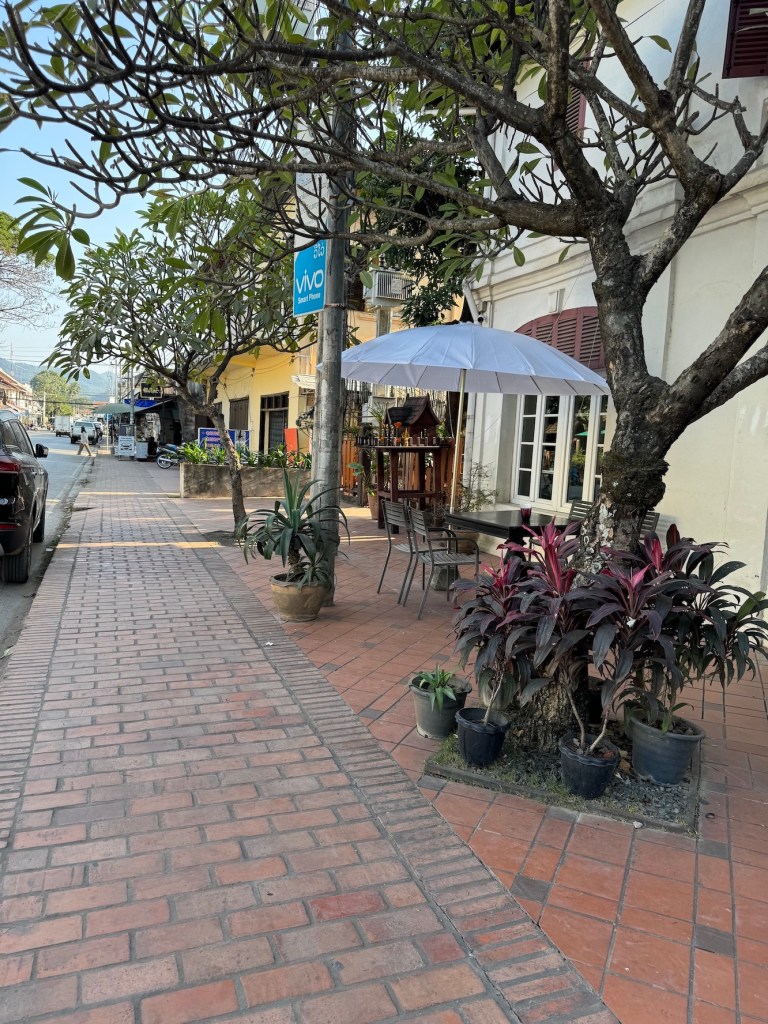
Luang Prabang is a quiet, small and quaint town. You will feel like you’ve been transported back in time with the old French style architecture juxtaposed by temple-after-temple which are distinctly Laos style. There is a midnight curfew which generally isn’t imposed on tourists but my point is Luang Prabang is not a night time party town.
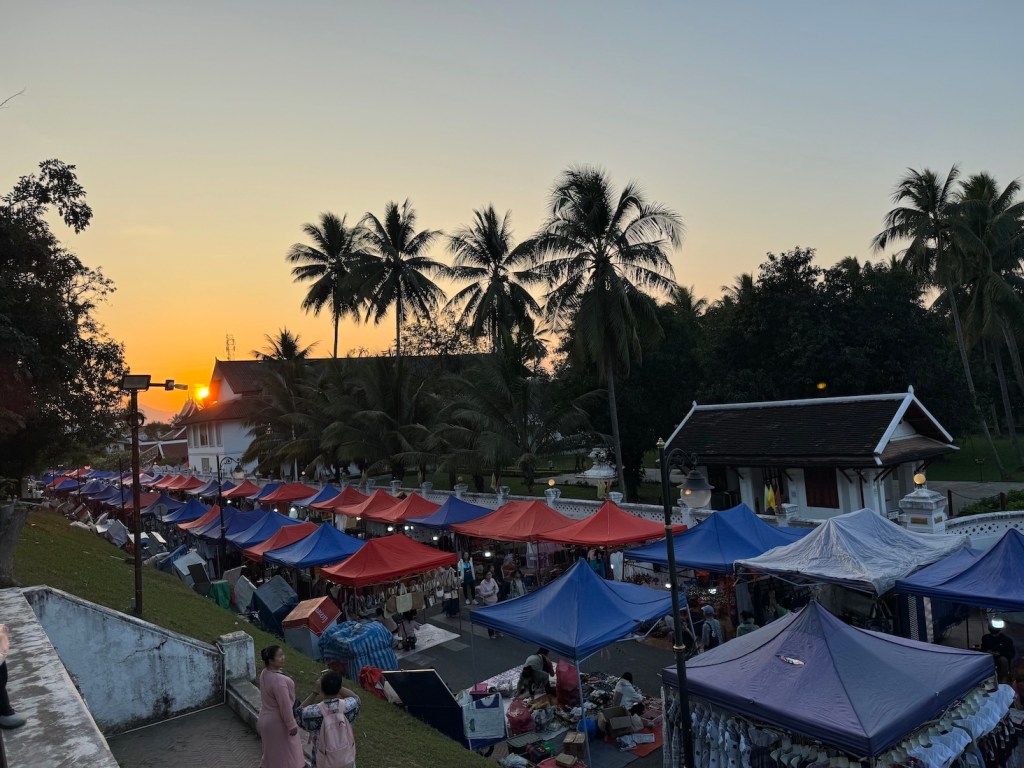
We loved meandering the streets, walking along the Mekong River, and checking out cafes and little boutiques. At night we strolled through the night market and some of the surrounding neighborhoods that were on the way to the D&T Supermarket.
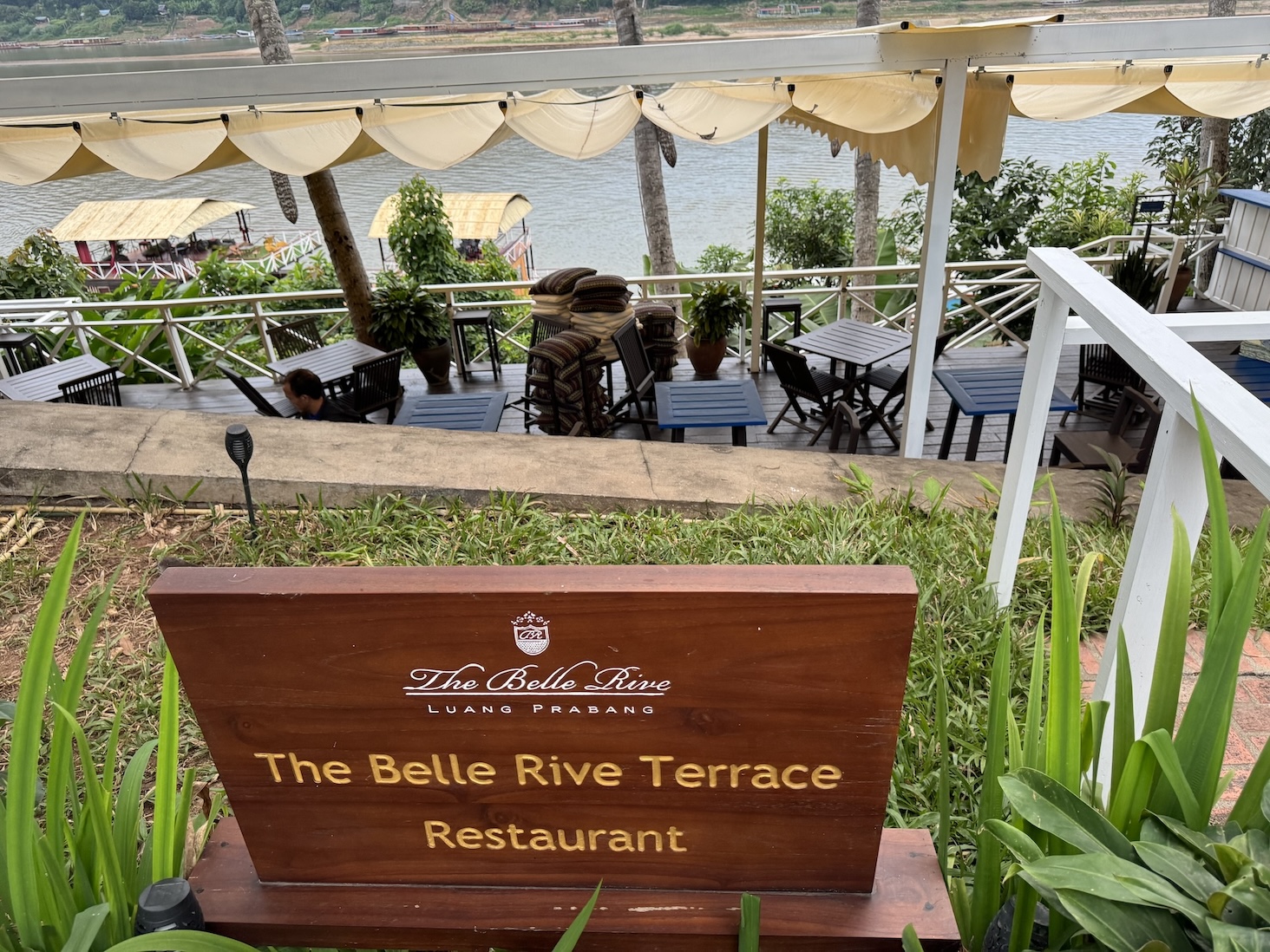
At night there the night market and nearby food bazaar shines and where you’ll see most people. People enjoy laughs sitting around by either river, have dinner at a riverfront restaurant or go on a party boat cruising along the Mekong. I have to admit those got a bit irritating as you’re trying to enjoy a romantic or serene evening and the party boats cruise by blasting music one-after-another. Or worse, where we stayed at the Belle Rive (HIGHLY recommend) was where many of the boats docked, so when we were at the hotel’s restaurant or one nearby then the party boats would continue partying for a while after docking.
As I said we loved the hotel though and at the end of the day wouldn’t have traded to move to a different location due to the party boats.

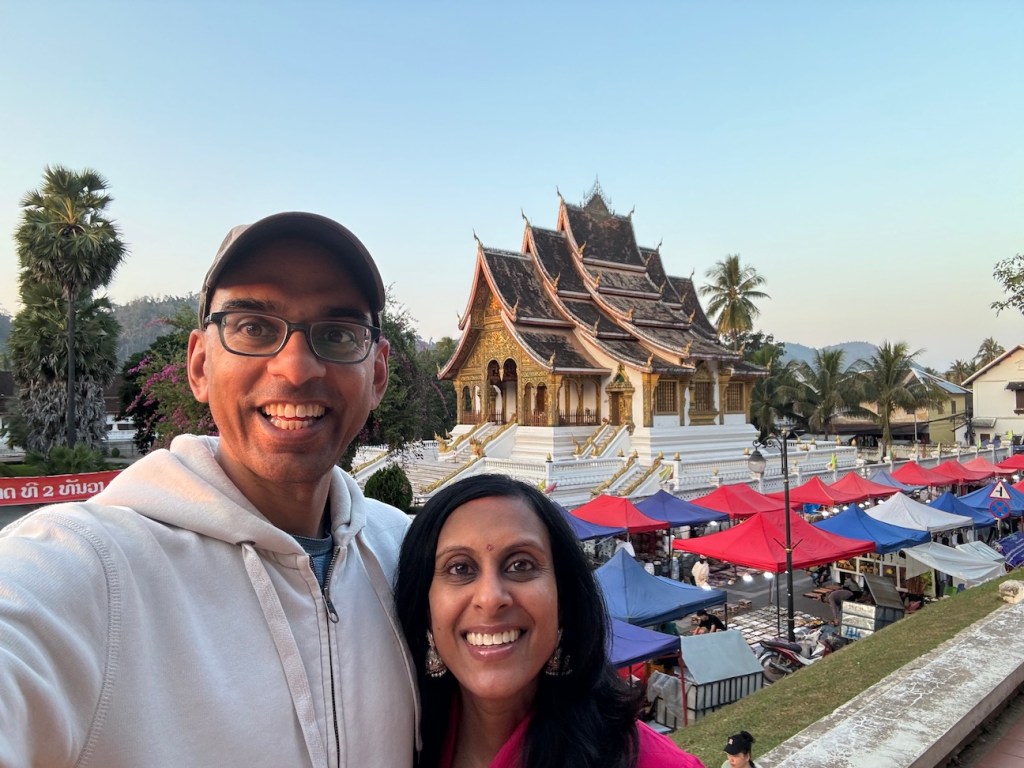
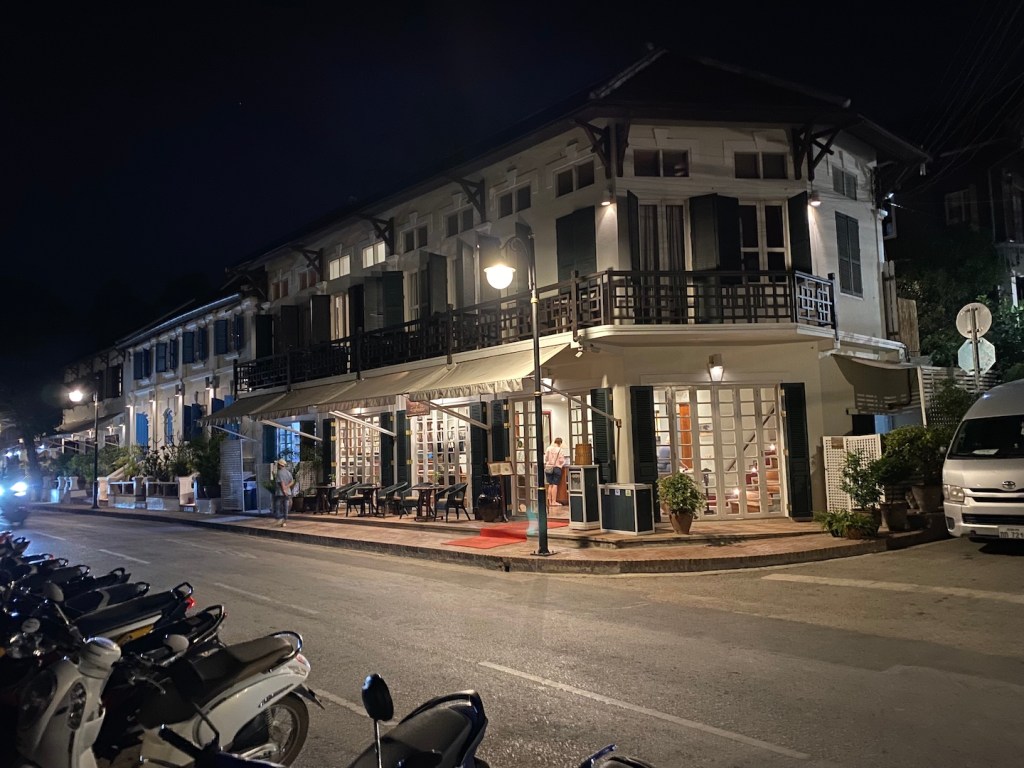
Kuang Si Waterfall
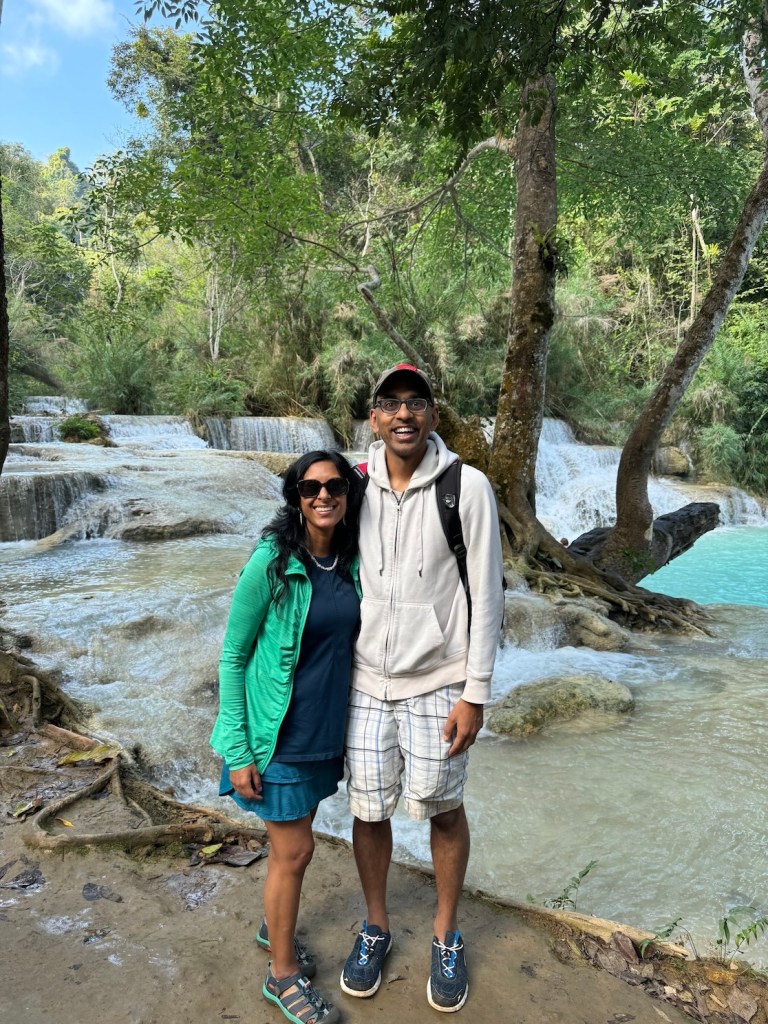
To say Kuangsi waterfall is beautiful is the understatement of the century. It took my breath away. If you’re into waterfalls, this is one of Earth’s most spectacular. There are 3 levels and multiple pools. Take your bathing suit because you can swim in most of them – though it will be chilly.
In this section we cover: general info, trip planning recommendations, how to get there, what to pack in your day pack, helpful tips.
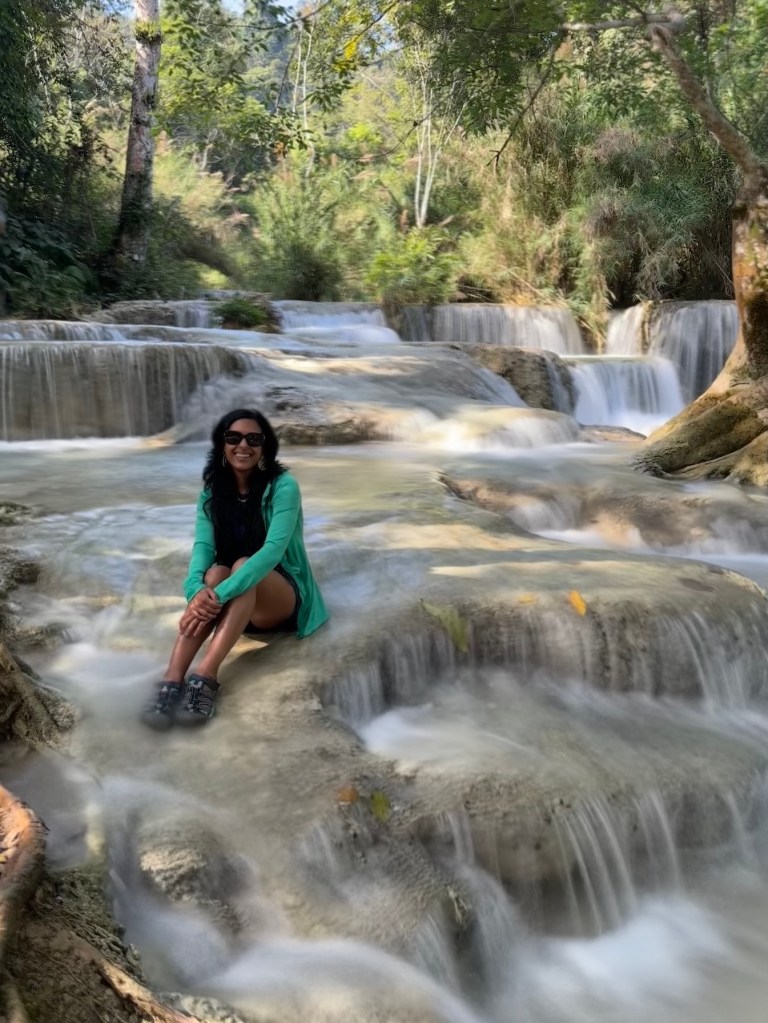
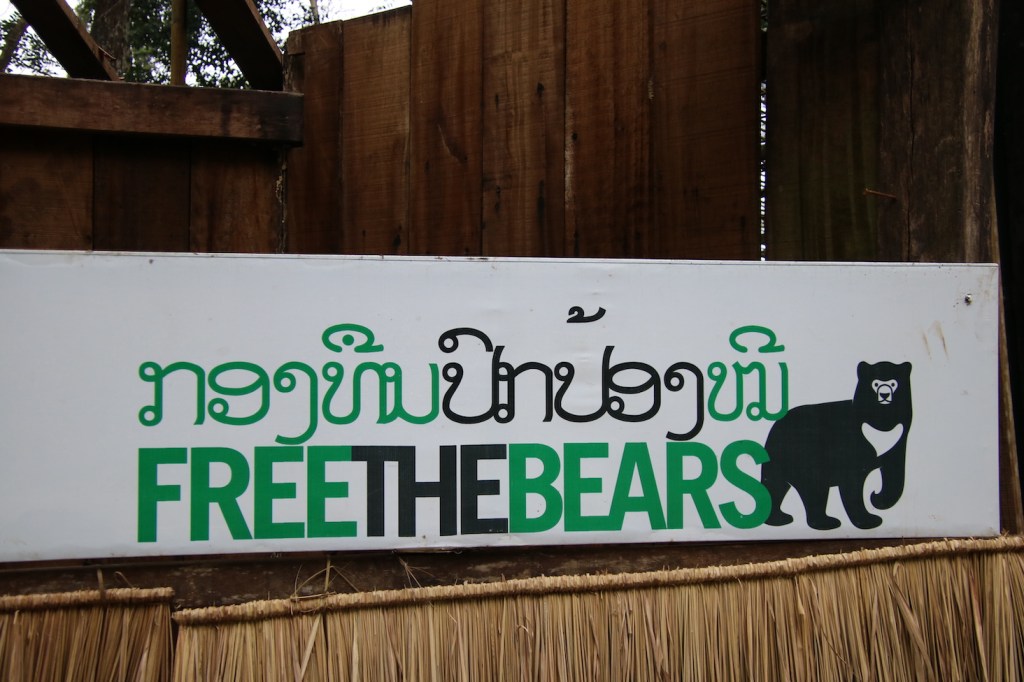
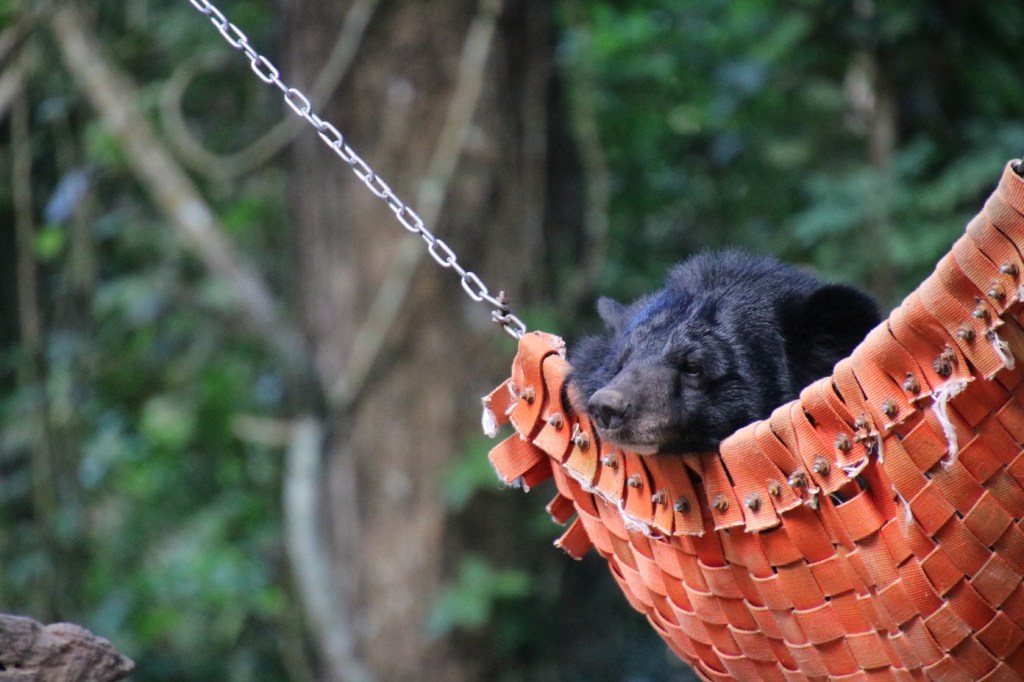
Kuang Si waterfall is the most famous attraction in Luang Prabang. The turquoise color of the water is due to excess calcium and light reflecting on the water. Even cooler is that you can swim in it. There’s hiking around the area, a bear sanctuary within Kuang Si Falls (your ticket covers the sanctuary as well).
For a visit to Kuang Si waterfall I recommend at least half a day and getting there right when it opens to avoid the crowds. Most people only spend about an hour or two and do it as part of a day trip; and all of the tour buses arrive at pretty much the same time.
In my opinion the group tours do not stop there long enough. If you’re into waterfalls instead of doing a day trip, I recommend arranging your own transportation to/from.
Since Kuang Si was the reason we went to Laos we dedicated an entire day for it. We ensured to get there when it opened and I arranged to return via a boat cruise down the Mekong, which was an awesome way to end a spectacular day.
If you do get there when it opens, I highly recommend bypassing the 1st two falls and heading straight up to the 3rd because when the tour buses arrive, and it starts getting crowded, you’ll be visiting the falls in the opposite order – avoiding the crowds.
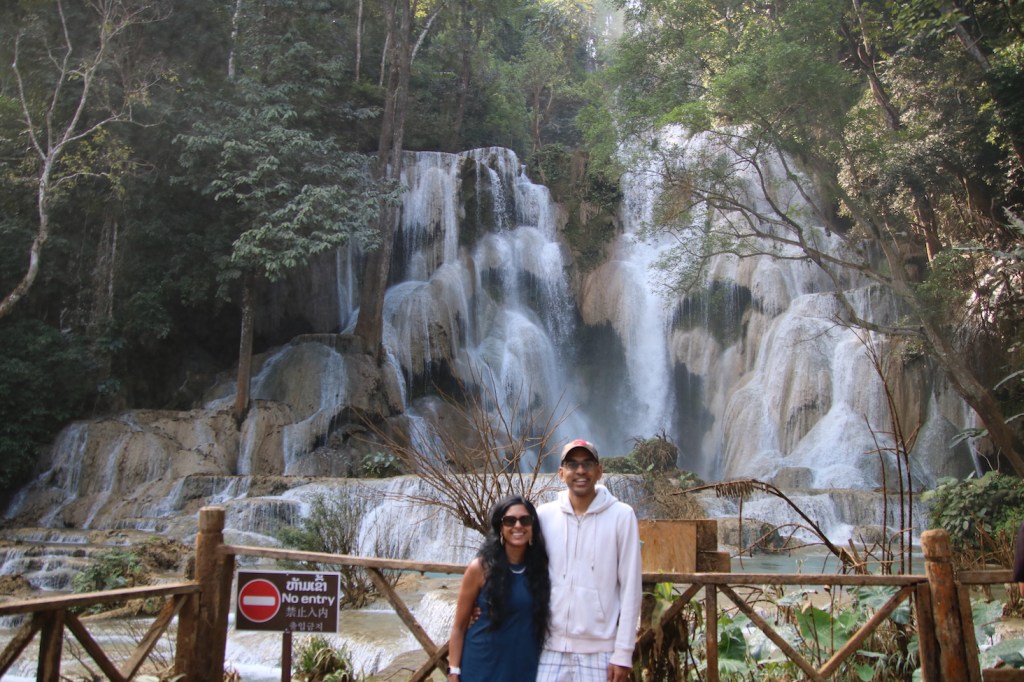
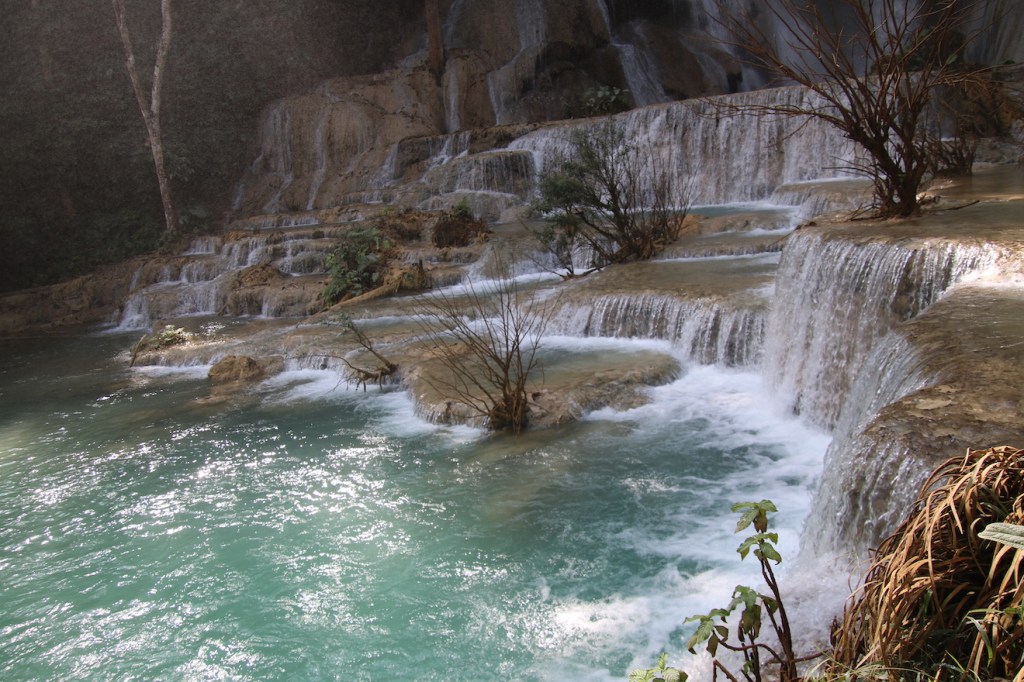
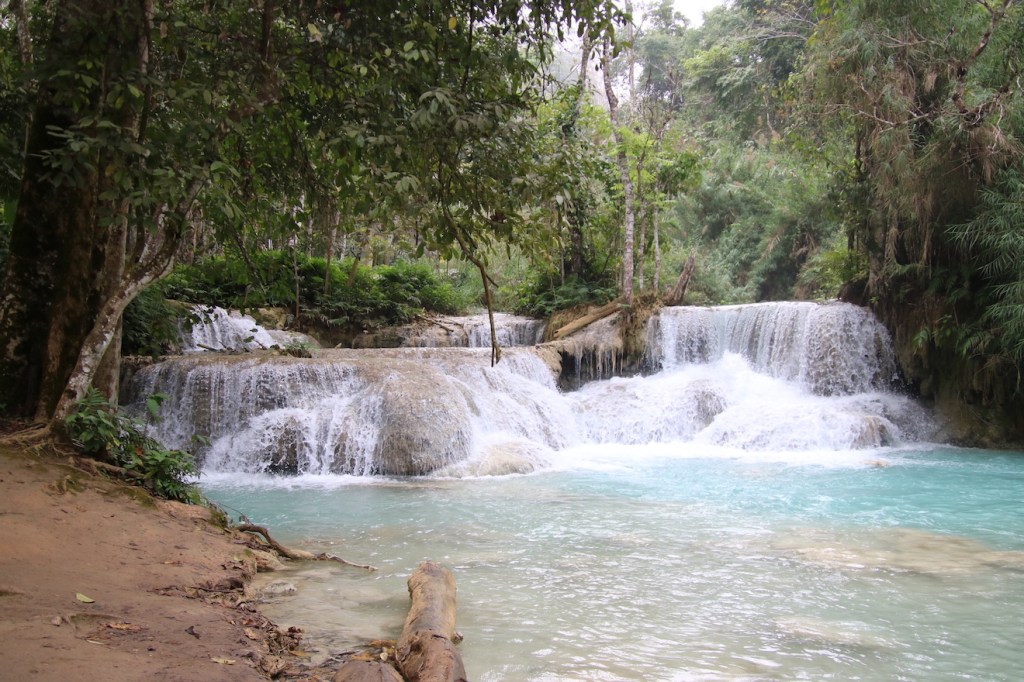
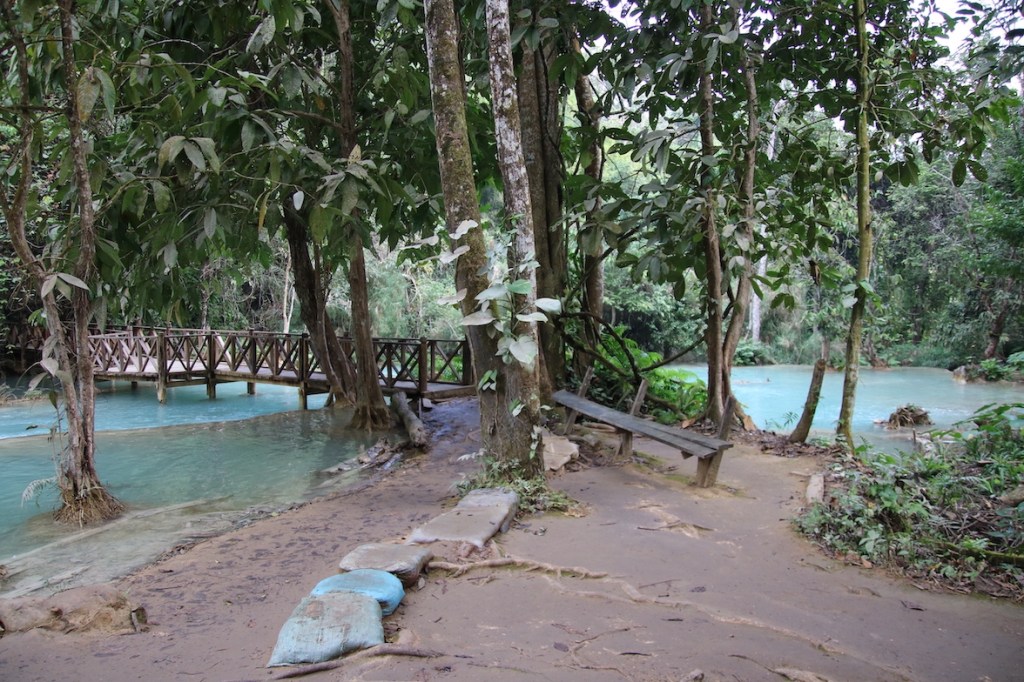

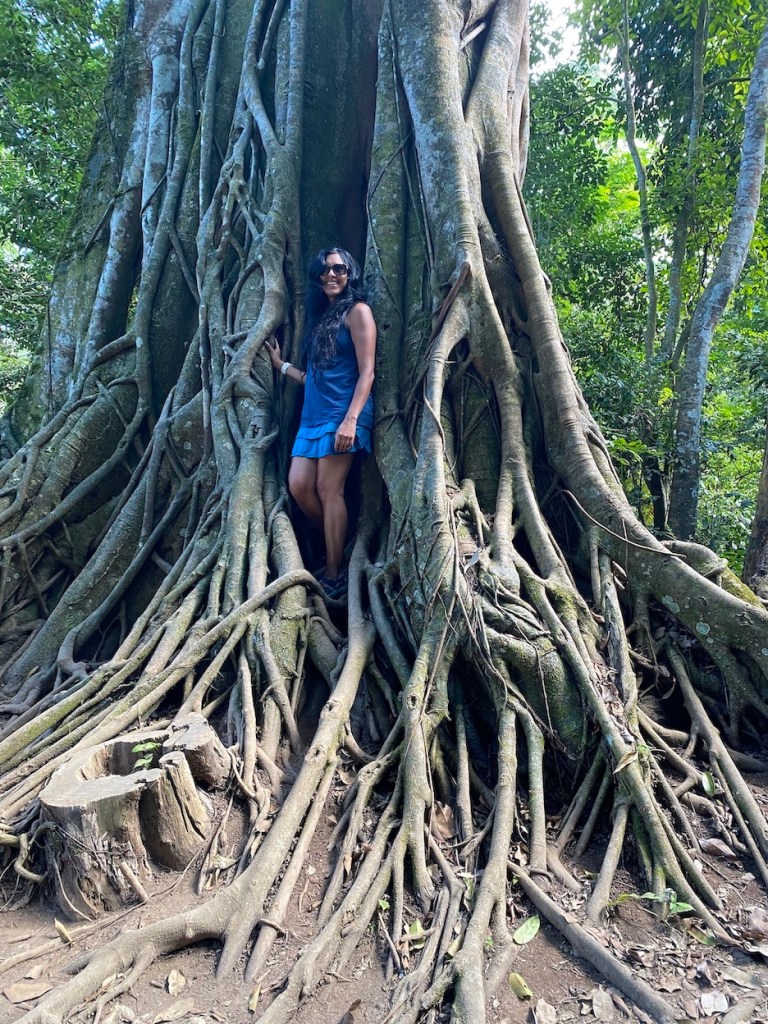
Other activities that people do on the same day they are visiting Kuang Si, is visiting the bear sanctuary which is right next to the waterfalls. We did this as well, as you’ll pass the bears as you walk to the Falls.
In addition the bear sanctuary, approximately 4 miles north of Kuang Si waterfall is the Laos Buffalo Dairy where you can see the buffalos, feed the pigs and learn about this nonprofit organization. FYI the animals are treated with love and respect. You will also get the chance to taste fresh buffalo milk ice cream. The basic tour is 45 minutes and costs $9. There are additional tours that are longer, include more tastings (some with wine), even a cooking class and a community farming experience. Visit their website to learn more.
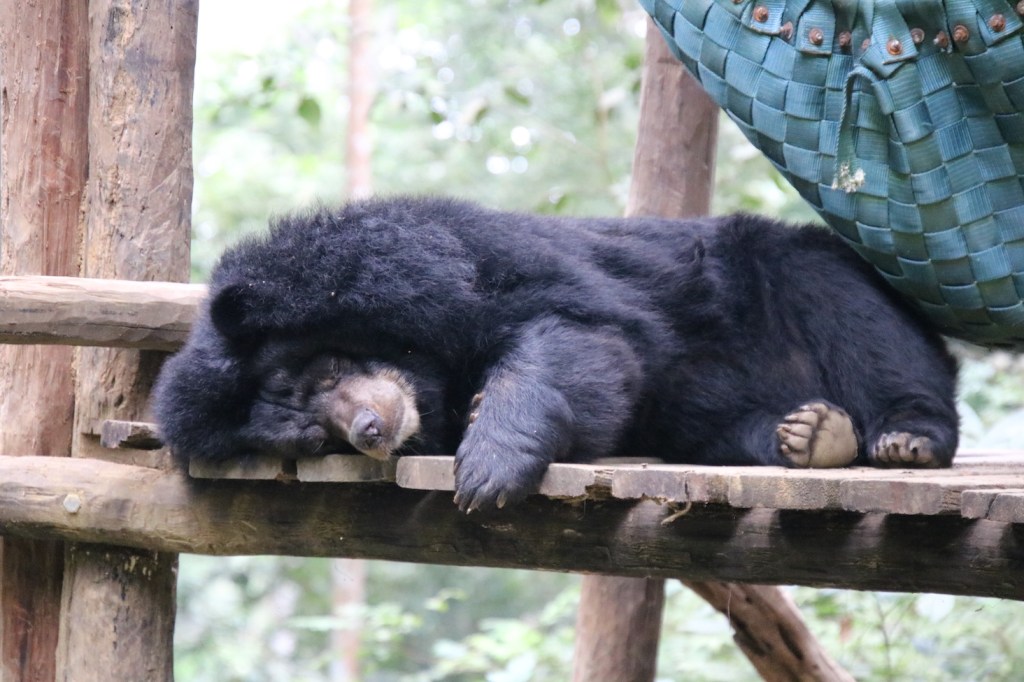
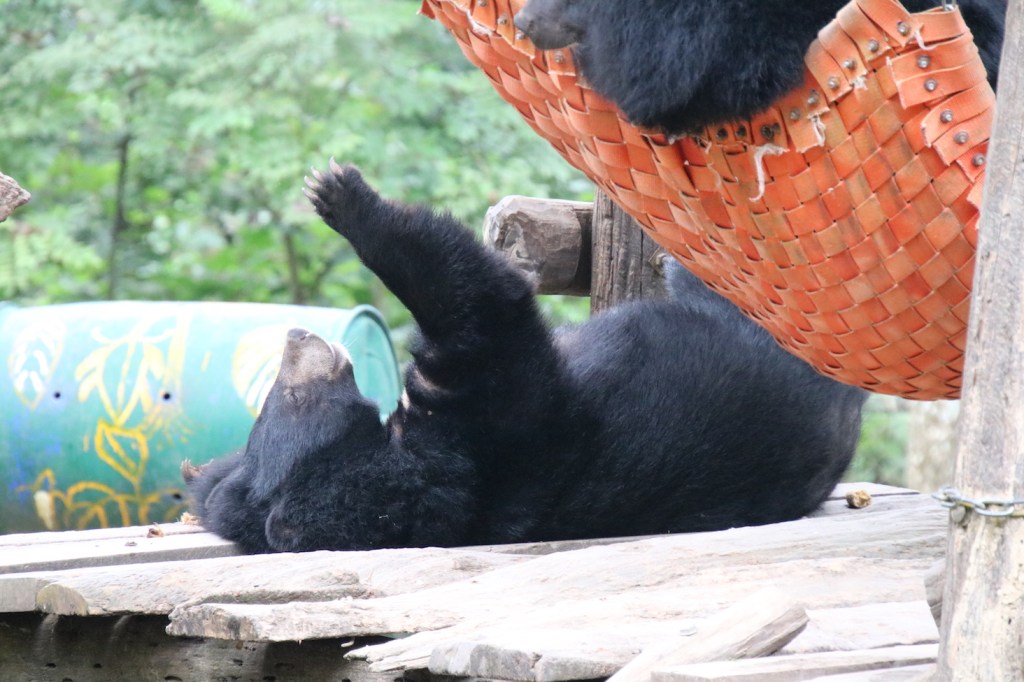
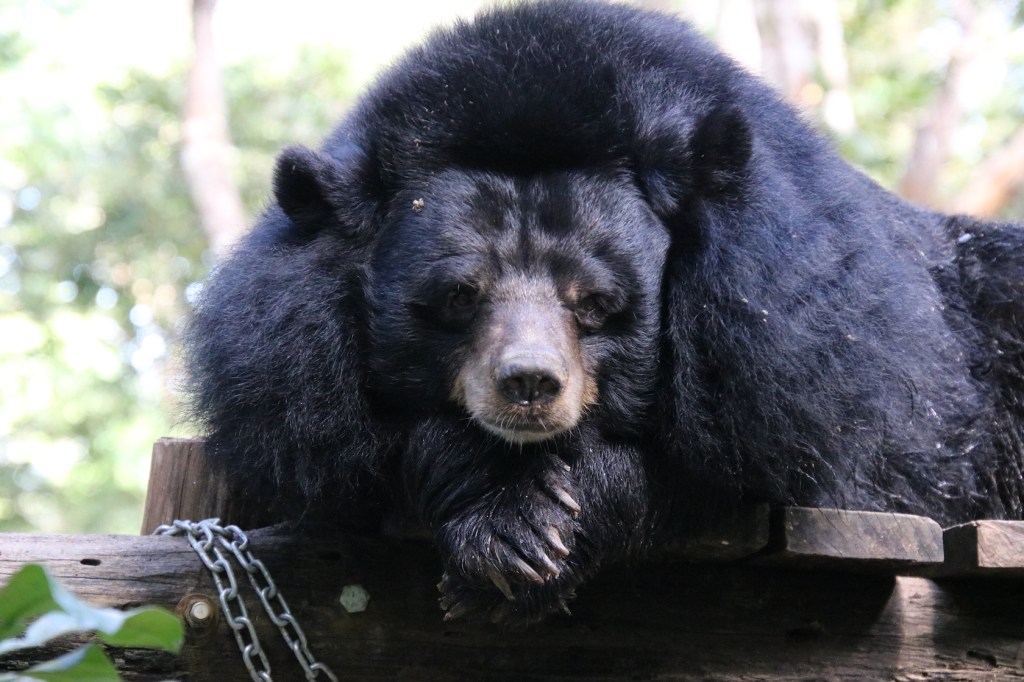
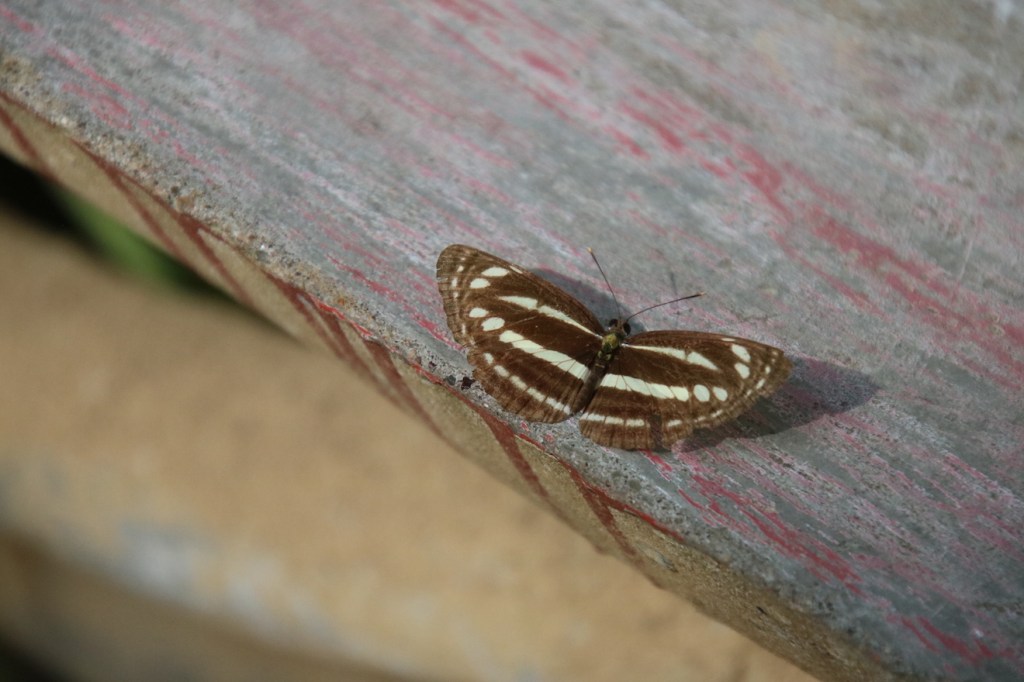
You can also visit the Kuang Si Butterfly Park which is super close the falls and costs about 30,000 Kip (~$3.30).
Many round out the day by visiting Mount Phou Si for sunset. After that head out for dinner and the night market.
Getting To/From Kuangsi Waterfall
The Kuang Si falls are about 18 miles south of Luang Prabang. You can get there by:
Car
Minivan
Songtaew – a covered pick-up truck with seats in the back; cool experience; not comfortable
Tuk tuk
Bicycle
Boat
If you’re going on a group tour, you’re likely going to go by mini van. For a private tour you’ll be in a car or a minivan, and the least expensive will be via tuk tuk. Or you can take a 1 hour boat down the Mekong River. The boat will take you close to the falls but you’ll still need a way to drive to the falls.
This is what we did on the return and it was really nice – a great way to end an already beautiful day and doubly served as our cruise down the Mekong – though it was not at sunset (it was just before).
Your accommodation or if you’re working with a tour company can help you arrange your visit to Kuang Si. If your tour doesn’t include the entry fee to the falls, bring cash as they don’t accept credit nor debit cards.
The falls are open 8am-5:30pm everyday. The tourist vans start arriving at 10am.
Kuang Si Falls Costs
Transportation: this will range from $6-$40 depending on type of transport you choose and whether it’s private or group.
Kuang Si Entrance Fee: 20,000 Kip per person = ~$2.50; bring cash
Kuang Si Butterfly Park: 30,000 kip per person = $3.30; bring cash
Laos Buffalo Dairy: varies $9-$200USD; if walk-in bring cash
Snacks/Souvenirs: bring cash
Kuang Si Falls Tips/Nice To Know
- The falls are beautiful year round and worth a visit even during dry season.
- The road to the falls is pretty bumpy.
- The water at Kuang Si is cold.
- There are designated areas where visitors can go as well as areas that are prohibited. Don’t be a jerk, abide by the signs and designated areas and be respectful.
- You can climb and (semi steep) hikes around the falls. For that I recommend sneakers, water shoes, or a sandal with a sturdy sole.
- In Laos people dress more modestly compared to Western countries. Don’t travel to/from Kuang Si just wearing your swimsuit – wear clothes/cover up. Ladies, bikinis are ok because they are accustomed to tourists but you’ll be hard pressed to find Lao ladies and even a lot of other Asian tourists in them. Even swim gear is more modest amongst the locals – board shorts + top.
- There are restrooms but they’re rough. There was only one stall that was Western style. The rest were squat toilets. There was no toilet paper and no hand soap. I recommend these products: soap sheets, toilet seat covers, travel toilet paper
- There is a little market at the ticketing area as well as the entrance to the Falls to buy snacks and souvenirs, so bring cash. But you’re allowed to bring food as well.
On the way to the Falls a lot of guides will stop at a local village which is designed to be a cultural experience but unfortunately we found it be inauthentic and uncomfortable as the village guide, vendors and locals placed this tacit pressure and expectation to buy trinkets and give them money to see the animals they keep and the other things in the village. They kept asking us to come inside or go into an area and watched us closely. There were local ladies selling the same souvenirs you’ll see throughout your visit and we just felt very uncomfortable so we didn’t stay long. After that brief stop we headed to the entrance of Kuang Si.
When we talked to our guide, he told us about this visit, so we knew ahead of time. I just didn’t know there was going to be an expectation to pay/buy. Looking back I see how that was naive of me.
Restrooms. There are restrooms are at the ticketing area as well at the Falls in addition to changing rooms at the Falls. When I was there in December 2023, there was only 1 stall with a Western style toilet and there was no toilet paper nor hand soap. It looked like they had been cleaned at least. I keep these travel soap sheets in my day pack and they come in very handy (not just for Laos, but for traveling anywhere).
After you get your ticket you will sit in an electric golf cart-like trolley that will take you to the entrance to the Falls. This was a pretty long drive – like 7-10 minutes and much of it was uphill. There were vendors selling souvenirs and food right outside. There are no vendors selling goods inside.
There are a few benches and picnic tables scattered around the Falls. There are loads of places to take photos.
There are no lockers or anywhere to store your stuff while you swim. If everyone in your group is going to be in the water simultaneously then I recommend taking a dry bag that you can keep on the ledge so you can keep an eye on it.
Wear water shoes instead of going in barefoot. There are slippery as well as sharp rocks.
Bring a light warm layer. In December when we arrived first thing in the morning it was chilly and overcast. It didn’t warm up and get sunny until about 11am’ish. The water is chilly so you might get cold or worse catch a cold by going in cold water and then stepping out into chilly weather. Also since we took a boat back to Luang Prabang it got a little windy and so again the warm layer was nice to have.
Attach a carabiner to your daypack – something you can use to hang your daypack from doors. There are changing rooms and restrooms but if you’re like me and don’t like putting your bag on the dirty floor/ground a carabiner for your daypack comes in handy. It also makes changing easier as your bag is elevated.
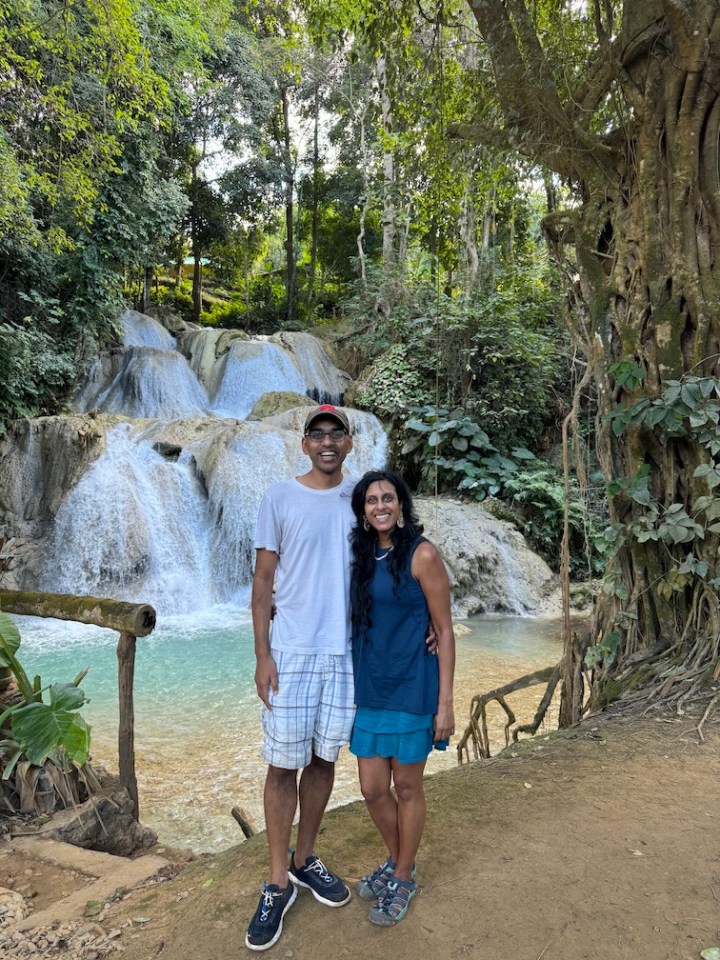
Final Recommendation: If you can swing it, I recommend hiring an English-speaking guide for your trip to the Falls. Our guide watched our stuff while we swam and wandered around; and he took photos for us. We were so carefree throughout the whole thing. He arranged lunch at a stunning outdoor restaurant overlooking a small waterfall, kind of like on the lower back side of Kuang Si. It was on the way from the Falls back to the ticketing area as we got off of the electric golf trolley early to go to the restaurant.
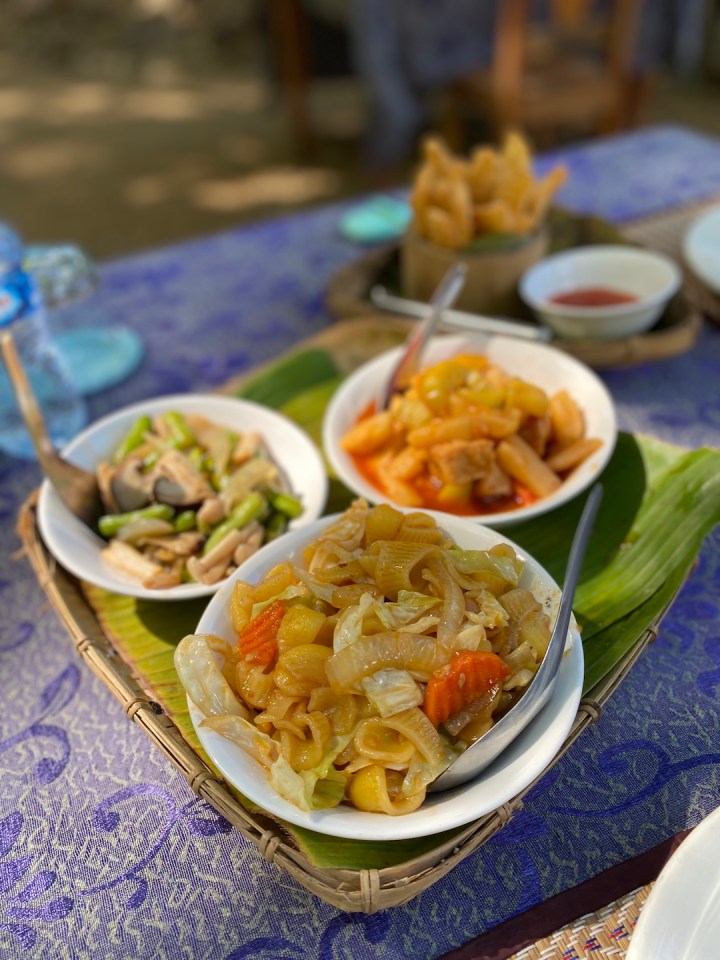
You can’t see our dining table in the photo below, but it was literally in front of where we’re standing. That waterfall was our view over lunch. And below that is the beautiful, vegan meal they made for us.
Things To Bring to Kuang Si
- Dry bag – if you/everyone in your group is going in the water simultaneously
- Water shoes
- Swimsuit
- Swim cover up/change of clothes
- Light warm layer
- Bag for wet clothes and towel
- Water and snacks
- Towel (quick dry, travel towel recommended)
- Sunscreen
- Bug repellent
- Toilet paper
- Soap sheets
- Tissues
- Hand sanitizer
- Hat
- Sunglasses
- Ladies: hair ties, hair brush
- Camera
- Selfie stick
- Chapstick (it’s dry in December)
- Carabiner for backpack
Mount Phou Si in Luang Prabang
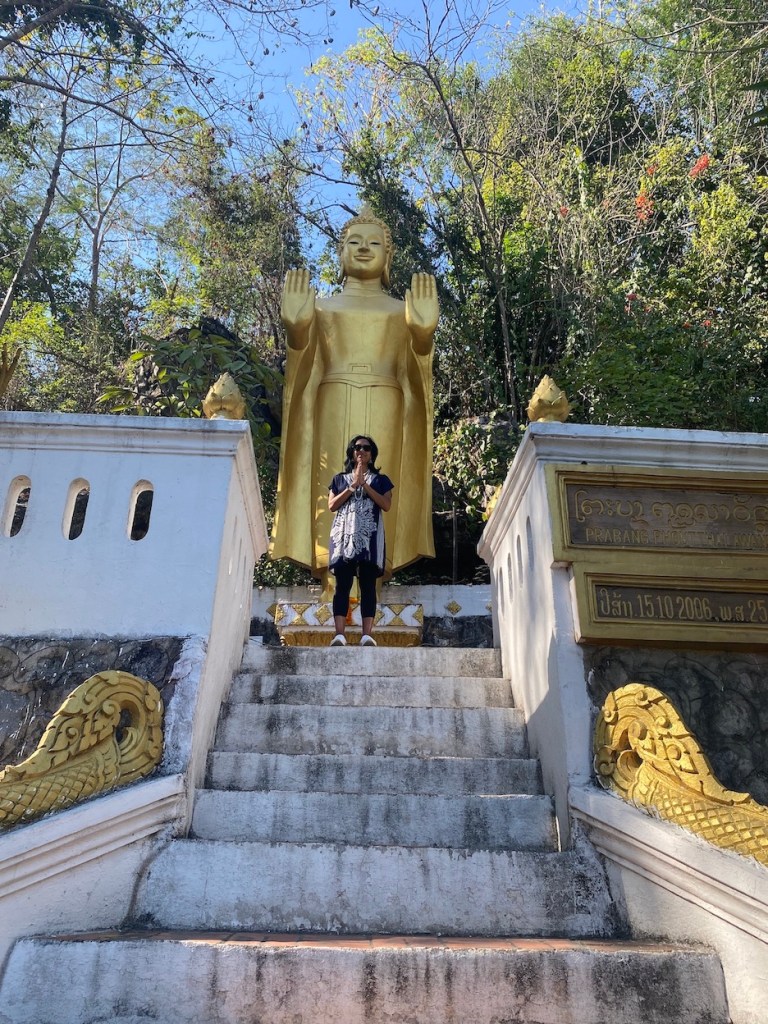
Mount Phou Si means Sacred Mountain. The 360-degree panoramic views of the city are pretty. But I am just being honest, I thought the statues and bridges along the way were more interesting and beautiful to look at than the view. Don’t get me wrong, the view is nice and I’m glad we did this but it is pretty extra hyped up in vlogs and blogs.
We went on the day we arrived in Laos as we didn’t have any activities planned and it was a good activity to do as we battled major jetlag (14 hour time difference between Luang Prabang and LA in December).
This is a particularly popular spot to catch sunset (and sunrise). Expect crowds at both times. The crowds come from the day-trippers.
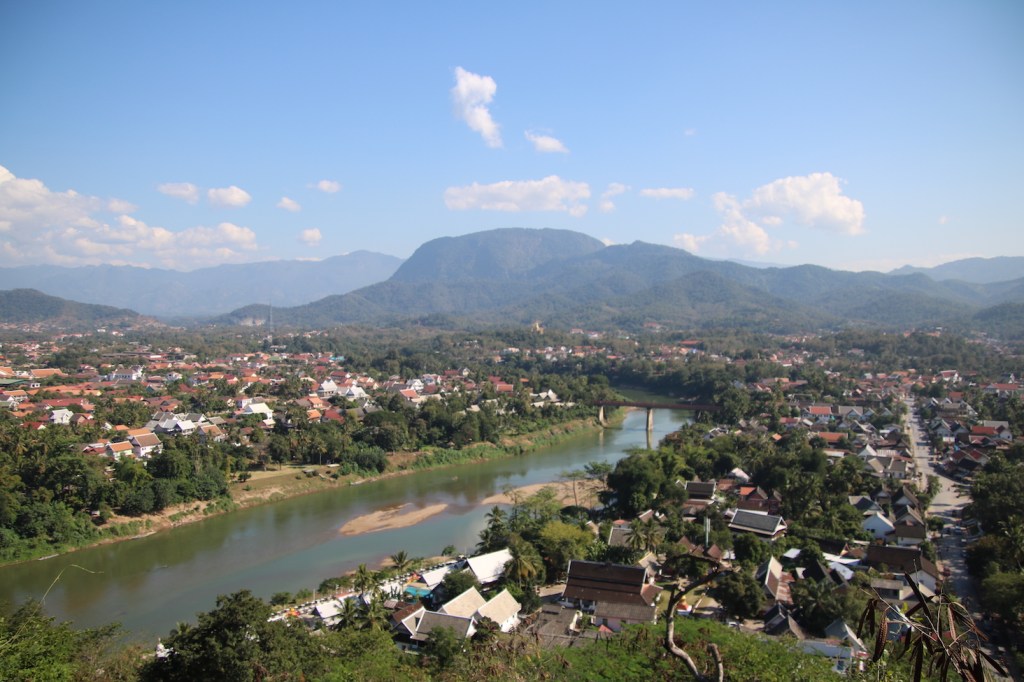
It costs approximately $2.50 per person to go up and technically it’s open 8am-6pm everyday but many people go before sunrise and stay after sunset so they can already be there to witness both times of day.
There are approximately 300 steps to climb and there are two pagodas at the top of Mount Phou Si that tourists may enter. It’s very easy to get there. If you’re staying in Luang Prabang’s center, simply walk to one of the two stairways. If you’re staying out of the city center take a tuk tuk.
Choose your entrance point wisely as there are two:
- opposite the Royal Palace at the night market (we did this one)
- next to the Nam Khan River on Thanon Phousi
Route 1 is shorter with 328 stairs but no views on the way up
Route 2 is longer with 355 steps but it’s the scenic route and takes you past Wat Tham Phousi
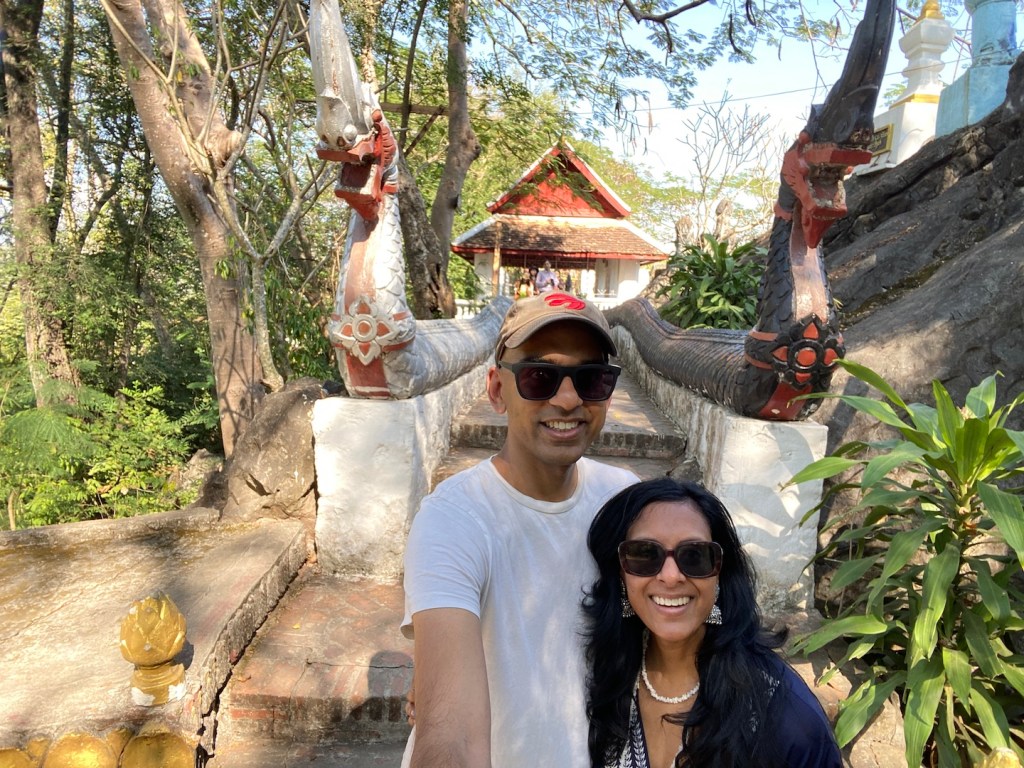
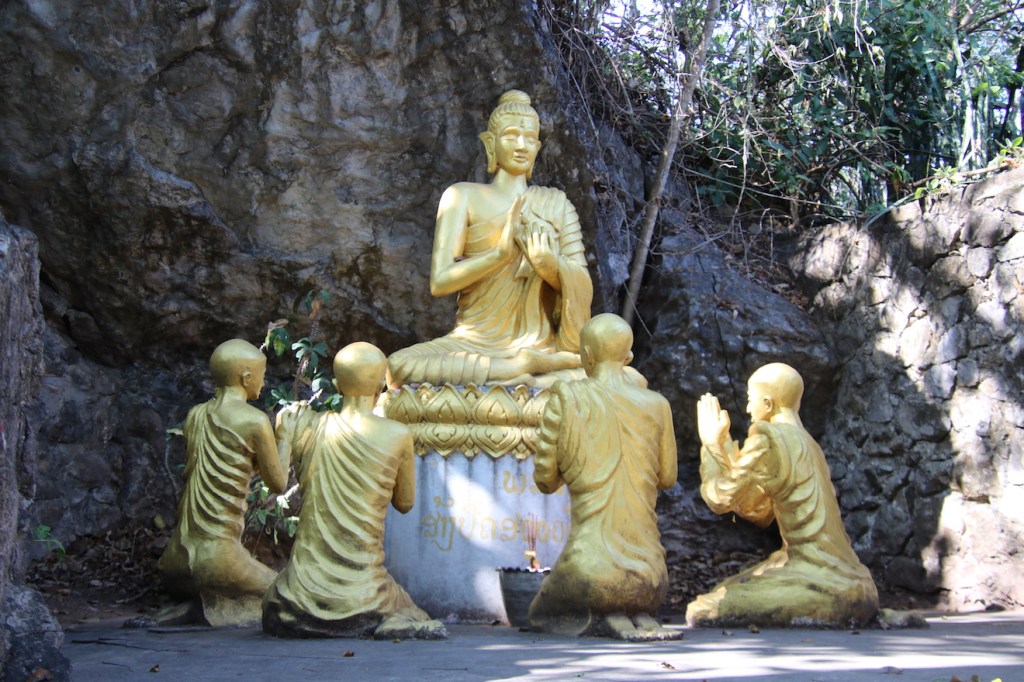
We went in the mid afternoon and it was hot. We were sweating a lot. But there was hardly anyone there…so trade offs. At one point, it was so hot, I thought we should have saved it for sunrise or sunset or just any cooler time of day. But later that day, at sunset, when we saw the (literally) hoards of tourist buses I was so glad that we did it in the afternoon.
If you’re in generally good physical fitness climbing the stairs will not be an issue. They are not extraordinarily tall or wide or anything. These are proper concrete steps and pathways (photo below) – you can wear sandals or sneakers – no need for hiking shoes. Some people refer to this as a hike. Personally, I call it going for a walk.
This was about a 1.5 hour excursion for us including sitting down for a few minutes to enjoy the view and taking photos at various spots.
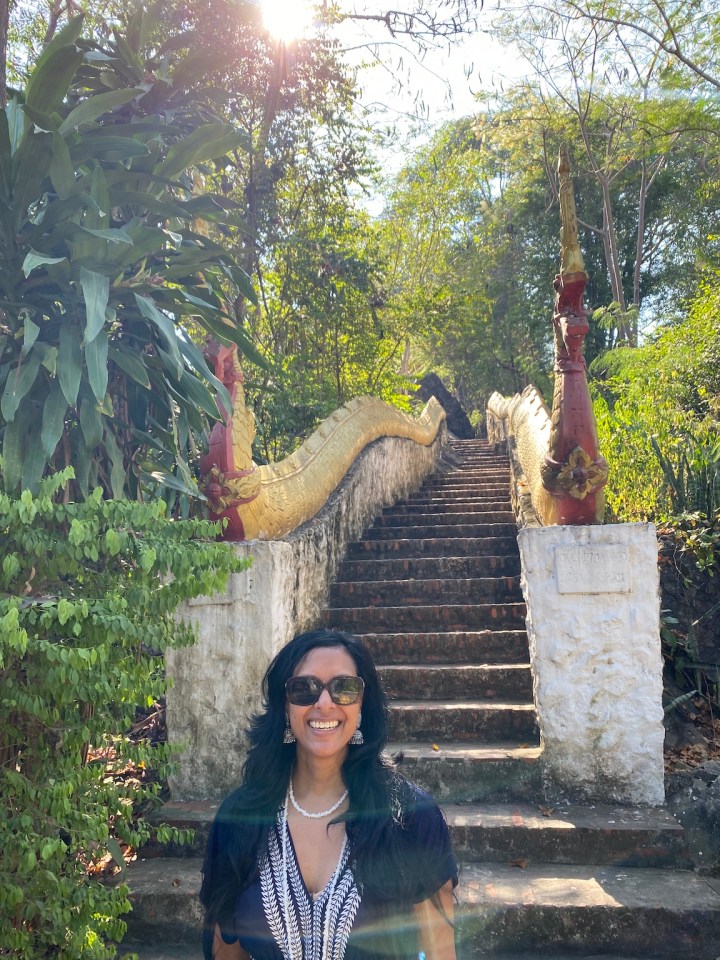
Mount Phou Si ProTips
- This is an active religious site, so dress appropriately. No shoulders nor knees showing, nothing revealing. There is a monastery inside and we saw monks. We did see people wearing shorts – so I don’t think they stop people but it’s just better to be respectful of the culture.
- Do not consume alcohol.
- Bring a hat, sunglasses, and water and wear mosquito repellant.
Pak Ou Caves
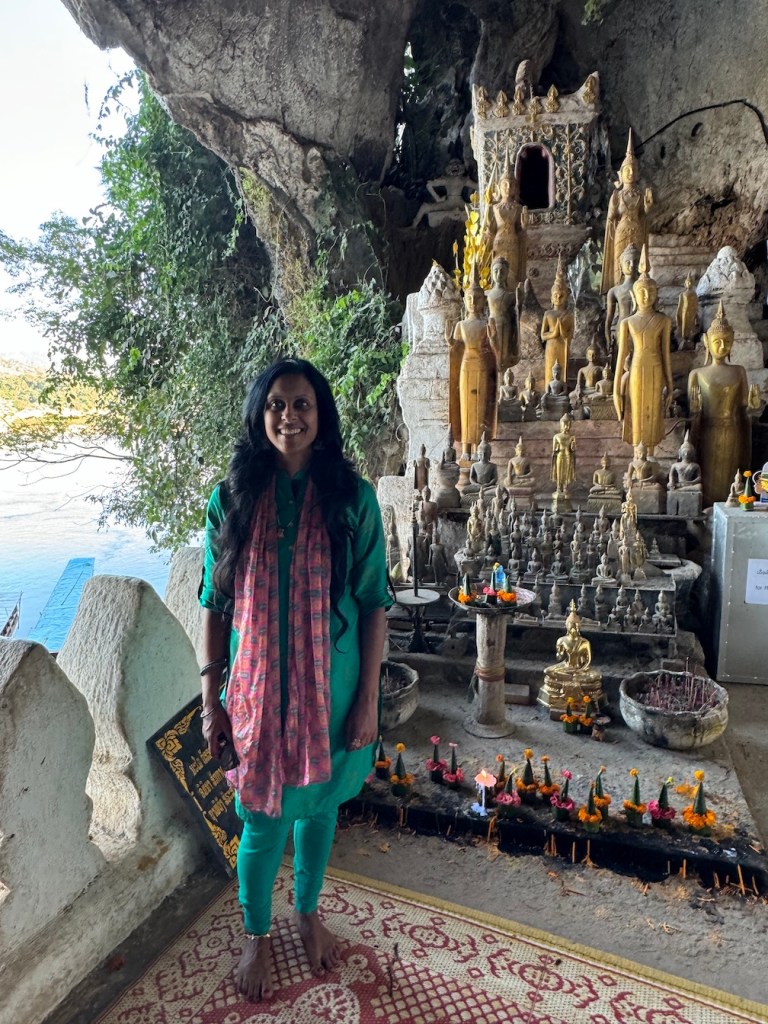
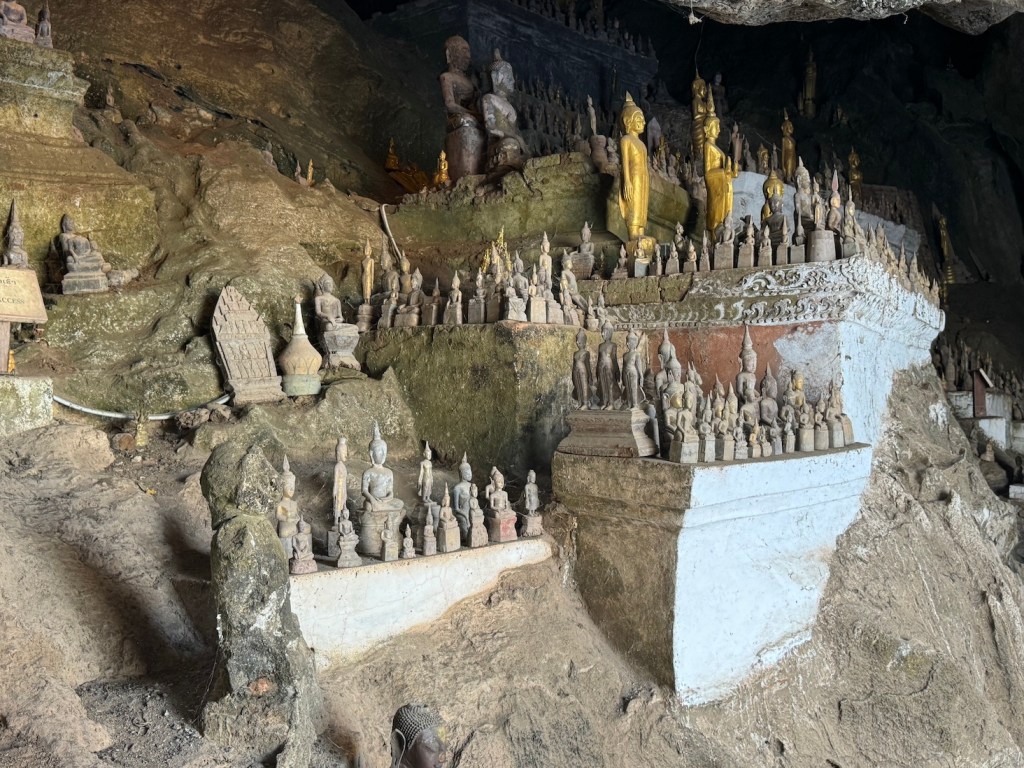
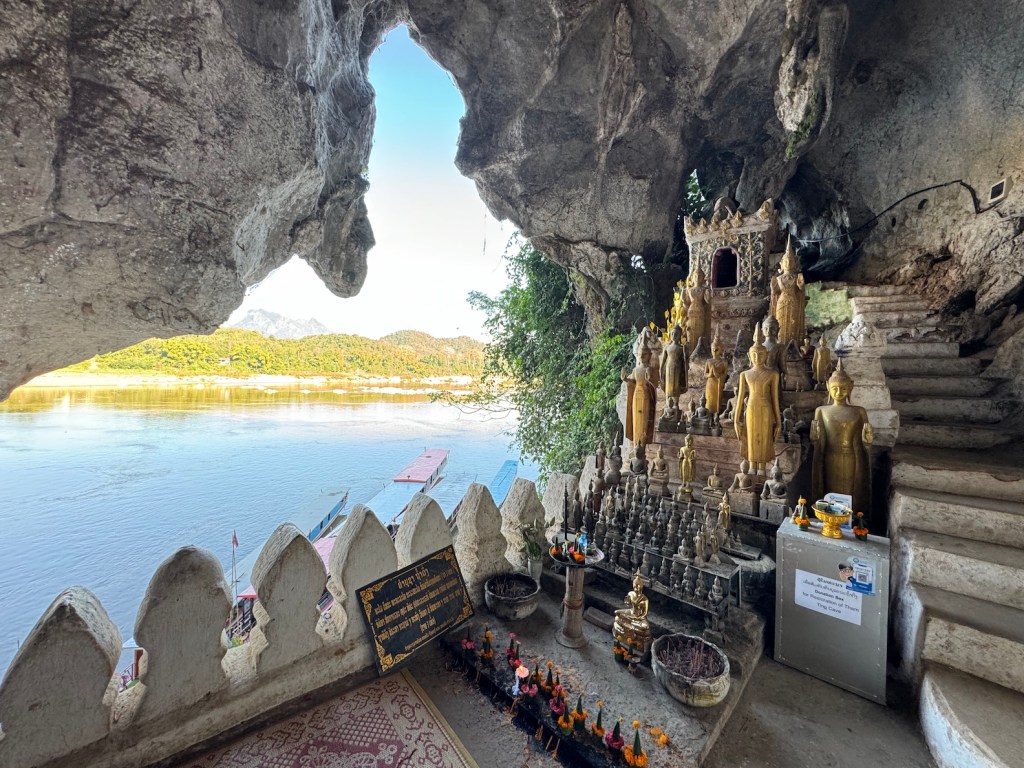
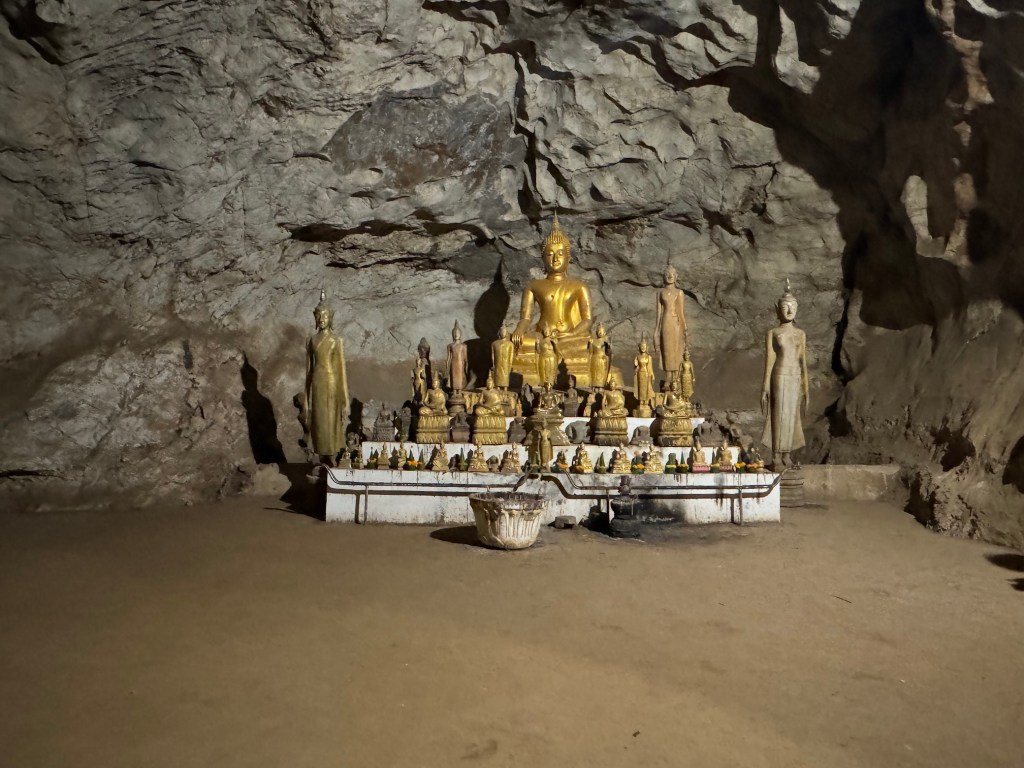
The Pak Ou Caves are a thousands year old religious site about 15 miles north of Luang Prabang.. Every April, Laos’ new year, pilgrims visit the caves to pray and wash in the water. There is an upper (Tham Theung) and a lower (Tham Ting) cave each filled with thousands of Buddha statues placed by pilgrims.
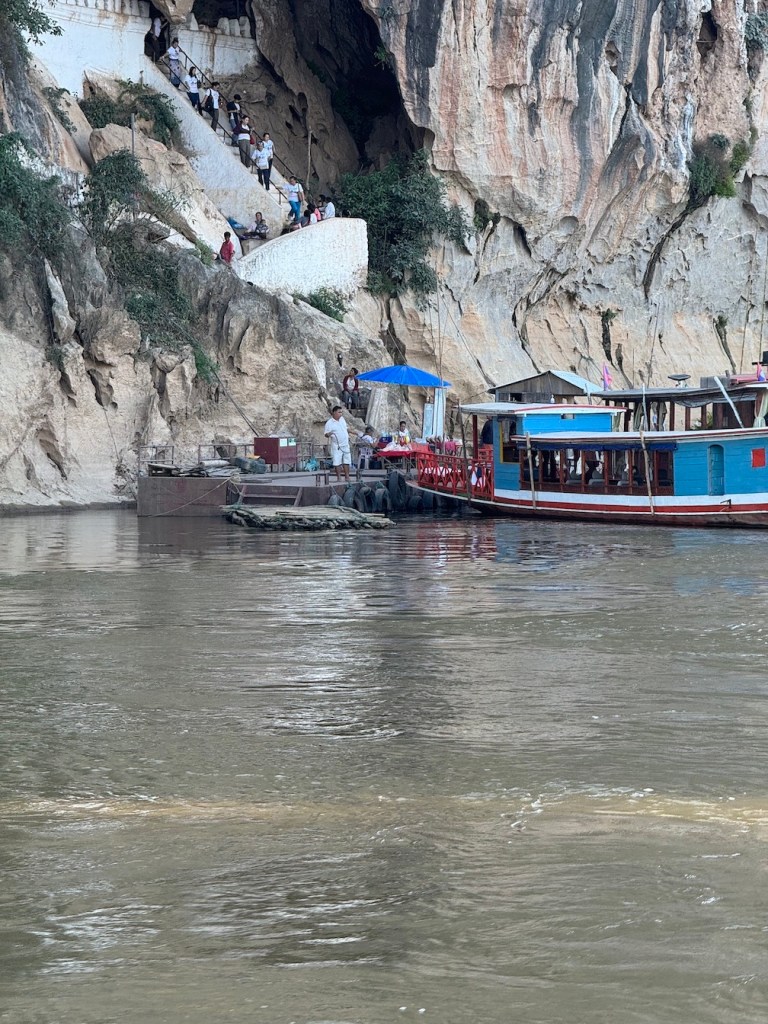
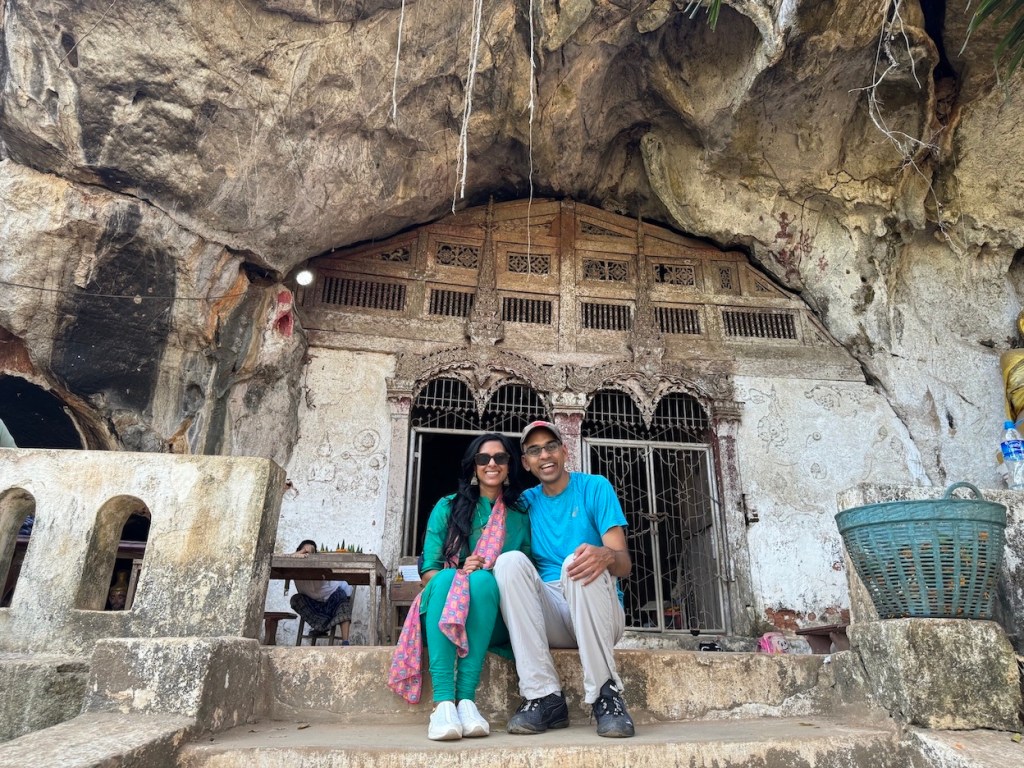
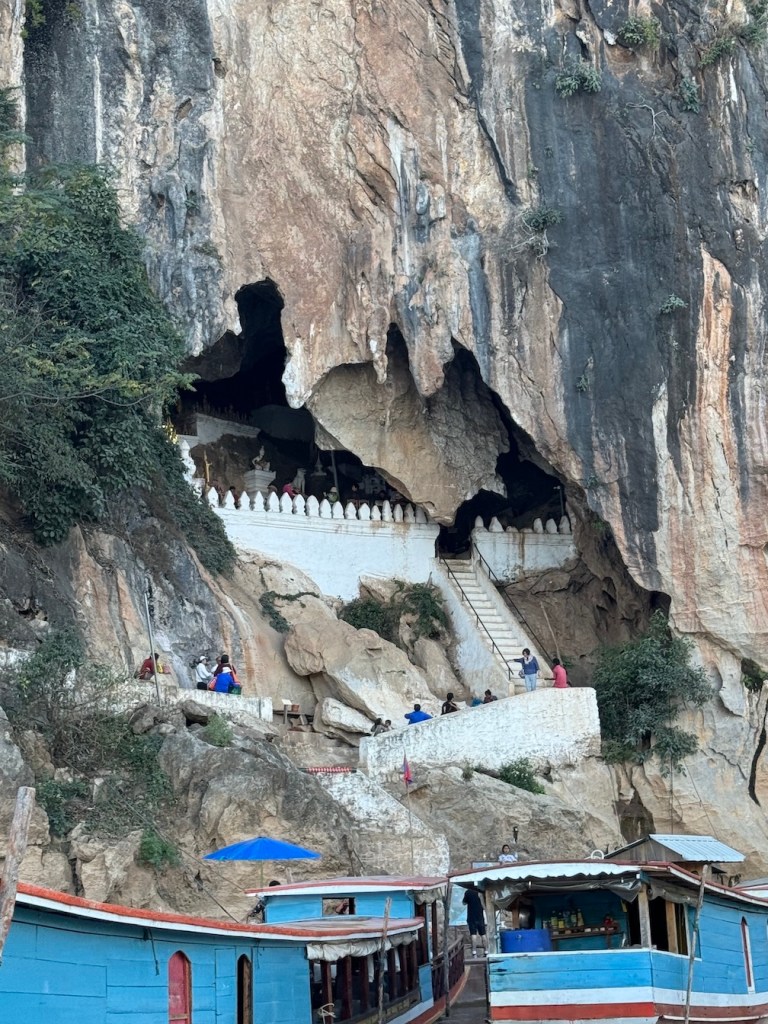
What Makes Them Special? They are caves in the side of a mountain. There is an upper cave and a lower cave each of which are reached via stairs. There are quite a few stairs to climb to get to the upper cave but anyone who doesn’t have mobility issues will be fine. You will sweat in December. Bring your water bottle.
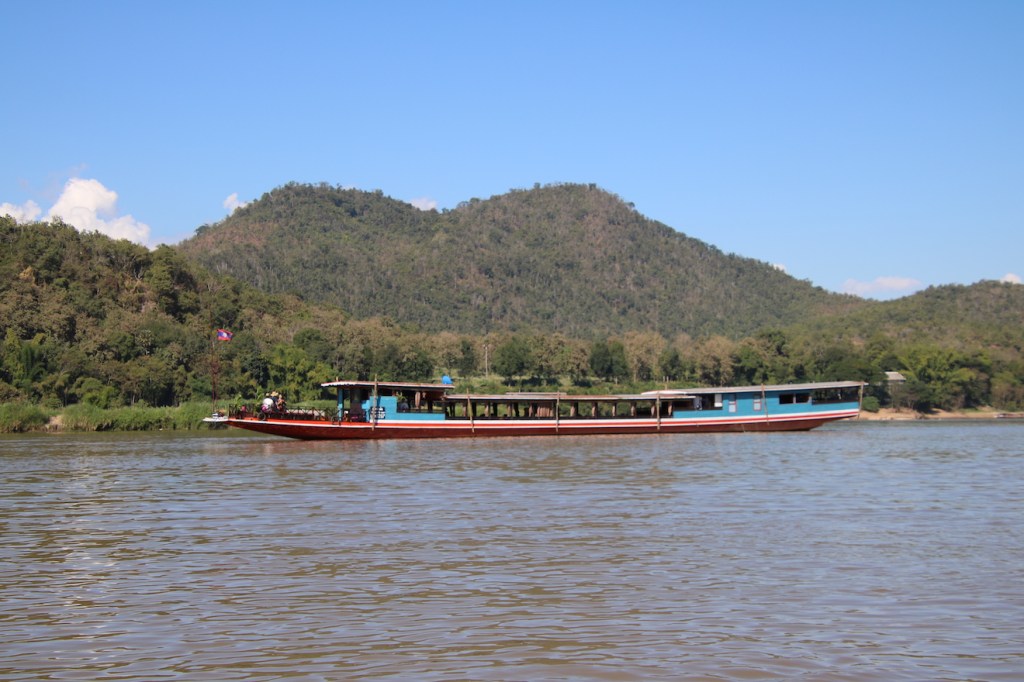
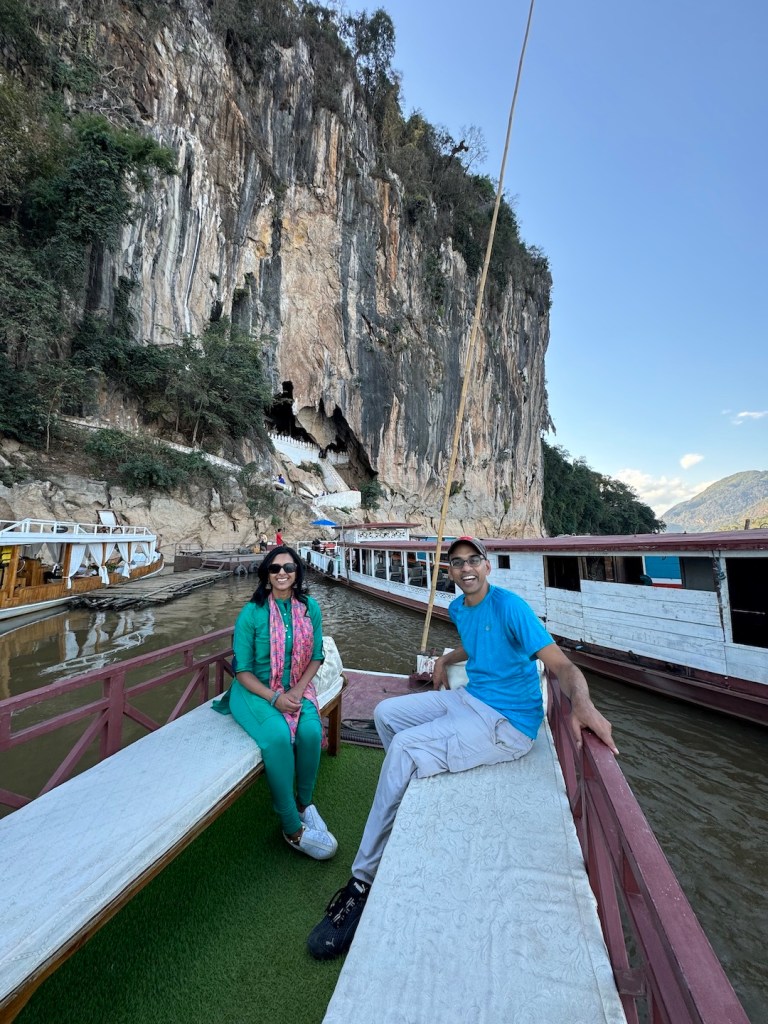
Getting to the Pak Ou Caves. You can reach the caves by car or by boat, though a boat is the preferred way to go as the road is bumpy and the route isn’t nearly as beautiful.
On the way there or on the way back most tours stop at a whiskey village and maybe a paper and silk production village.
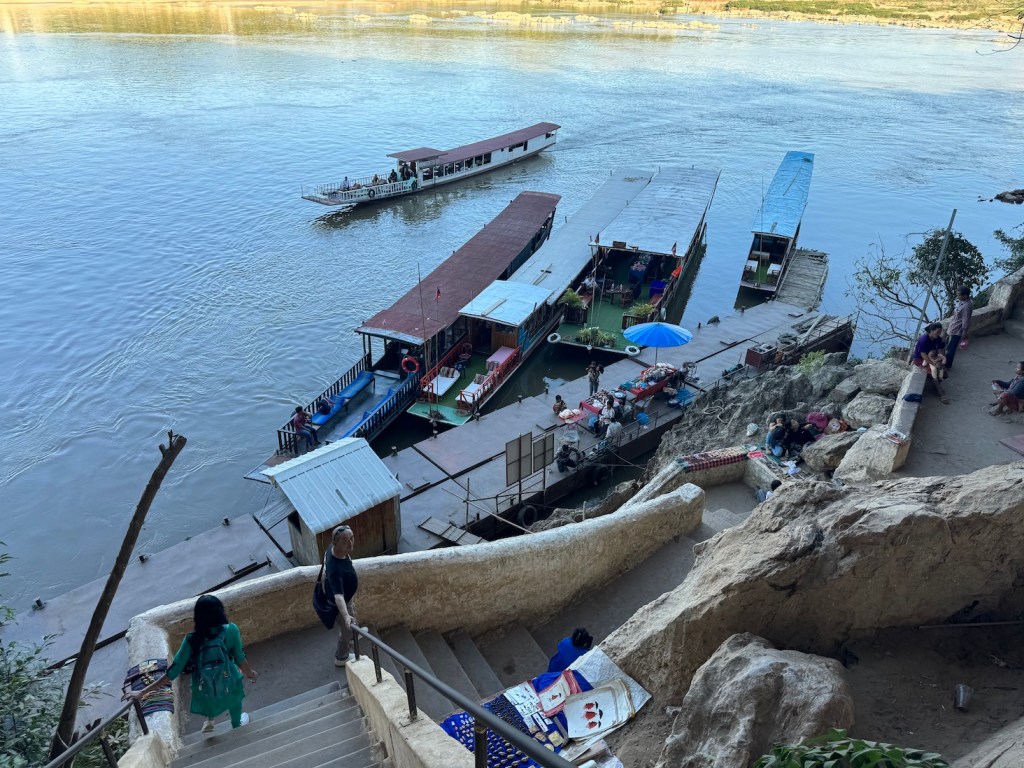
I’ll be honest, for me, the best part of this half day trip was the boat ride to get there and back. We booked a private tour and skipped the whiskey village etc. on the way as after seeing videos of it online, decided it wasn’t for us.
It took 1.5 hours on the way there and 1 hour on the way back. A lot of people combine their sunset Mekong cruise with a visit to the Pak Ou Caves. However, in my opinion, 1 hour total cruising along the Mekong is enough. So suffice it to say by the time we got back to Luang Prabang, while I enjoyed the cruise, I was ready to be done. The cruise is relaxing and along the banks of the river you’ll see a lot of villages, cows and buffalo.
It costs about 20,000 Kip per person (approximately $2.25) for the caves.
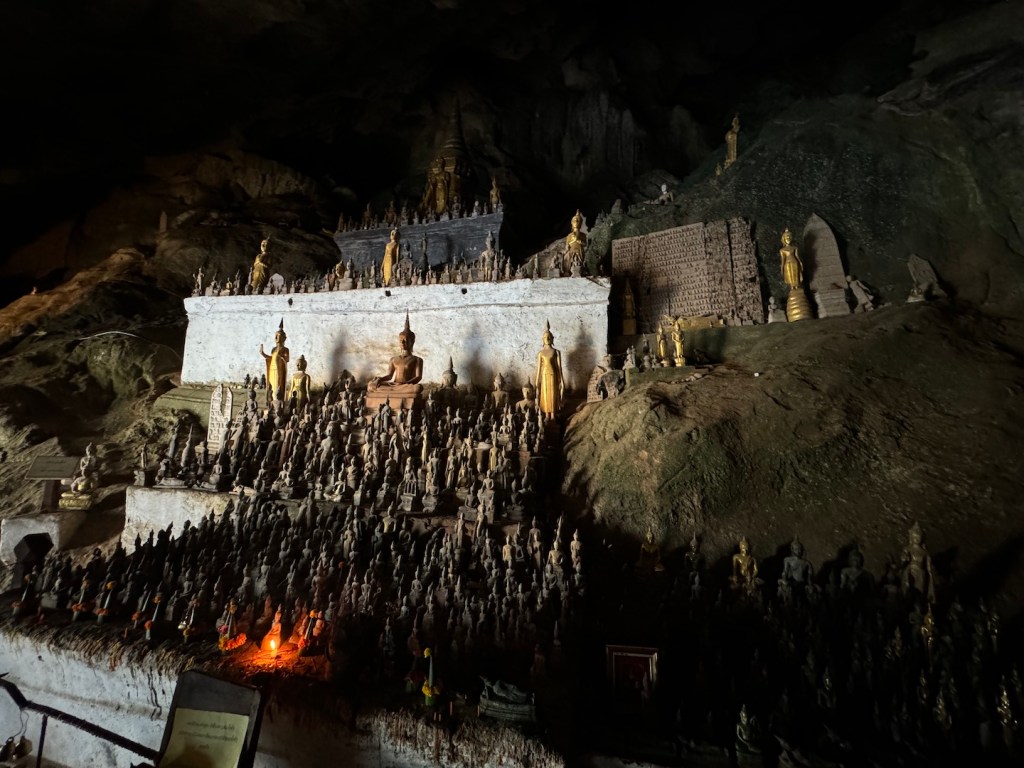
Would I Recommend The Pak Ou Caves?
No. For one, in my opinion this site is not particularly attractive inside nor inside the caves. Secondly, our experience at the caves was completely unpleasant because locals bombard tourists selling their souvenirs and wares. From the literal moment that we stepped off of the boat the peddling started. They sit all along the stairs all the way to the entrances of the caves and in front of the caves – it was nonstop. I got fatigued saying no, over and over. What’s even worse is the children and feeling even worse saying no to them. The whole thing was just really unpleasant.
What really turned me off was seeing a fish trapped inside a plastic bag or a bird trapped inside a tiny cage and they would release it if you give them money. Seriously? Respecting life and animals is a part of Buddhism yet this was the behavior — at a temple, of all places.
Tourists are expected to abide by all cultural norms and respect the culture and rules and laws of the places they visit – as it should be. Locals should have to respect the culture and not ruin the experience for tourists.
Before going to Luang Prabang, during my research and watching videos from others’ I had a feeling this was going to be a tourist trap and I booked it anyway because I said to myself, “well we’re gonna be there anyway, might as well go.” If I had to do it all over again, I would not go to the Pak Ou Caves, even though we were there anyway. And I would have used that time instead to relax at a riverview cafe or walk around town.
Pak Ou Caves ProTips
- Wear sneakers or soled sandals as there’s a 15-20 minute walk to the upper cave
- Bring some sort of light (phone, flashlight, headlamp etc.) for the upper cave – it may be dark.
- Wear something breezy, especially during dry season
- Even though it’s a religious site, covering your shoulders and knees isn’t enforced there
- You won’t get wet and you do not need a dry bag.
- Bring a warm layer for the boat ride.
Note About The Mekong River Party Boats
As I mentioned, sunset cruises on the Mekong are popular. These are often turned Pak Ou Caves bound on the way there and turn into a party boat booze cruises on the way back. We tended to have dinner at river restaurants – along the Mekong – which is where said party boats depart and arrive from. So during dinner they’d just pass by or if we were unlucky just float in the area with the music blasting. There’s really no nightlife in Luang Prabang other than the food market and the night market, so these cruises are really it.
It was annoying but a part of being in Luang Prabang – so just a heads up.
Tad Sae Waterfall
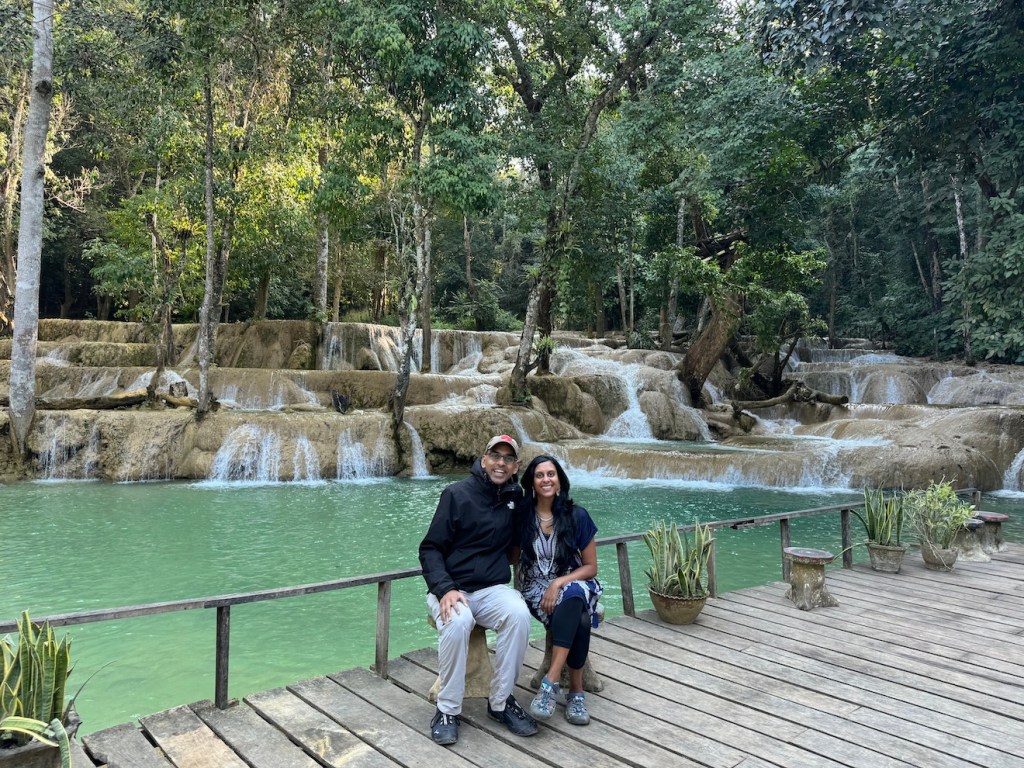
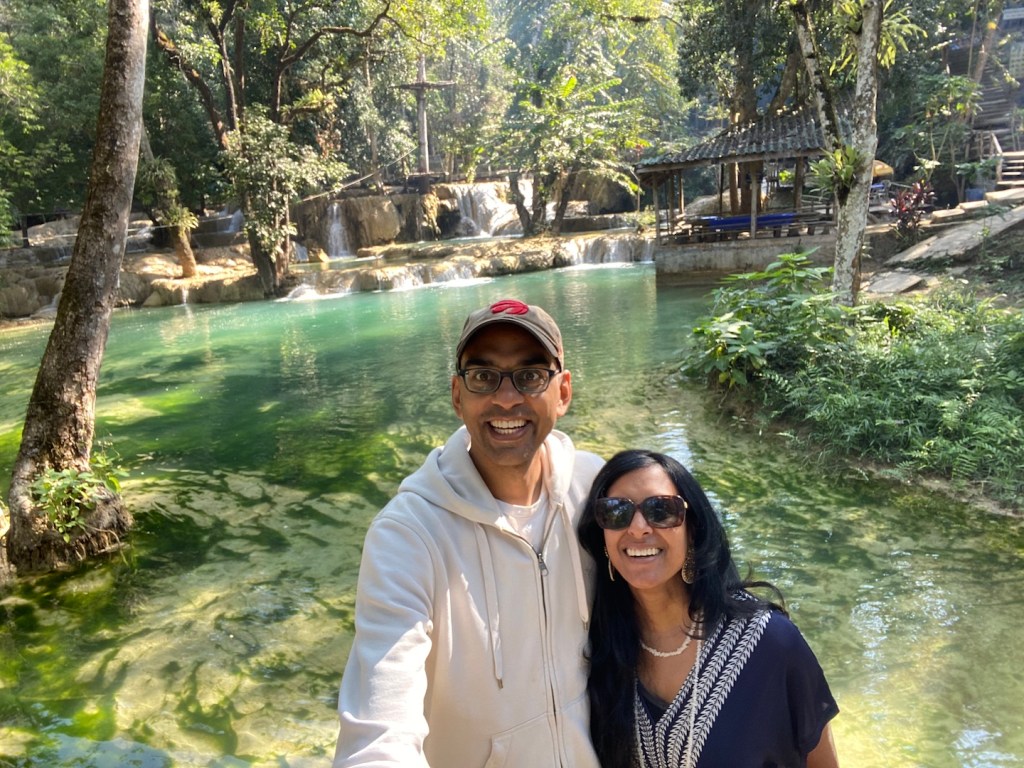
Tad Sae Waterfall is the lesser known brother of Kuang Si, also in Luang Prabang. Because of this it’s often overlooked by tourists, even though it’s only about 9 miles southwest of the city. And perhaps for some who have been to Kuang Si this may feel redundant – but it’s not. In some ways I liked Tad Sae even more than Kuang Si, and I LOVED Kuang Si – keep reading to understand why.
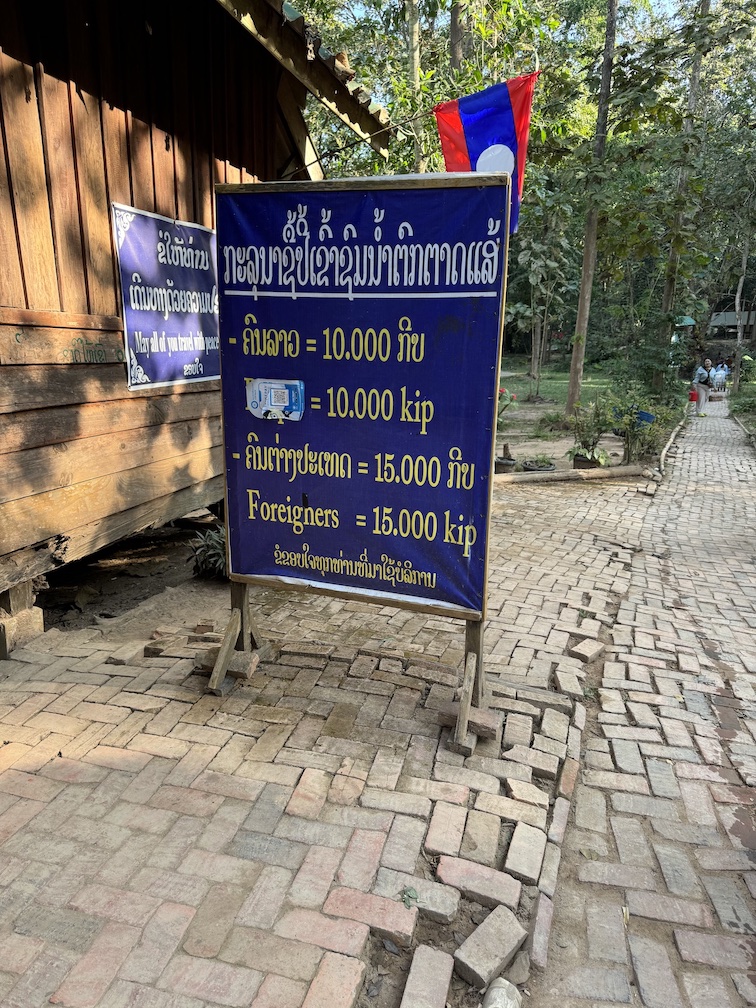
You can get to Tad Sae Waterfalls by road so any road transportation: motorbike, car, minivan, tuk tuk etc. Once you get there, if you brought your own motorbike/car etc. pay for parking. Then pay the 10,000 Kip per person (about $.50) to take the short ferry canoe across the channel, to the entrance of the falls. Pay the 15,000 kip (approximately $.70) per person entrance fee. Yes, that’s in addition to the 10,000 you already paid for the boat ride. Everybody’s makin’ money. Bring cash.
From there you’ll walk to the falls. It’s a short, mostly flat walk. You can walk around the falls as well, so wear good soled shoes, Keens or sandals with good tread. It was slippery, muddy and like a hiking path so I do not recommend slippers. You are allowed to swim in the water. There are a handful of vendors selling souvenirs, food and drinks but not a lot, still bring cash.
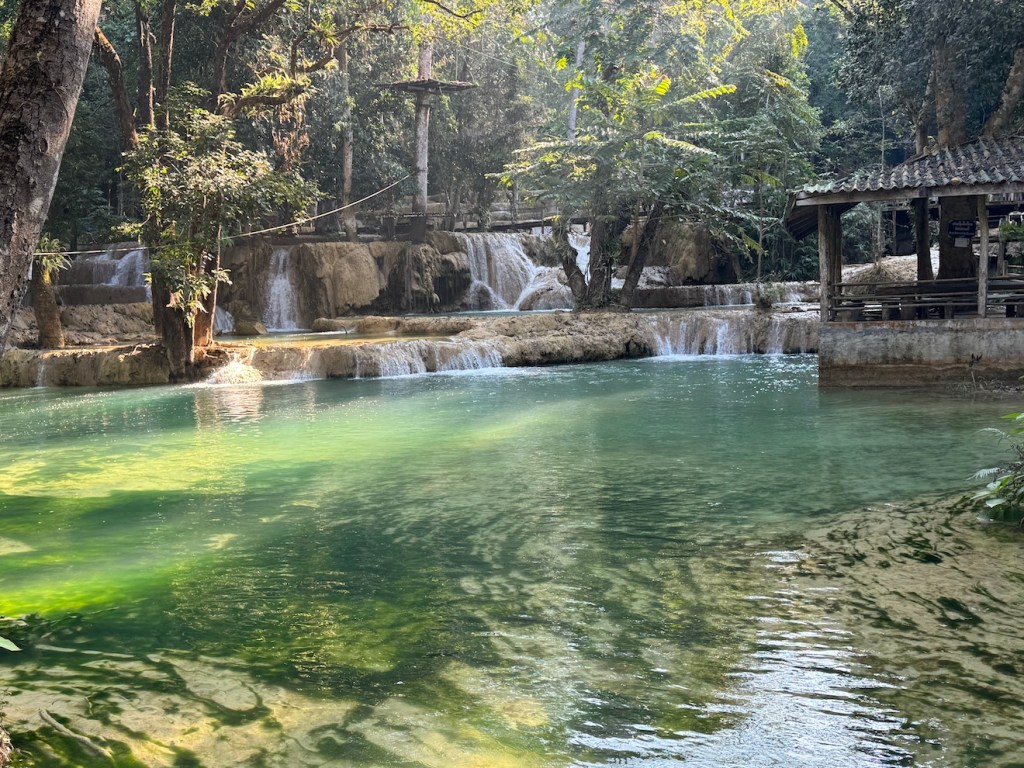
When I went in December 2024, the place was run down. And it was really really sad. I don’t know why and I asked my guide but didn’t get a straight answer as to why the local municipality is not maintaining this beautiful area. The waterfalls and the pools are awesome and there’s more infrastructure around it than Kuang Si — more and really great seating areas like these cute gazebos, a restaurant overlooking the Falls, little bridges and ledges that were made for people to sit/take pictures. But everything was dilapidated – as you can see in the photos.
I didn’t use the bathroom there, but my husband did and said it was gross.
I’m really selling it right?
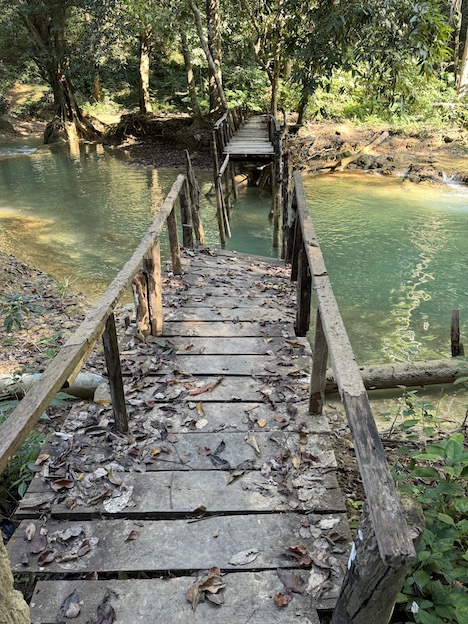
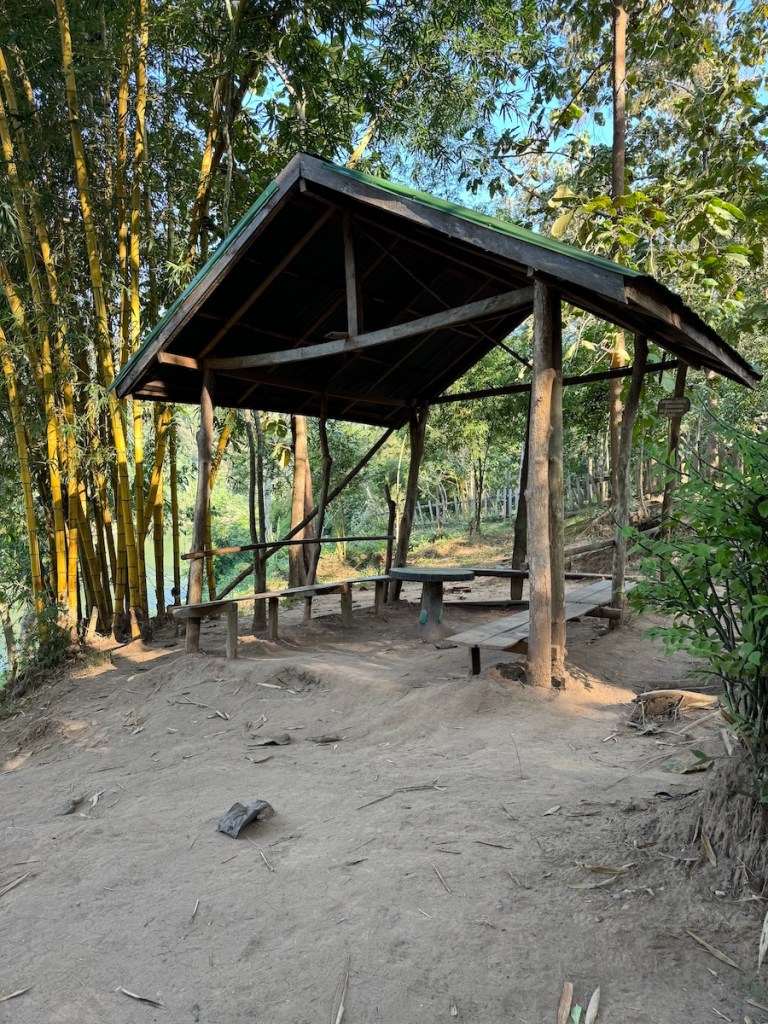
Seriously, despite this, I still loved it. The Falls themselves are gorgeous and totally different than Kuang Si. We got there right when it opened and had the Falls to ourselves for a good 45 minutes.
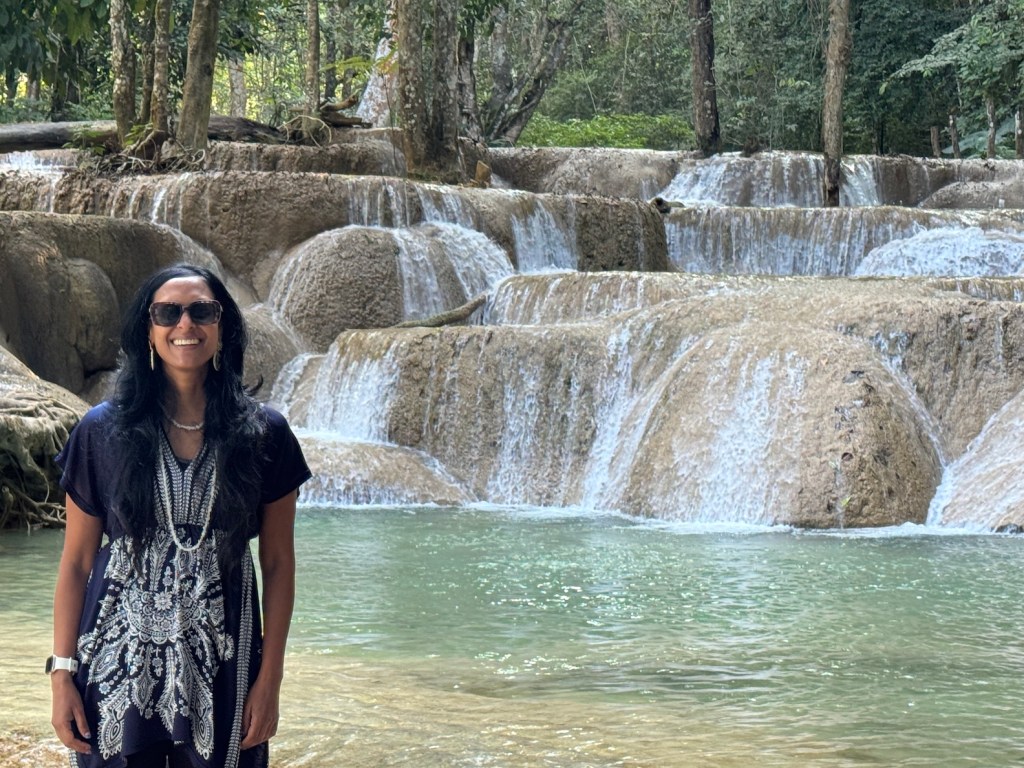
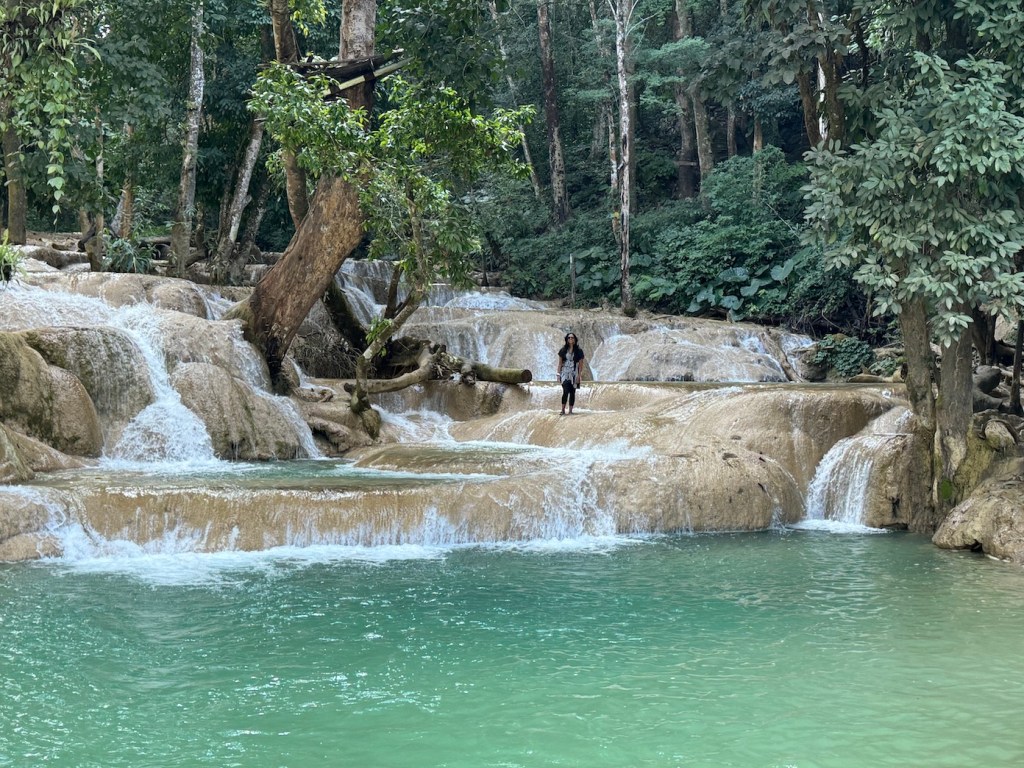
This (above) was early in the morning when it was still overcast.
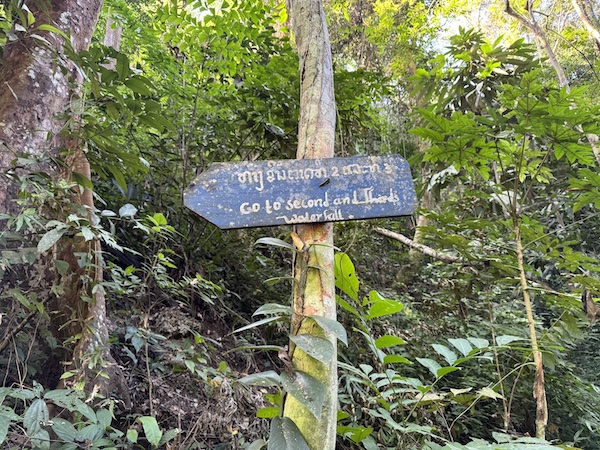
Overcast vs. Sunny Makes a Big Difference. Also, when we got there, first thing in the morning, it was overcast. When we left, the sun had emerged giving the whole thing a totally different look that was worth waiting for. You can see the difference in my photos.
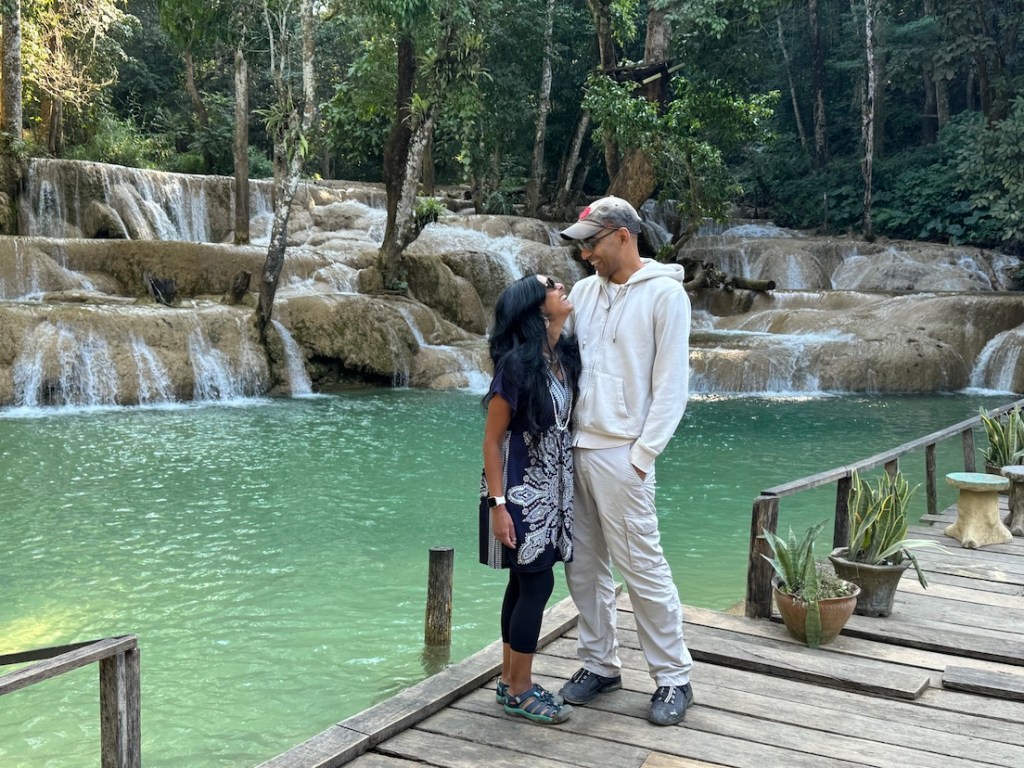
Things To Bring to Tad Sae
- Dry bag (if you’re going swimming)
- Cash
- water shoes
- Swimsuit
- Swim cover up
- Bag for wet clothes, towel
- Water and snacks
- Towel (quick dry, travel towel recommended)
- Sunscreen
- Bug repellent
- Toilet Paper
- Hand sanitizer
- Hat
- Sunglasses
- Change of clothes
- Ladies: hair ties, hair brush
- Camera
- Chapstick (it’s dry in December)
- Warm layer – in the morning and/or if it’s overcast it’s chilly.
Tad Sae Waterfall ProTips
- In Laos people dress more modestly compared to Western countries. Don’t travel to/from the falls just wearing your swimsuit – wear clothes/cover up. Ladies, bikinis are ok because they are accustomed to tourists but you’ll be hard pressed to find Lao ladies in them. Even swim gear is more modest among the locals. You might consider one-piece, shorts or skirted swimsuits and wearing a tank top or t-shirt.
- You can bring your own food.
Mandalao Elephant Conservation
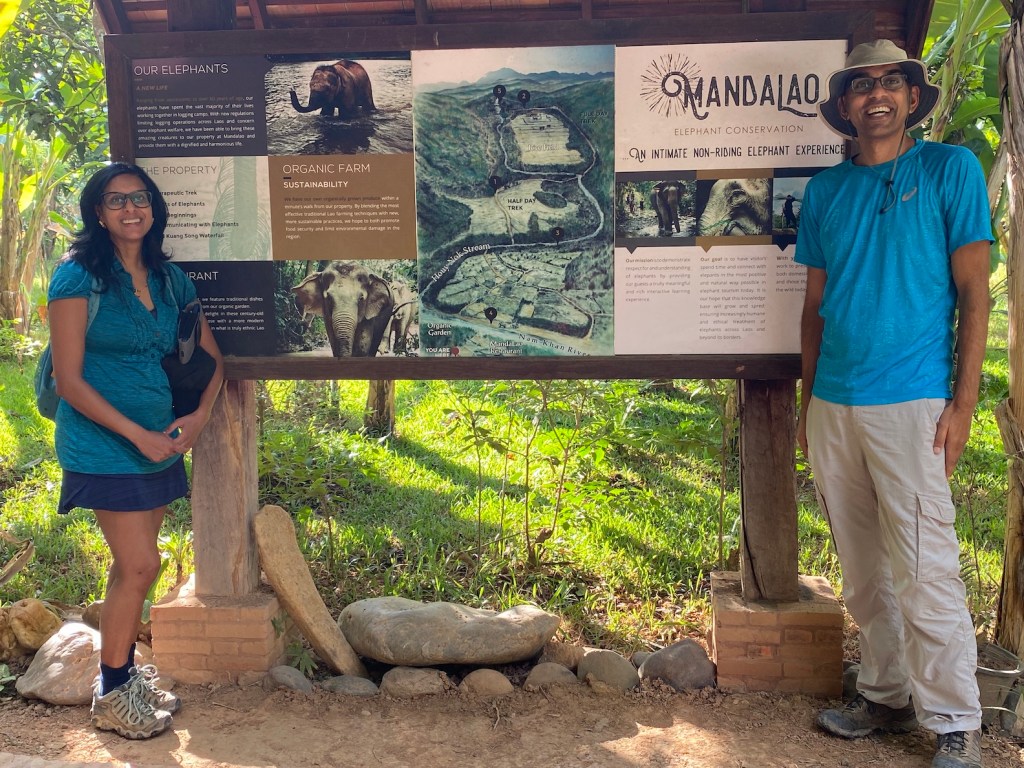
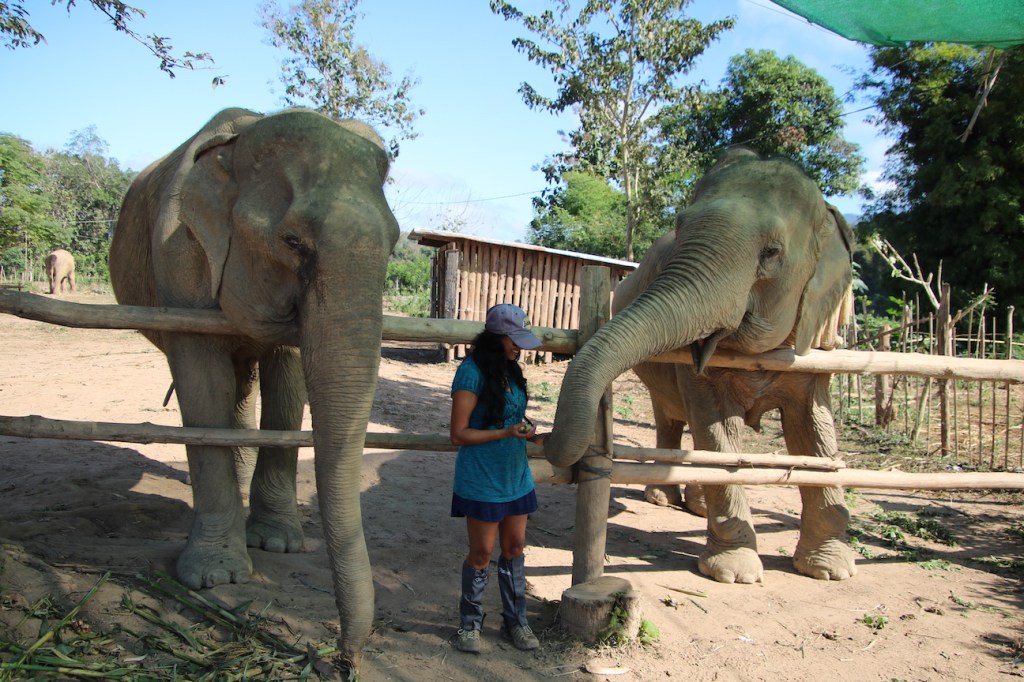
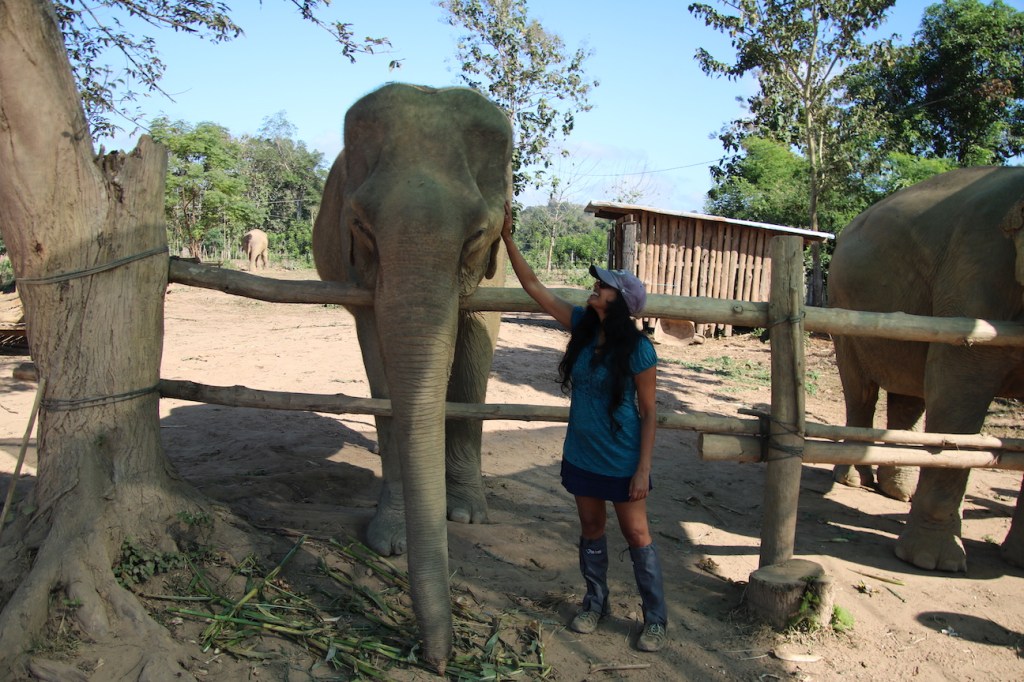
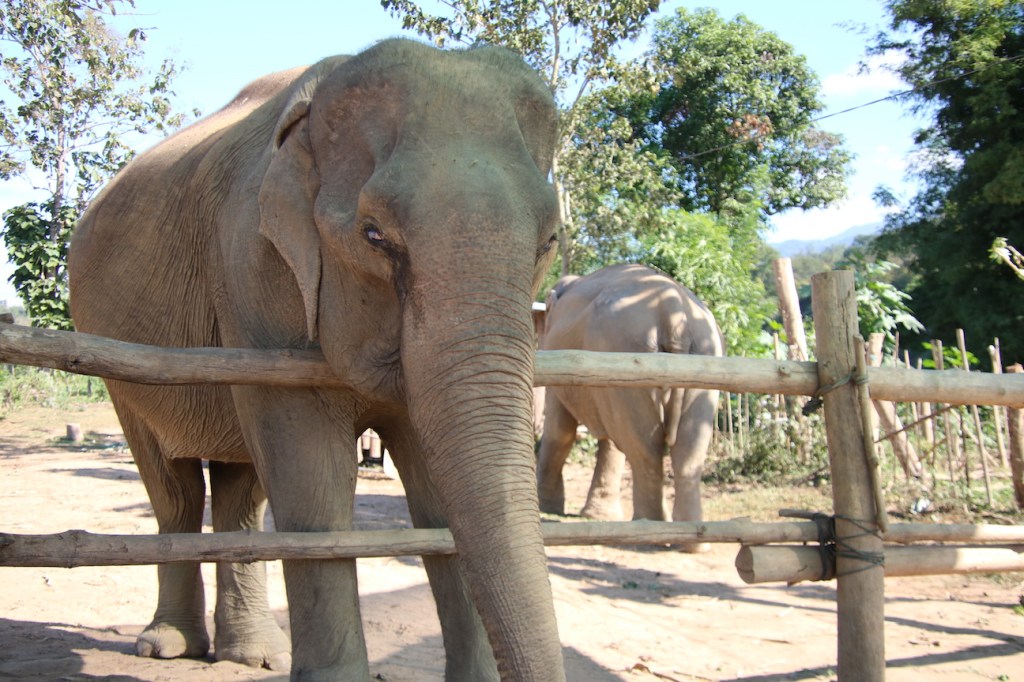
This is a responsible and ethical opportunity to interact with two or more adult elephants. They have half day and full day tours where you will walk through the jungle with them, learn about them and interact responsibly. There are a max of 8 people in a group. The full day tour is $150 per adult. The half day tour is $100 per adult. The tour comes with lunch included.
It’s about 12 miles from the city.
You can arrange for them to pick you up at either 8:30 or 9:15am and drop you off. Or you can arrange your own transportation. They can accommodate dietary preferences, just let them know well in advance. The tour started with an intro about Mandalao by a guide/staff member. Then they gave us gear – the rubber boots and a water bottle. Then we took a very short canoe ride across the channel to where the elephants were.
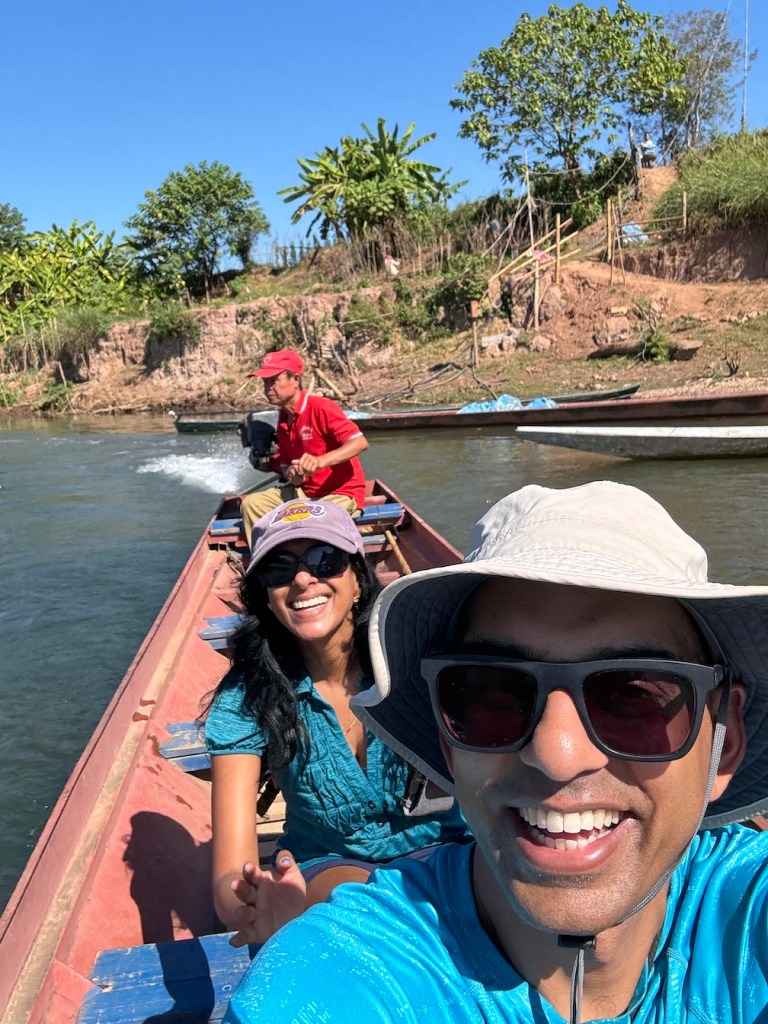
In total, for the half day, you’ll walk about 1.5 miles on flat, dusty, and potentially muddy and wet terrain (especially during the rainy season). It was a very easy walk. This is something you’ll want to book in advance meaning at least the day before. You can pay by credit card or cash in USD or Kip on the day-of.

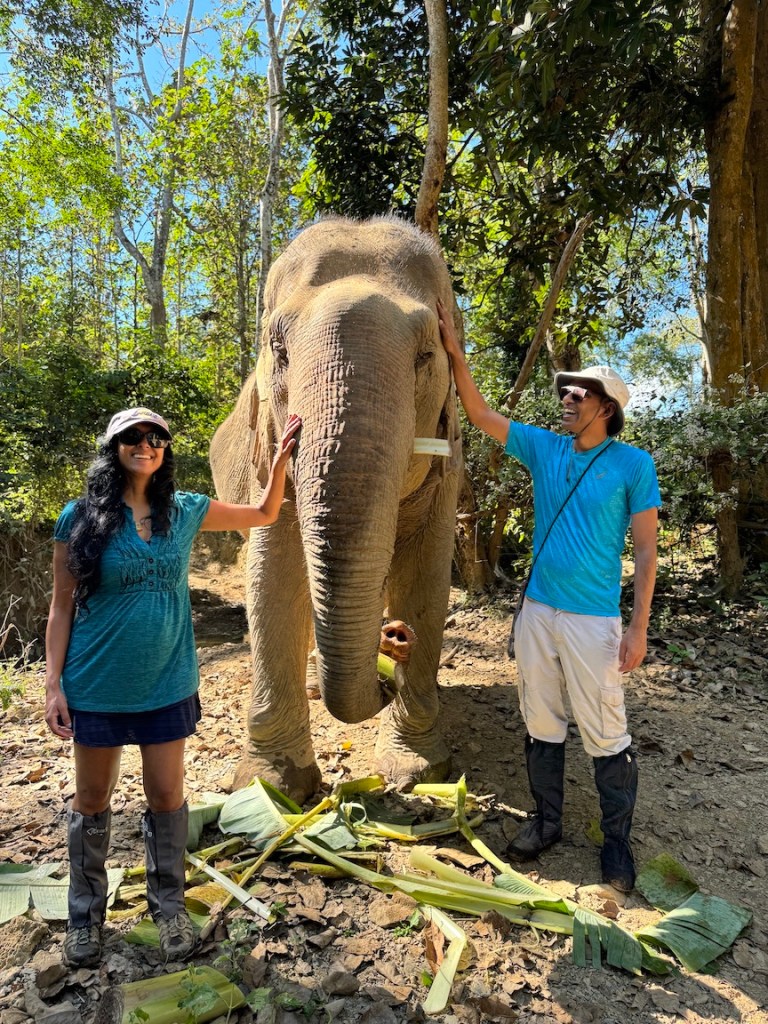
We did the half day tour and felt like that was the right amount of time. We got to feed two adult elephants and walk with them through the jungle, followed by a lovely lunch. Some people had signed up for the half day but were easily able to convert that into the full day.
The grounds are beautiful in themselves and we had a chance to sit and relax and enjoy them before our tour started.
In my opinion, the intro was too long – it dragged on. It’s absolutely important to share the horrific conditions the elephants faced but the guide started talking in circles and repeating himself and sharing really obscure facts. I think they lost sight of the fact that we are tourists and there to have fun as well as learn, because the intro talk became pretty grim, followed by a request for donations.
I told you at the beginning of this blog, I tell it like it is. Did I feel that we made the wrong decision by going? Hell no! I would recommend it over and over. We loved this experience and we loved supporting this elephant sanctuary. But again I keep it real and; I didn’t care for the intro. The rest of it was fantastic.
The person who did the intro talk was not one of our guides for the actual tour – those guides were upbeat, funny, while still educating us about these beautiful animals. They were also really awesome about taking photos for everyone.
ProTips for Mandalao Elephant Conservation
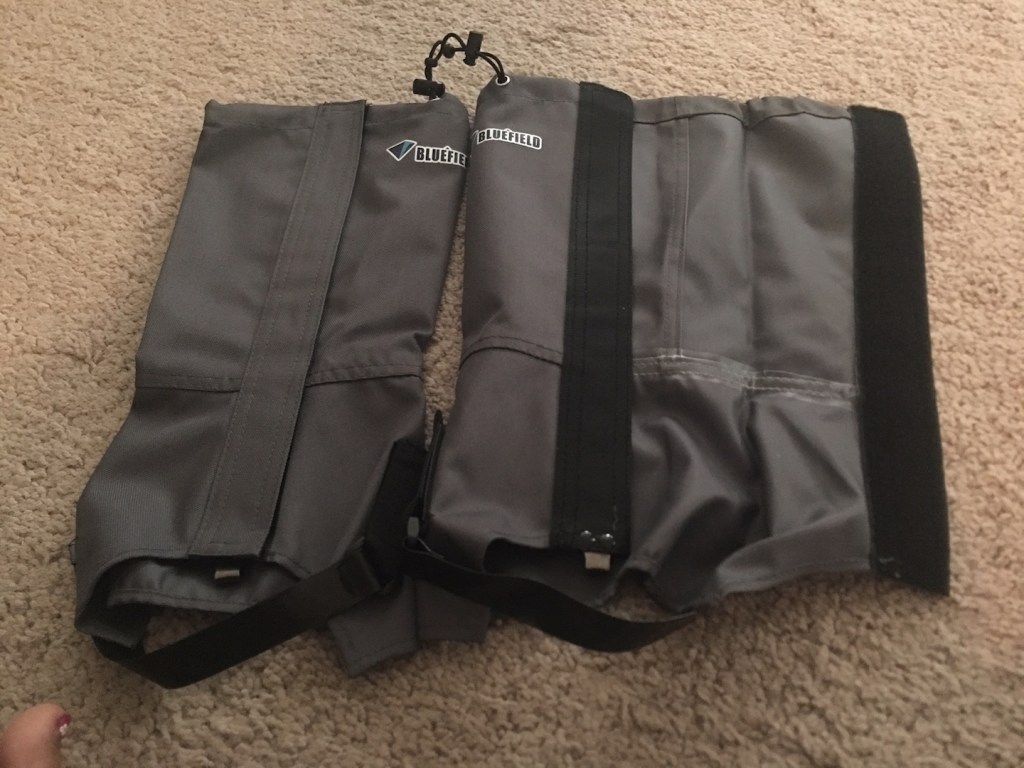
They provide water and optional footwear if needed. Everyone else wore the rubber boots that they provided. As a petite woman and having been on enough tours I was pretty certain they wouldn’t have my shoe size (I was right) so I went prepared. I wore my own (waterproof) hiking shoes and my gaiters which were perfect. I would have been slipping and sliding if I had worn my my Keens. And would have ruined my shoes in the mud if I had worn sneakers.
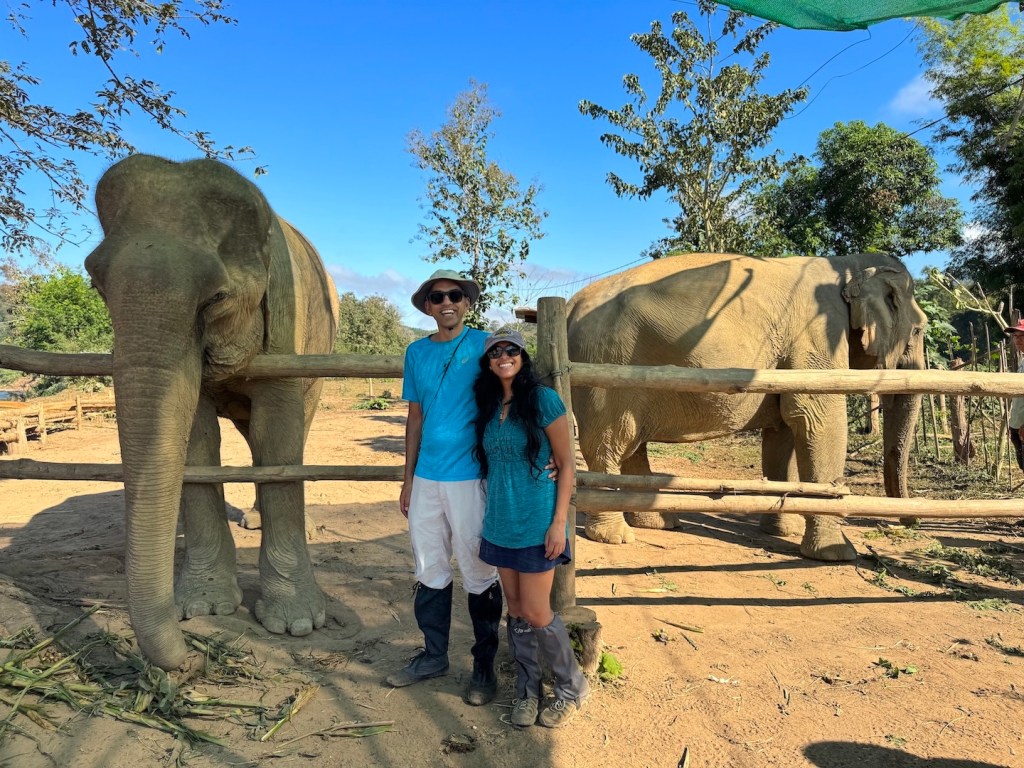
They have a nice, clean bathroom and sinks with soap to wash your hands. I took my DSLR as well as my phone. I was able to get close up shots of the eyes with the DSLR. The guides were really great about taking photos for party within the group.
The lunch was Laos cuisine and they accommodated our request for vegan food and we really enjoyed it.
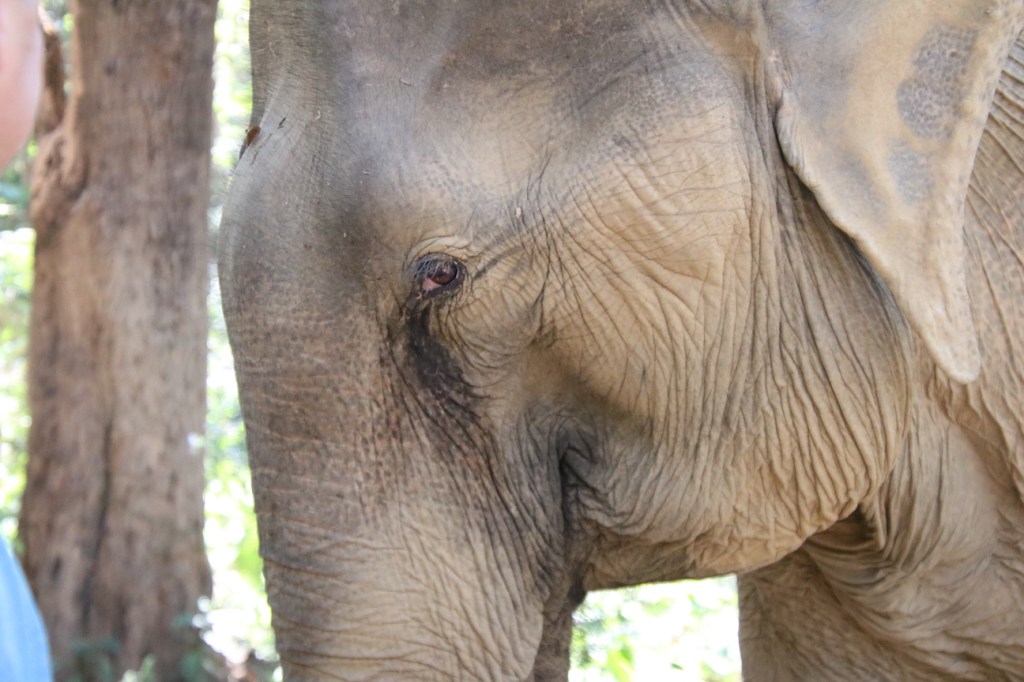
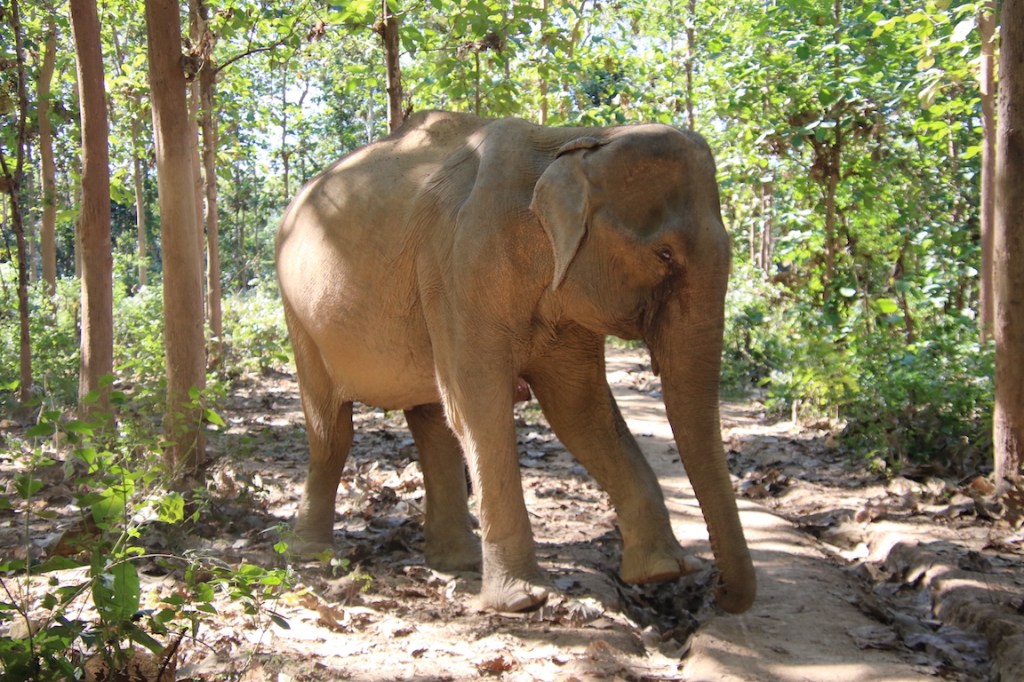
Things to Take To Mandalao Elephant Conservation
- Cash
- Good soled shoes
- Sunscreen
- Sunglasses
- Bug repellent
- Hand sanitizer
- Hat
- Camera
- Chapstick (it’s dry in the cool season/December)
Living Land Rice Experience
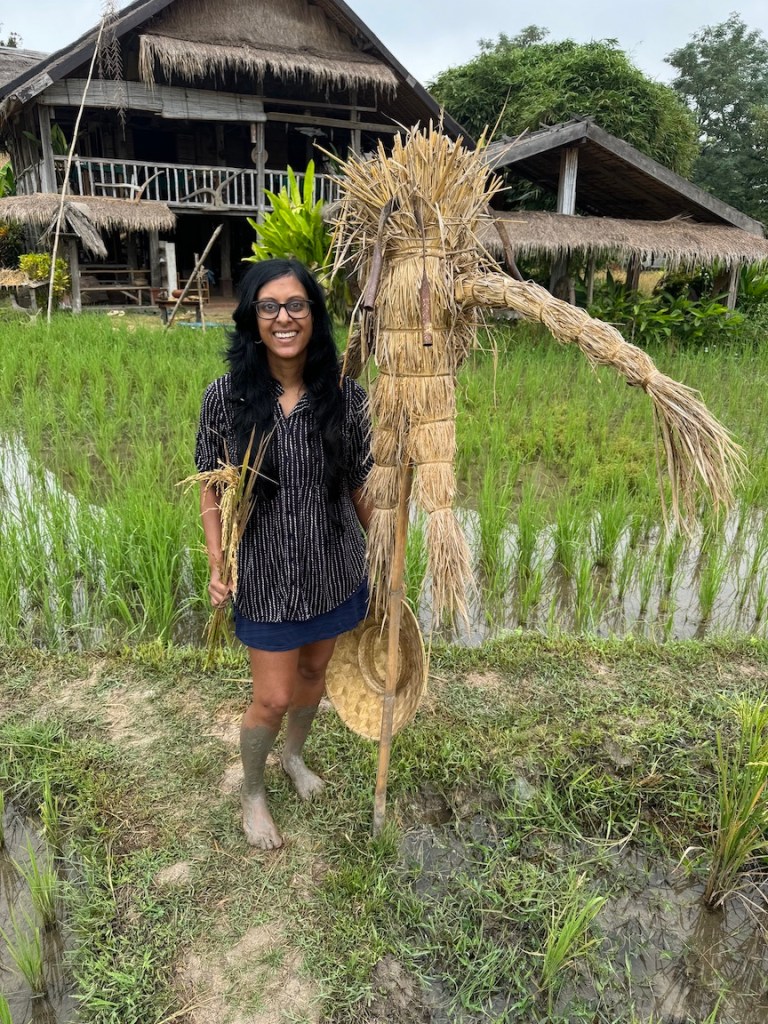
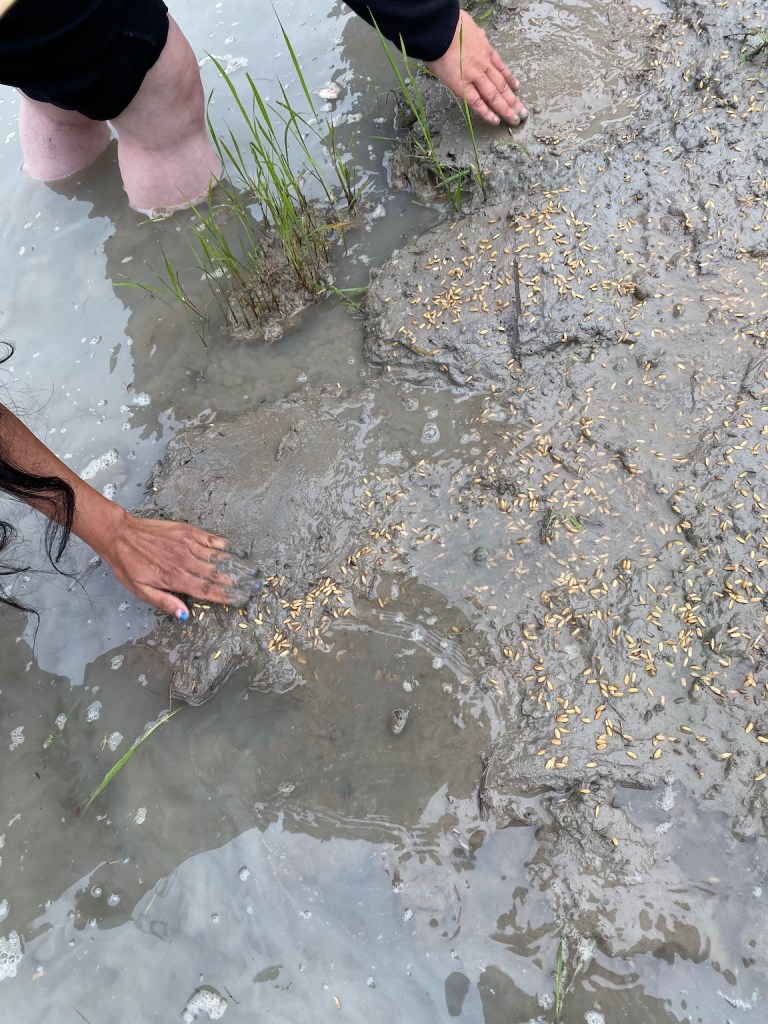
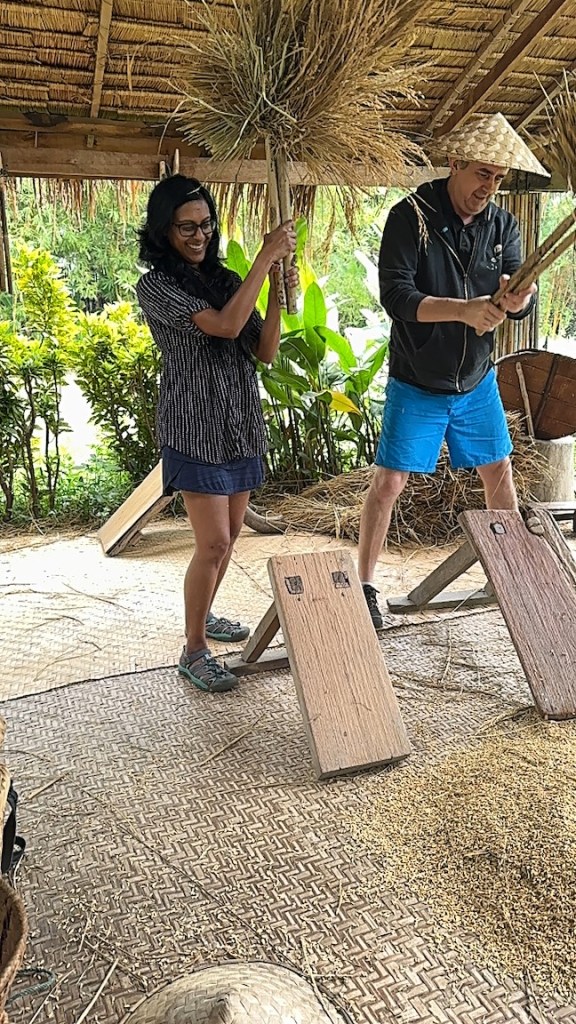
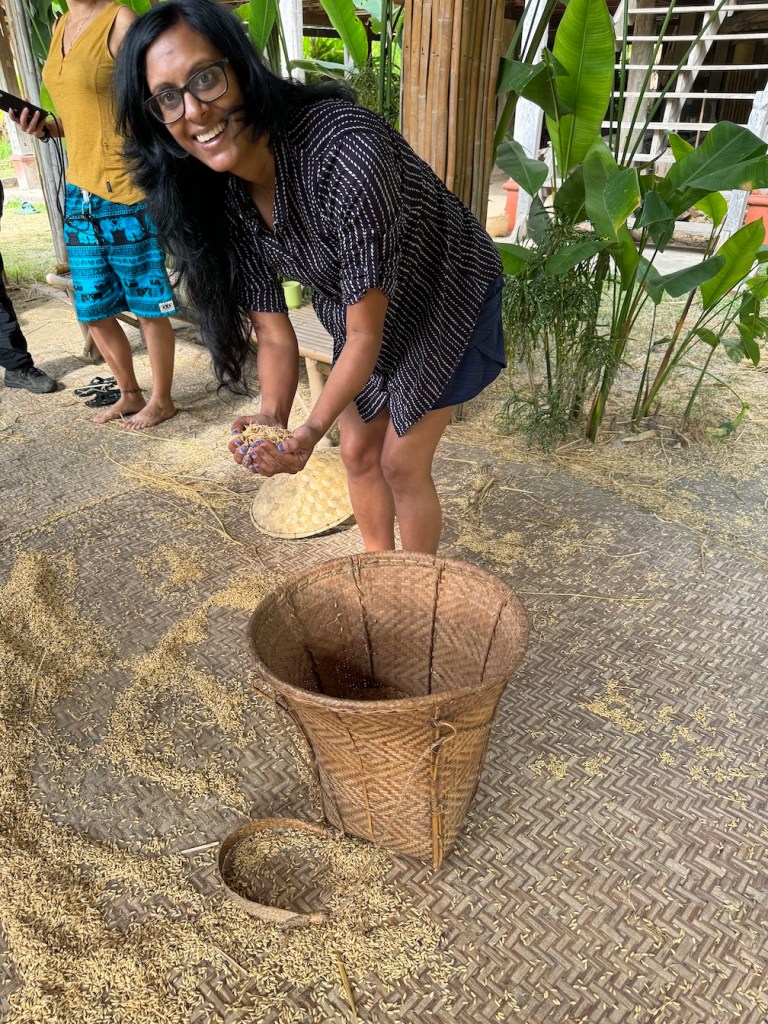
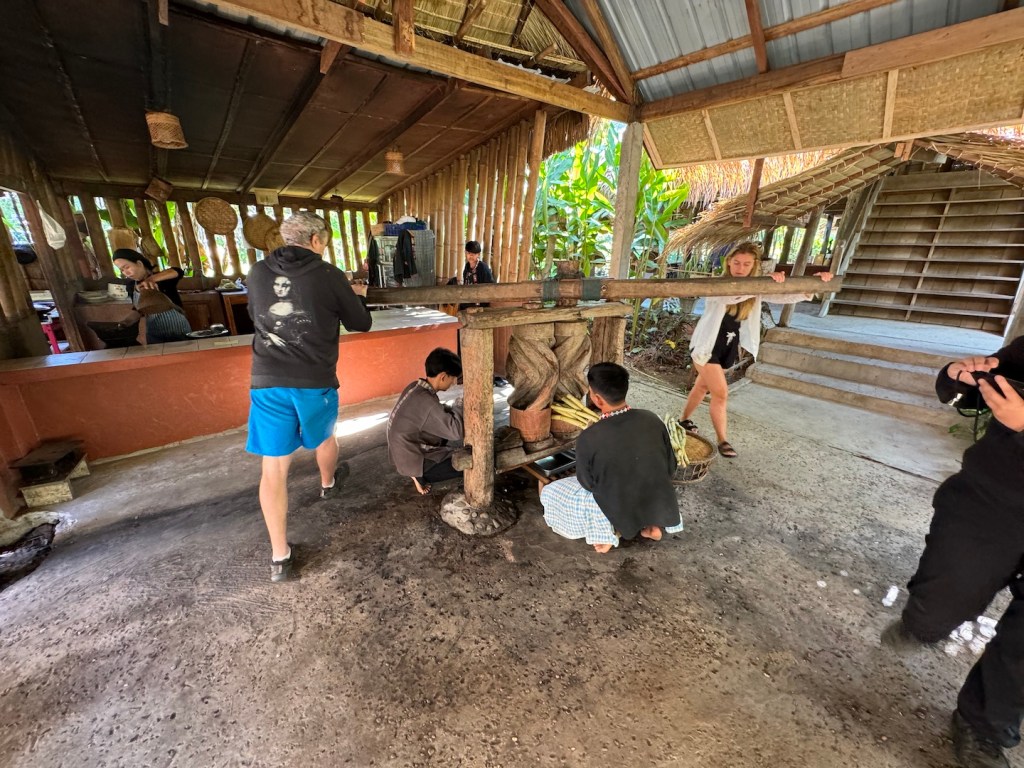
The Living Land Rice Experience is a half day excursion on the outskirts of Luang Prabang where you can learn about and engage in the process of planting and harvesting sticky rice. We really enjoyed this and highly recommend this as an activity in Luang Prabang, in addition to Kuang Si Waterfall, Tad Sae Waterfall, and Mandalao Elephant Sanctuary.
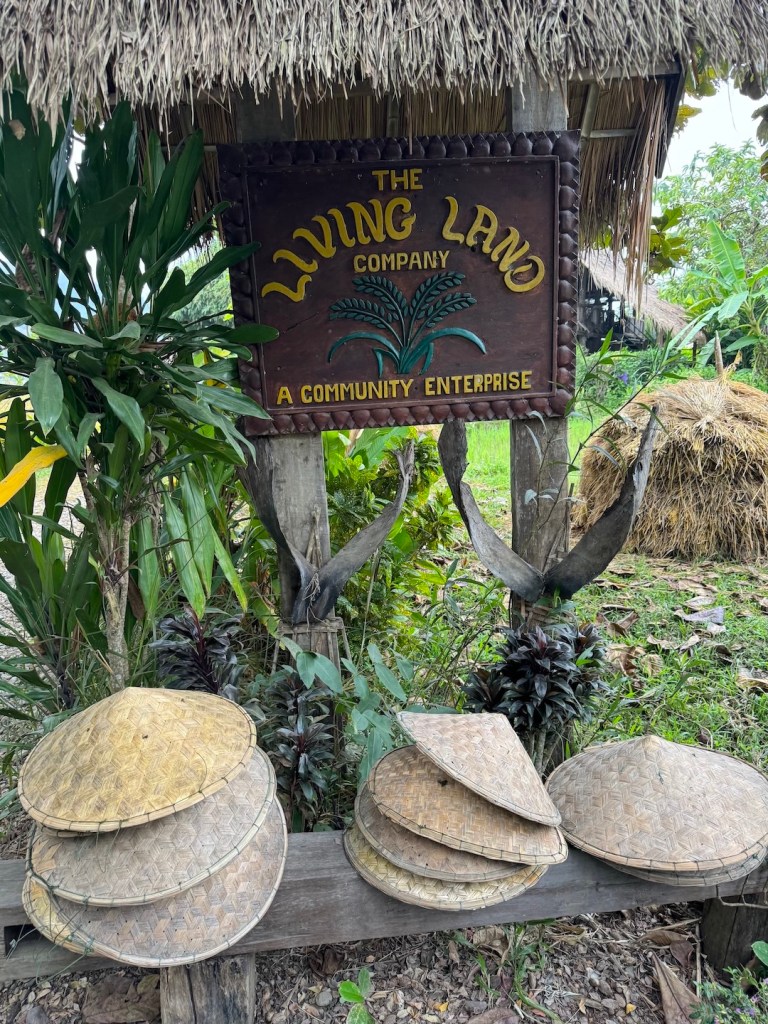

The process of planting and harvesting sticky rise is a fascinating and labor intense process. The farm itself is very pretty and there’s even a school where people, including tourists, volunteer time to teach English to local children.
When you book this excursion you can choose to have lunch afterwards or not. We did and it was delicious.
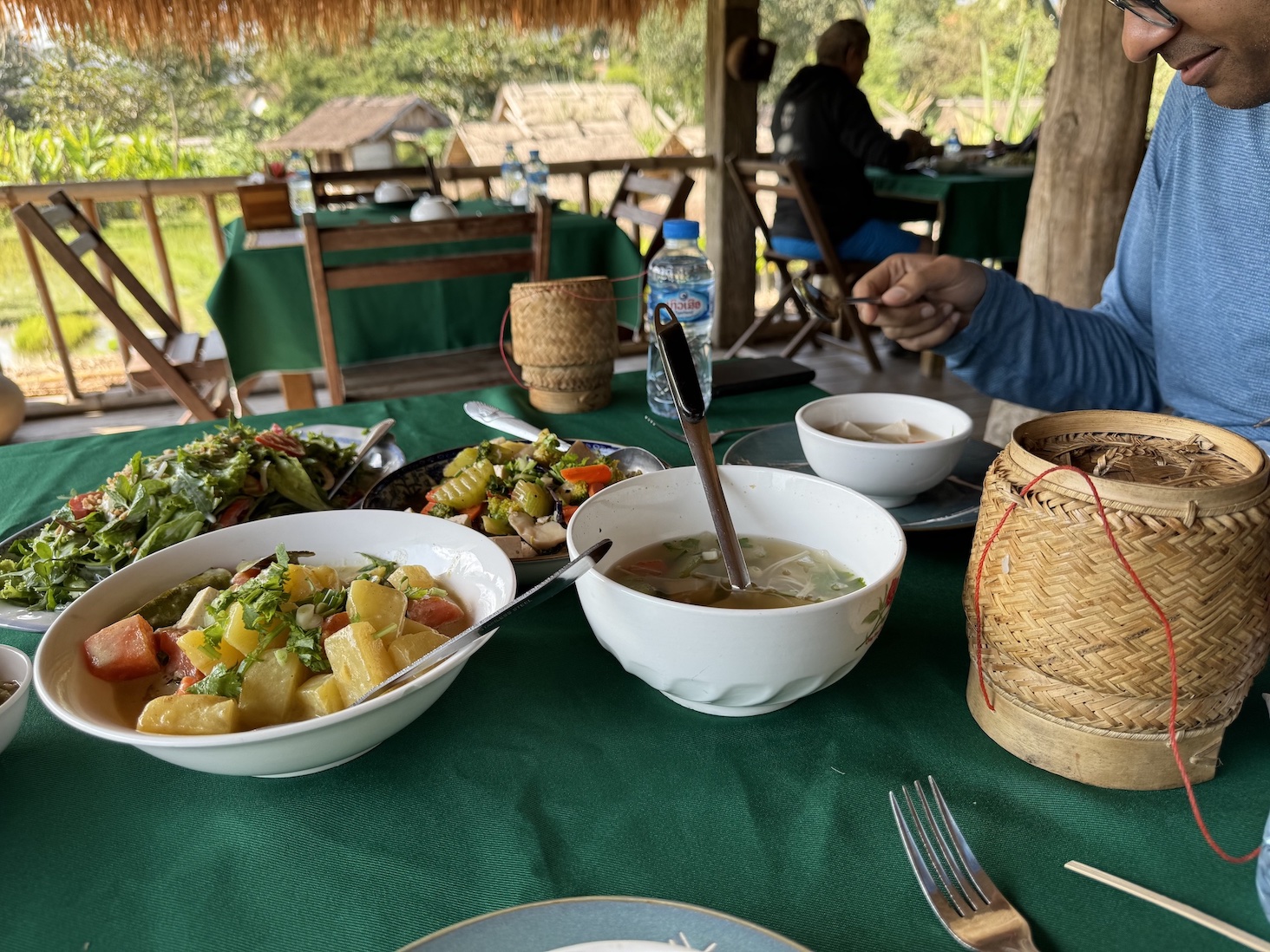
We got there by private car but you can easily hire a tuk tuk from town. It took us about 20 minutes to get there from the main city center.
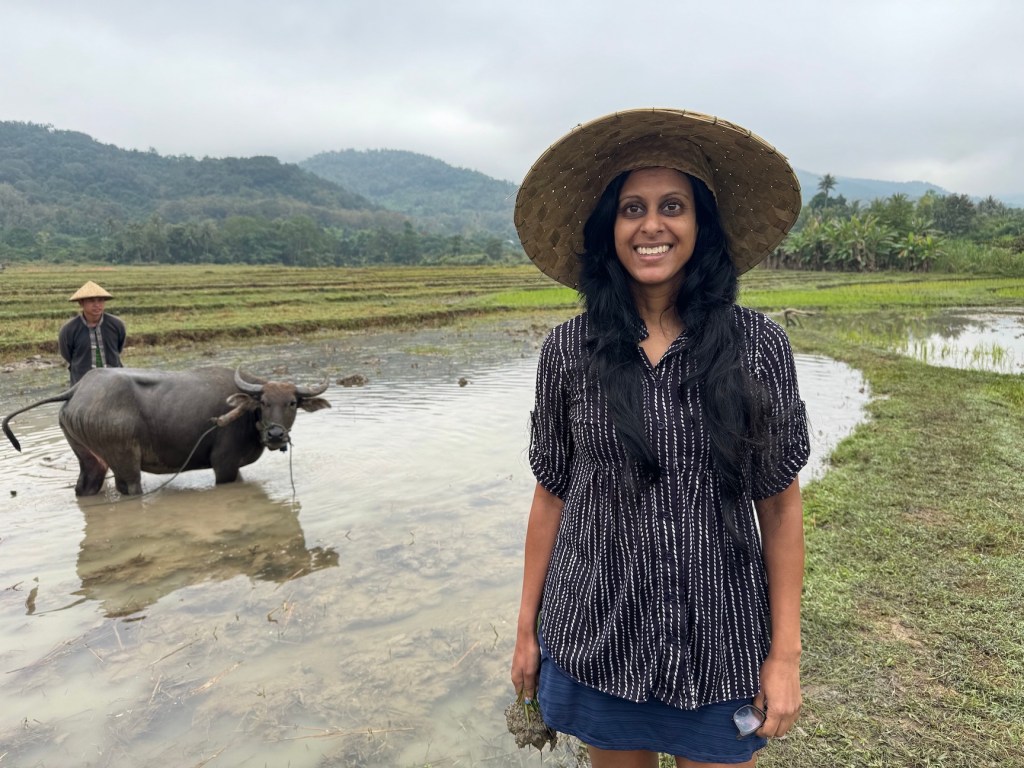
They welcome you and give you a koup, the iconic conical hat associated with agricultural work throughout southeast Asia. And they walked us through what we’d be doing throughout the day. The guides were relaxed and funny.


ProTips for Living Land Rice Experience
Wear shorts/something above the knee or pants that you can roll up easily as you will be going at least calf height into the mud.
In that same vein, wear a short sleeve, sleeveless or top where you can roll up your sleeves easily.
You’ll be bare foot for most of it. They will ask you to take your shoes off which will be better for you anyway.
You don’t need a dry bag – there are lockers where you can put your stuff.
We did the morning tour (mid December) and it was overcast and a little chilly, so maybe bring a light warm layer.
Take your phone and/or a camera that can be immersed in water. I would leave the DSLR/mirrorless behind and bring your action camera and/or phone. I only had my phone – no action camera.
They have an area for you to get cleaned up afterwards.
After our visit at Living Land we had a city tour planned where we were going to visit temples; and what I wore to Living Land was not appropriate temple-wear. I didn’t want to waste time going back to the hotel, since we were able to clean up at Living Land. There’s a nice restroom there where you can change your clothes. I packed my change of clothes in my daypack.
Pro Pro Tip: In my day pack I always have a few extra large plastic bags (like grocery bag size). These come in handy, for days like this where I had muddy/wet items that I needed to keep inside my daypack.
Giving of Alms
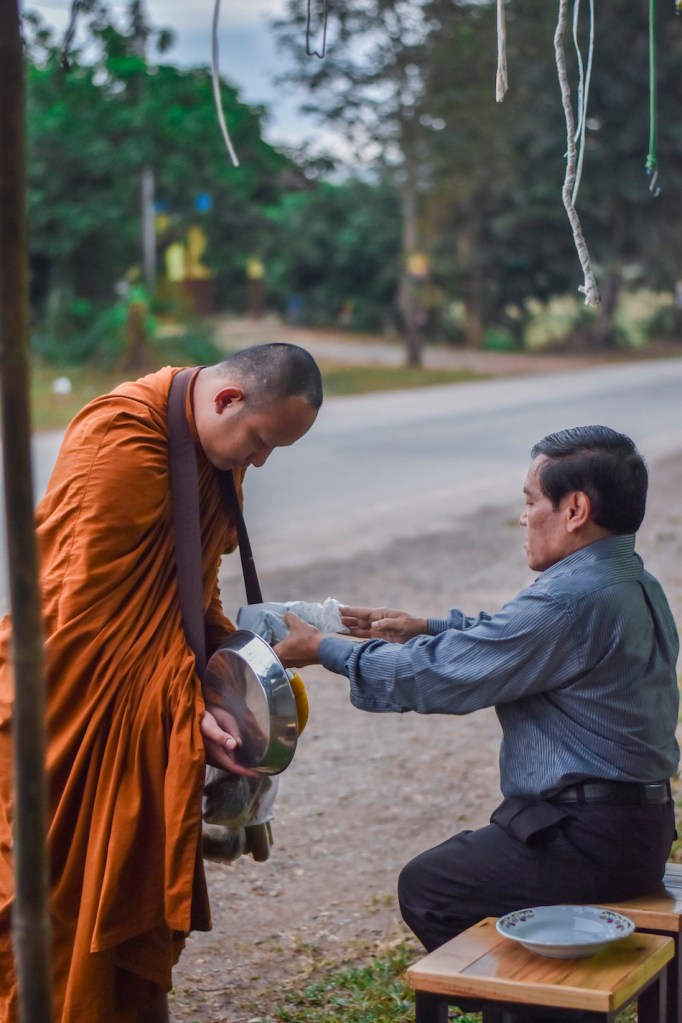
Be respectful and mindful during the daily giving of alms. Unfortunately, this important and also just regular part of daily life, has become a tourist spectacle in Luang Prabang. There are signs everywhere in the main area of Luang Prabang about how to participate respectfully. When I visit my family in India the monks come to our home to collect alms and never would I take a photo nor ask them for a selfie. It’s just a regular part of life.
We saw plenty of tourists participating in this. Most were respectful. We saw a couple of things that made us cringe. We opted not to participate.
Where to Stay in Luang Prabang
There are 3 main areas:
- Old Town
- Mekong River
- Nam Khan River
Stay in old town to be in the city center and walking distance to the temples, restaurants and cafes. This is great for 1st timers to Luang Prabang that want to be walking distance to attractions and restaurants. Stay on the Mekong Riverfront for views. It’s popular amongst backpackers for very budget-friendly hostels and guesthouses.
The Nam Khan Riverfront area was developed for tourists. There are loads of restaurants and cafes that serve Western food. It’s popular amongst backpackers so this is where to go if you’re seeking nightlife.
That said there are upscale resort style accommodations with river views. We wanted to be in the city center because we knew that after a day out exploring we’d enjoy going out to eat and and going for a walk. My husband and I are vegetarian so it made sense to be in the city center with easy access to the widest variety of restaurants and eateries as options for vegetarians and vegans are generally very limited in every southeast Asian country that we have visited. The good thing is that being vegetarian in Laos is akin to being vegan. There’s very little dairy in Laos cuisine.
There are Indian restaurants in Luang Prabang so that was a good option for vegetarian food. I have a whole section in this blog about being vegan or vegetarian in Laos and Cambodia. And I have a separate article called Vegetarian or Vegan in Vietnam as well.
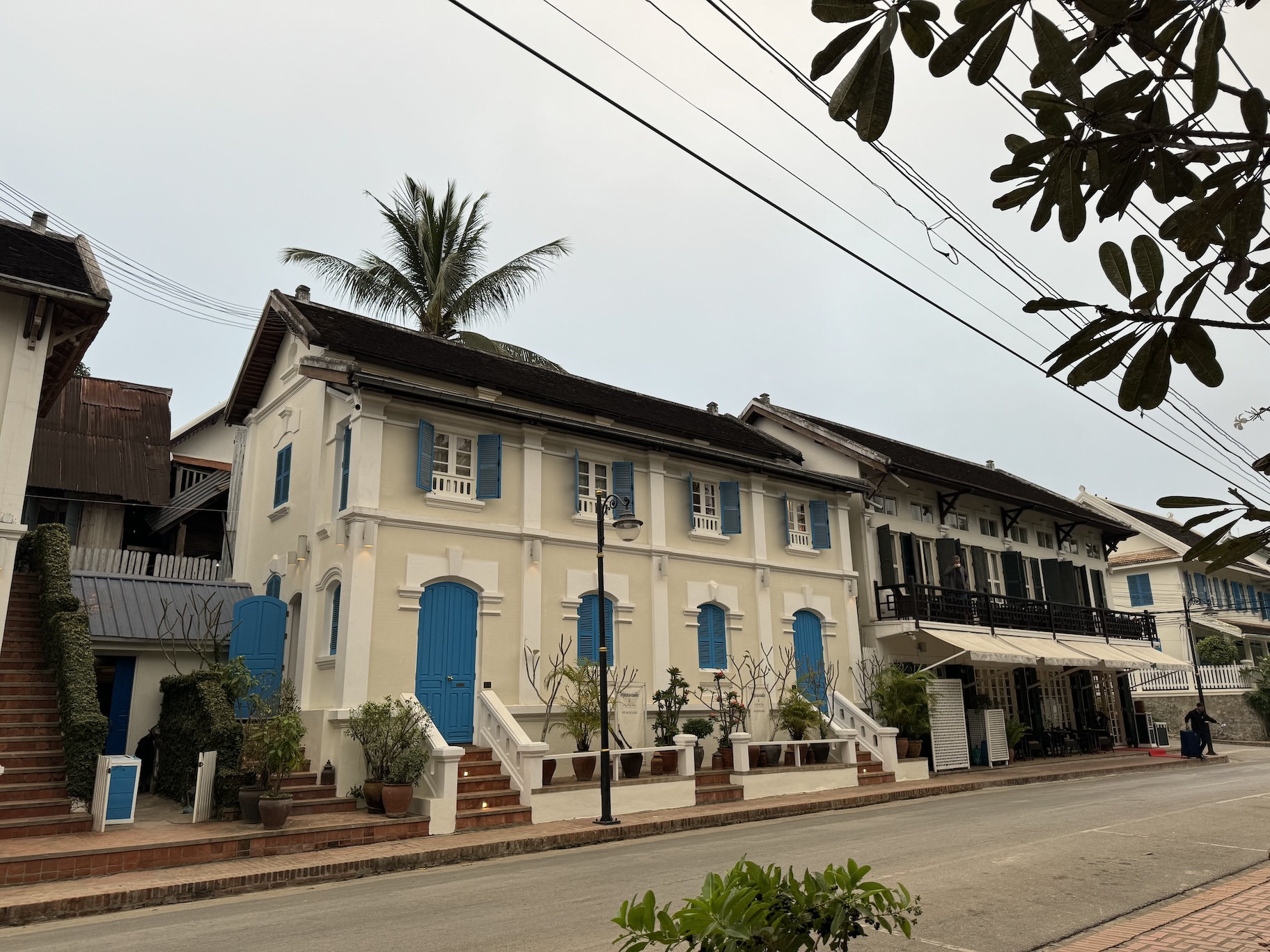
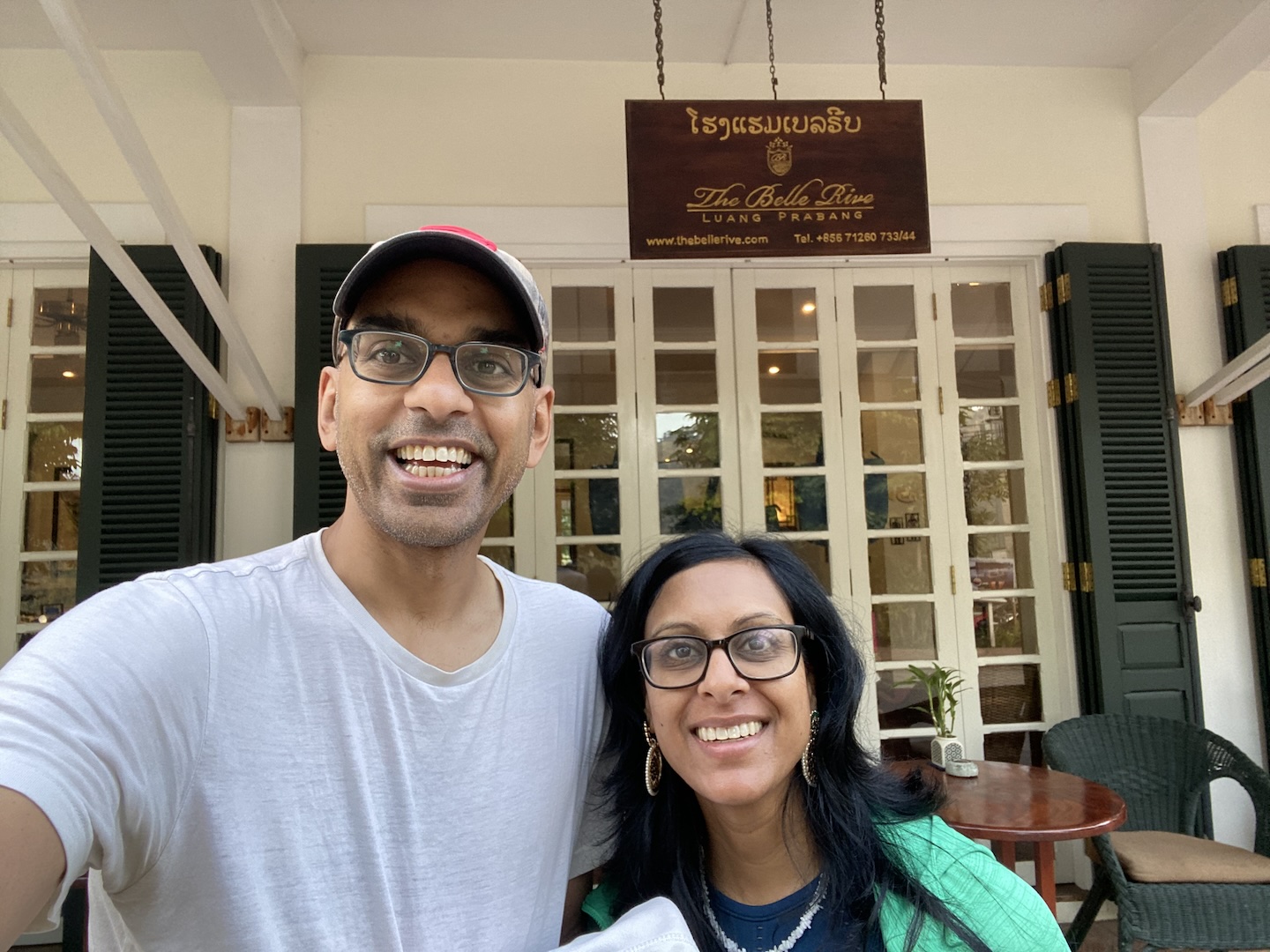
We stayed at the Belle Rive Hotel on the Mekong River. We had a fantastic experience. e stayed in the Deluxe Suite as well as the Superior Room With Balcony, during our stay and we liked all of them. Having a room with a balcony was worth it as we enjoyed relaxing out there in the evening.
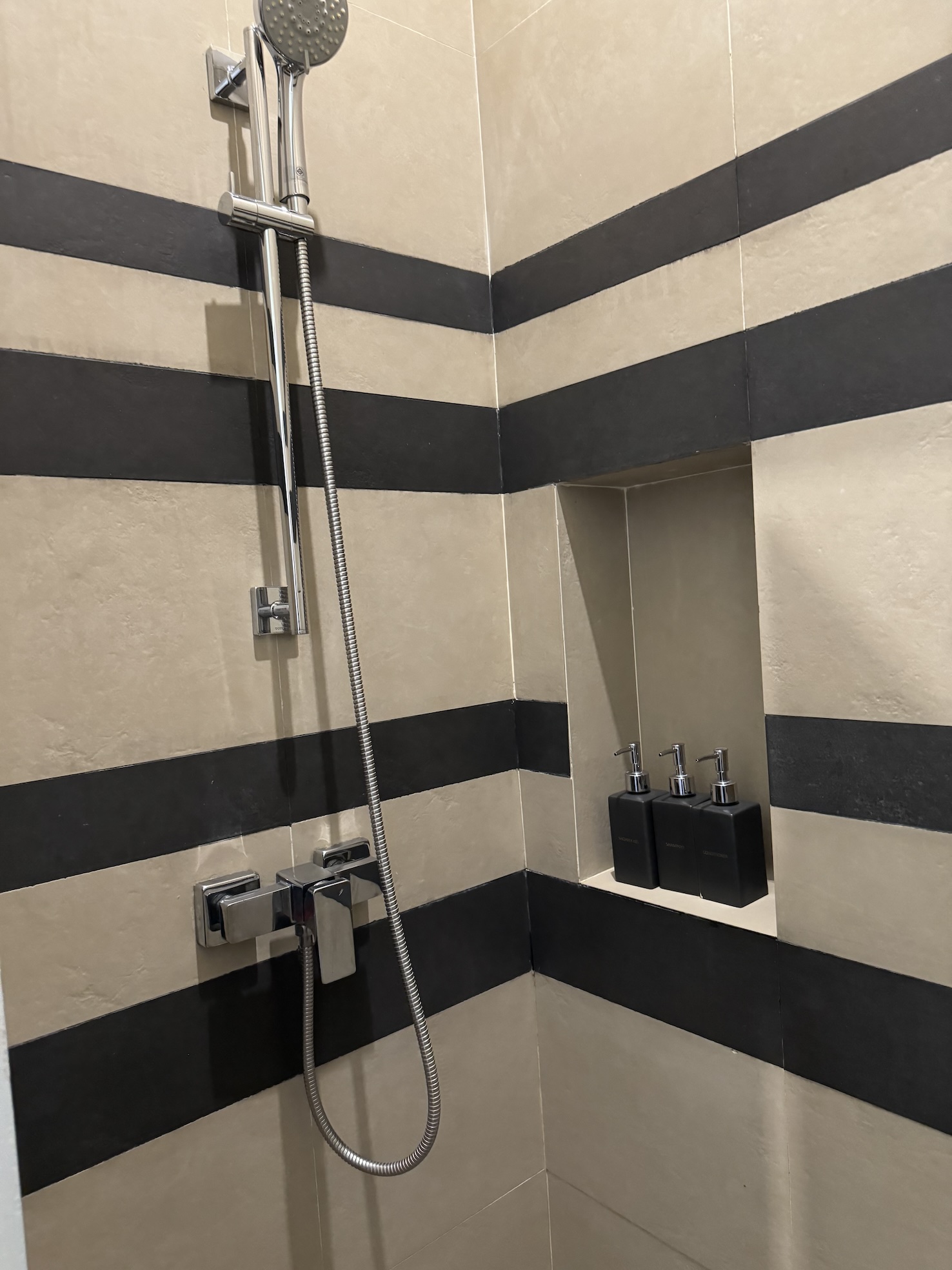
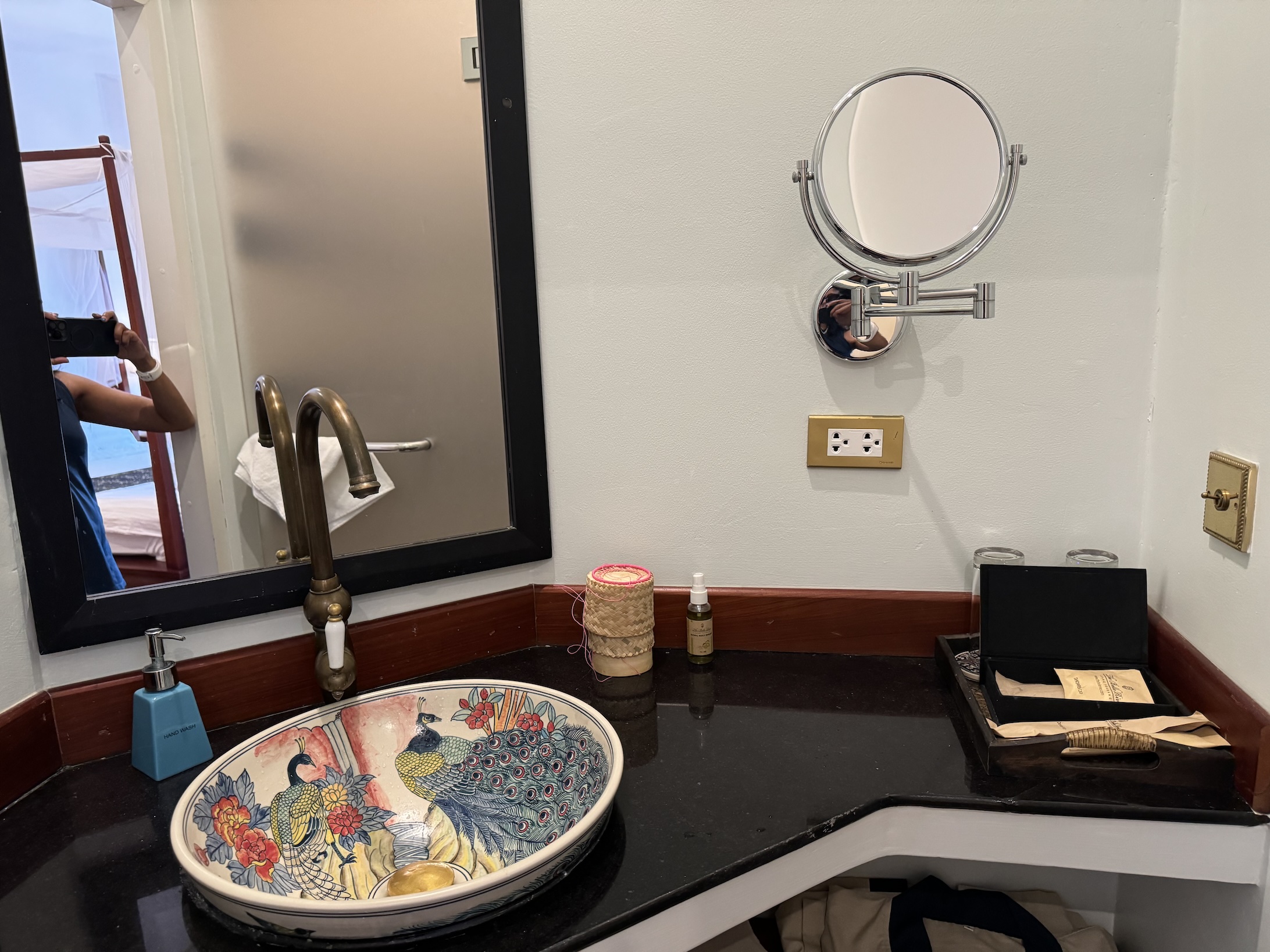
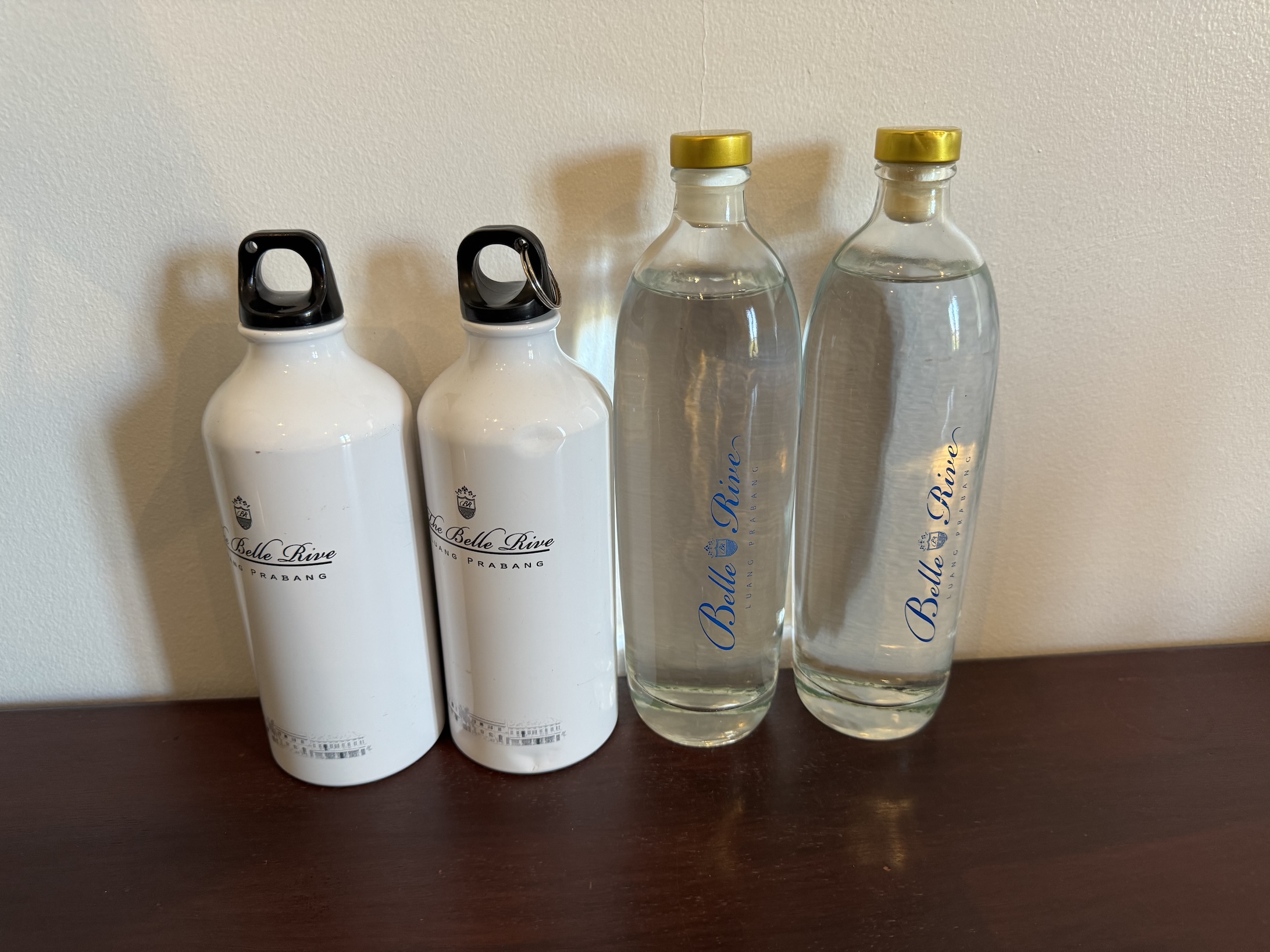
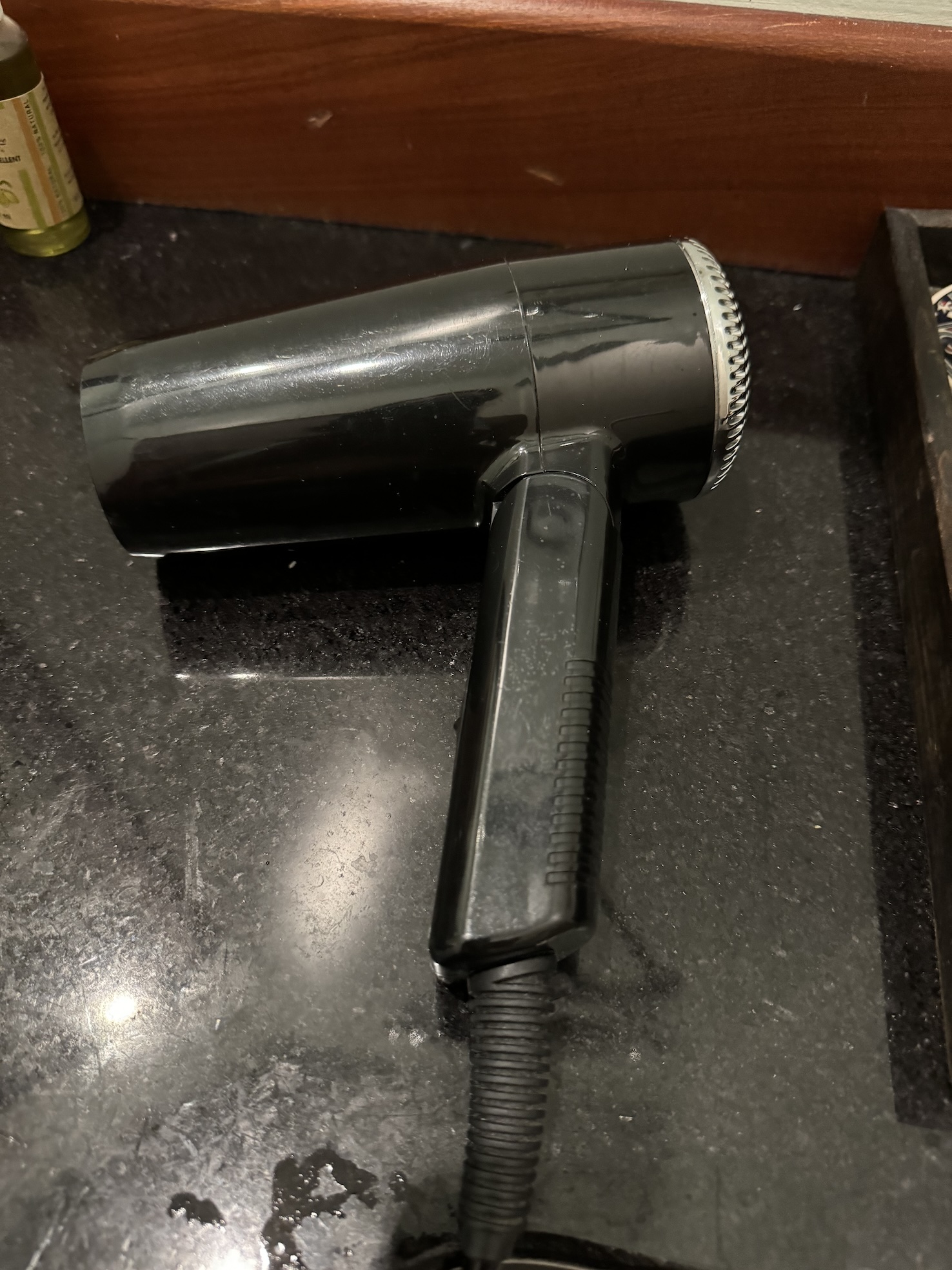
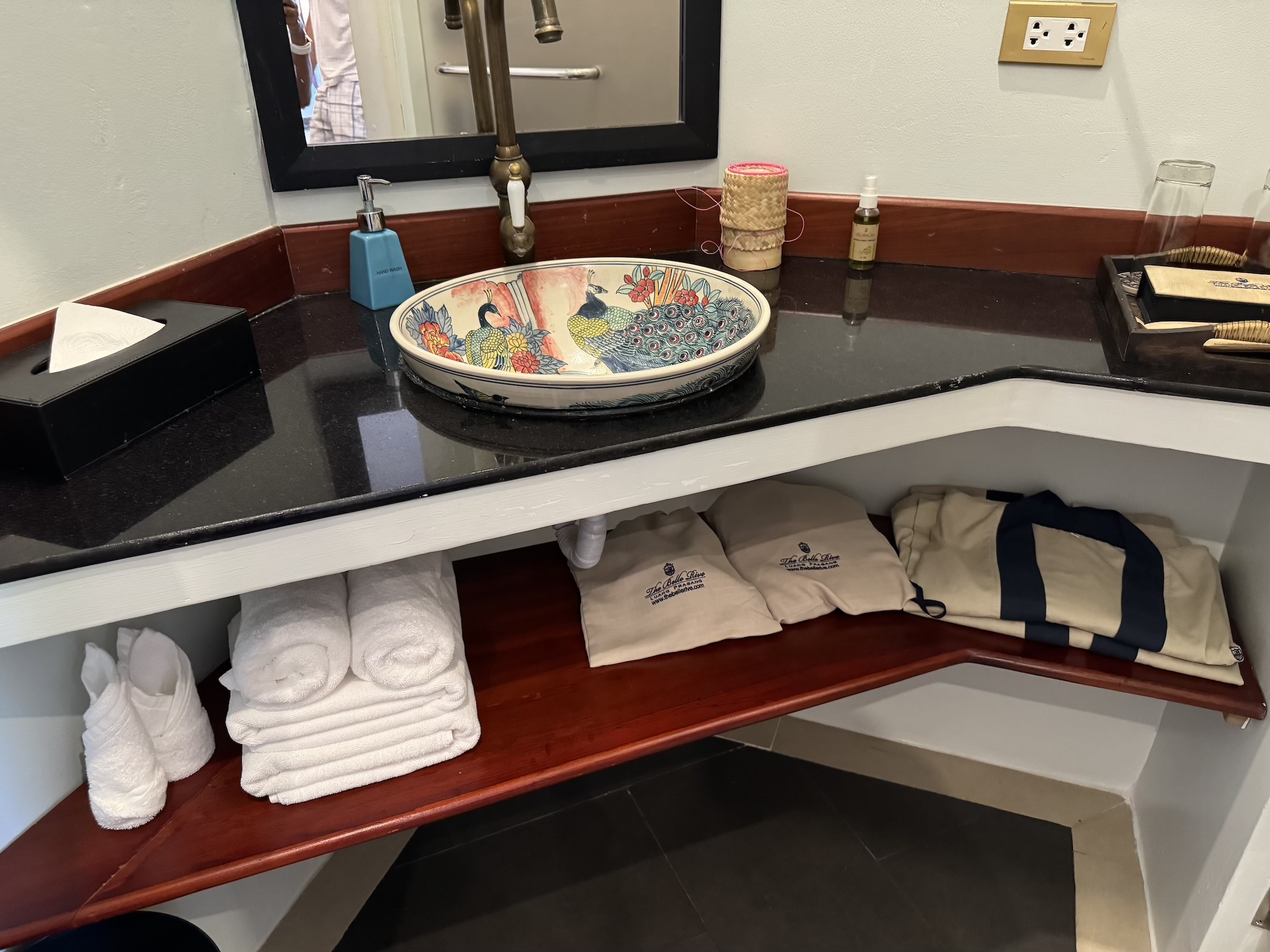
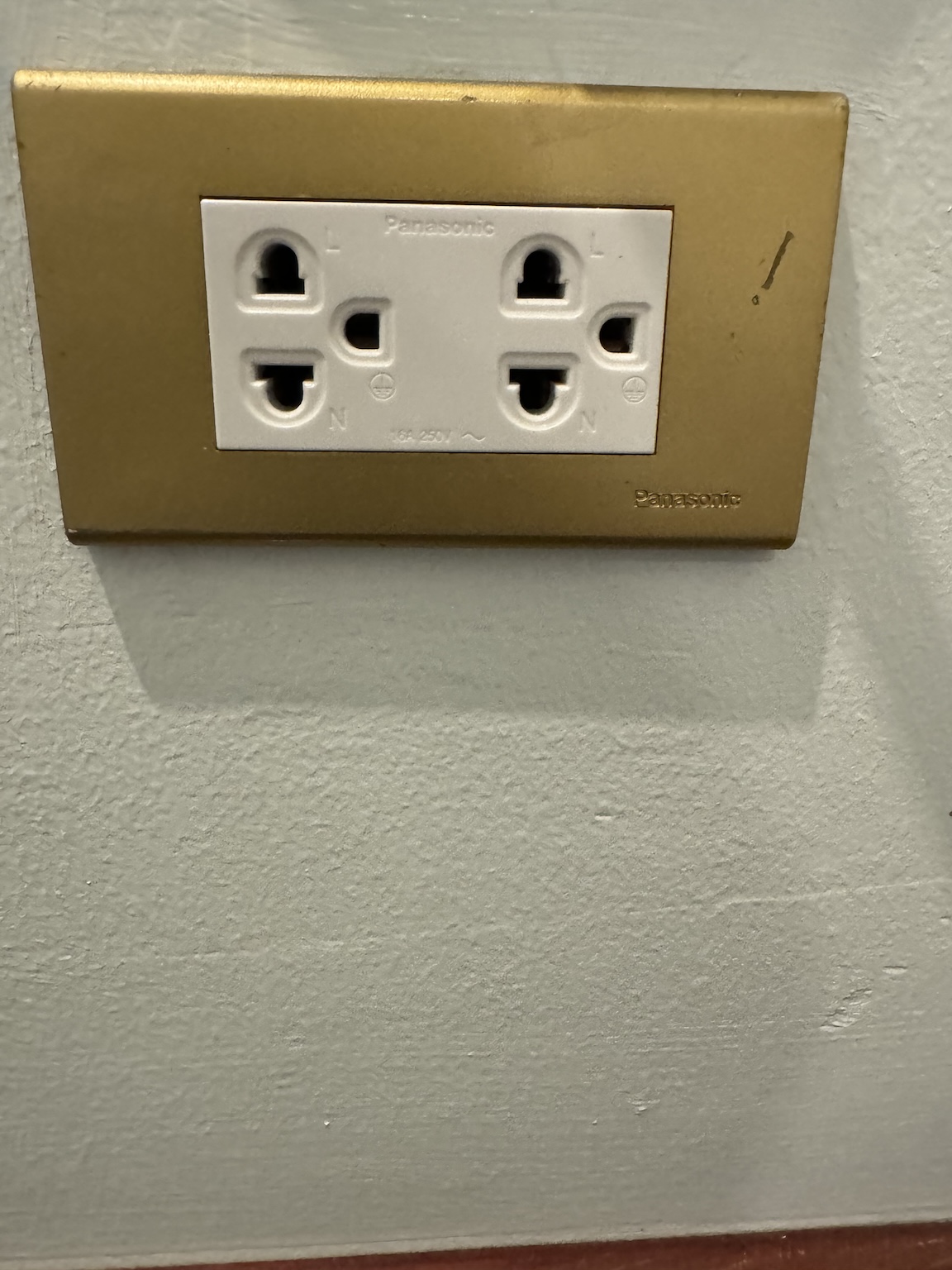
What was remarkable is how well thought out the rooms were from the quality hair dryer, the mosquito repellant, water bottles and water, plush towels, robes, shampoo, conditioner and shower gel, hooks to hang towels and clothes throughout the room as well as well placed electrical outlets and perhaps our favorite was the separate shower and separate toilet.

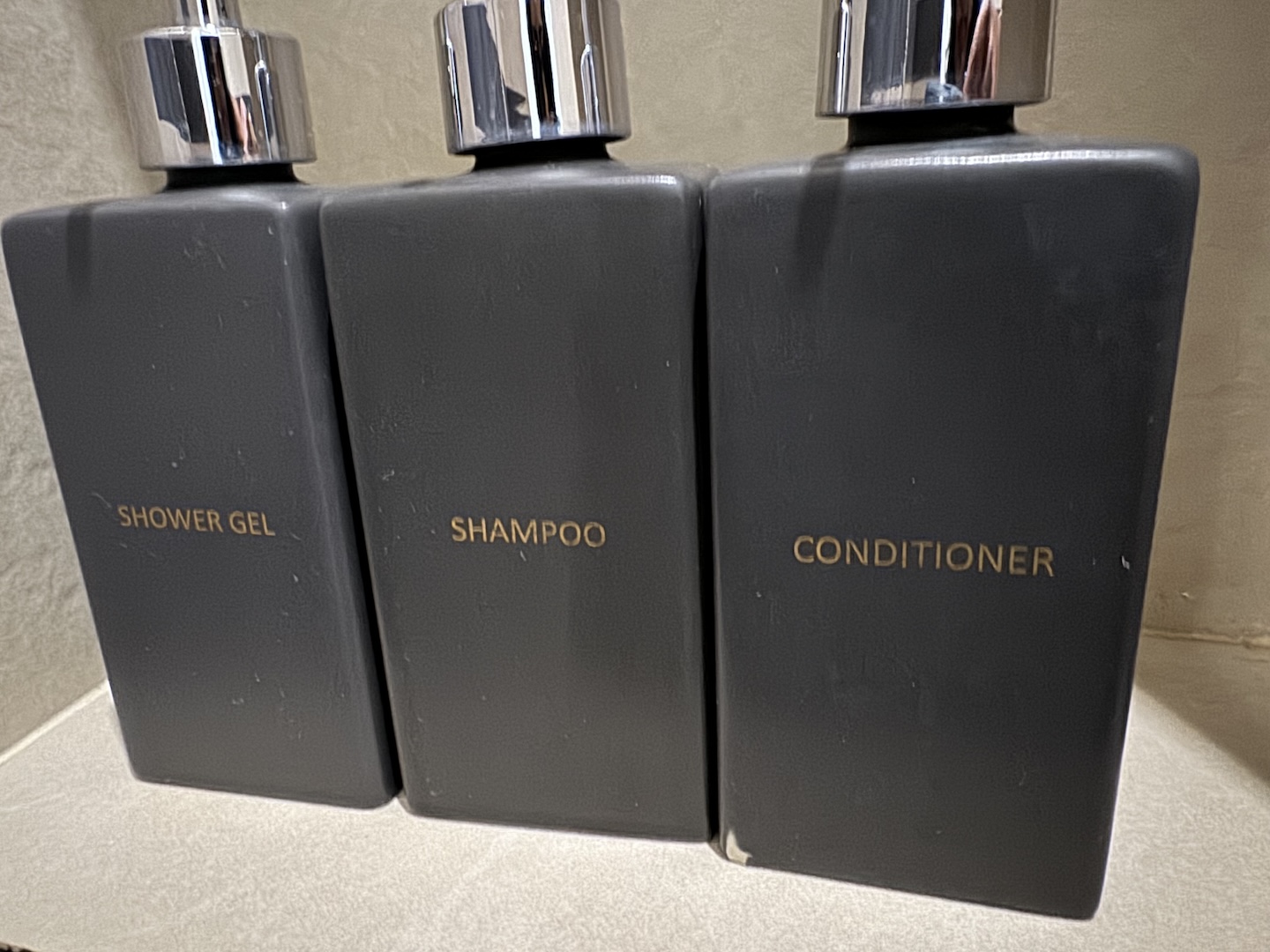
Nong Khiaw
Nong Khiaw is a little village on the banks of the Nam Ou River approximately 90 miles (3 hour drive) northwest of Luang Prabang.
The area is known for the scenery and hiking including the 100 waterfalls hike. This is a 1 day tour where you should expect to get wet for hours. You’ll be hiking in water so bring Keens or hiking shoes/boots.
After lunch, you’ll start the descent but along a different route so you’ll enjoy the different and beautiful views.
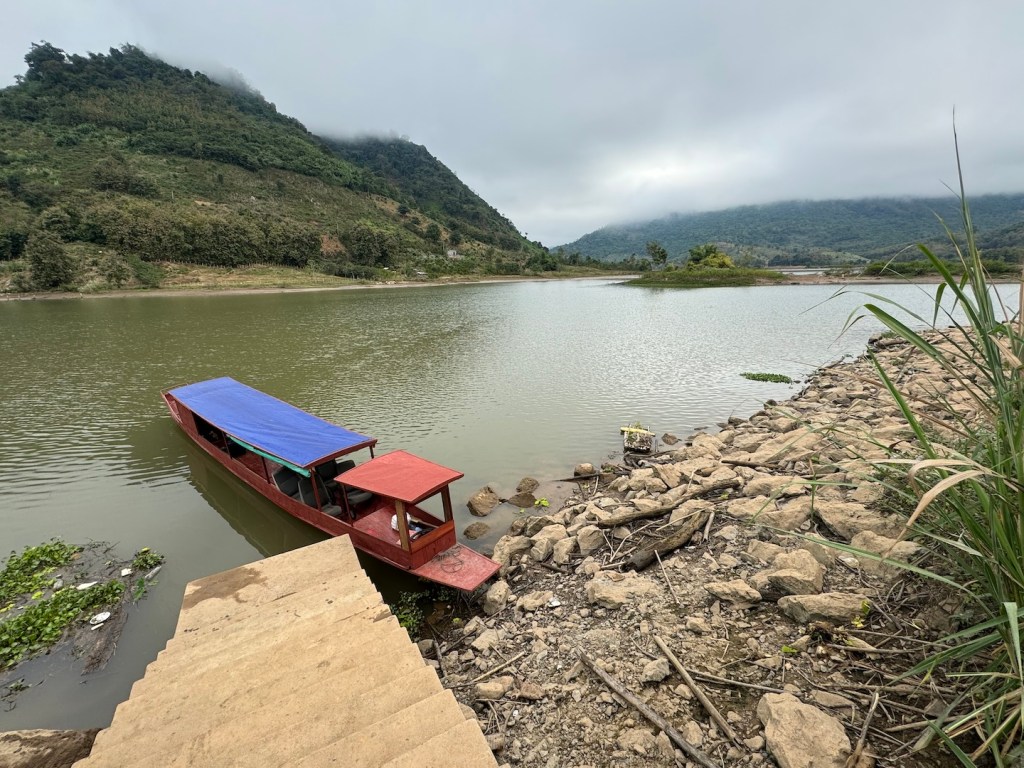
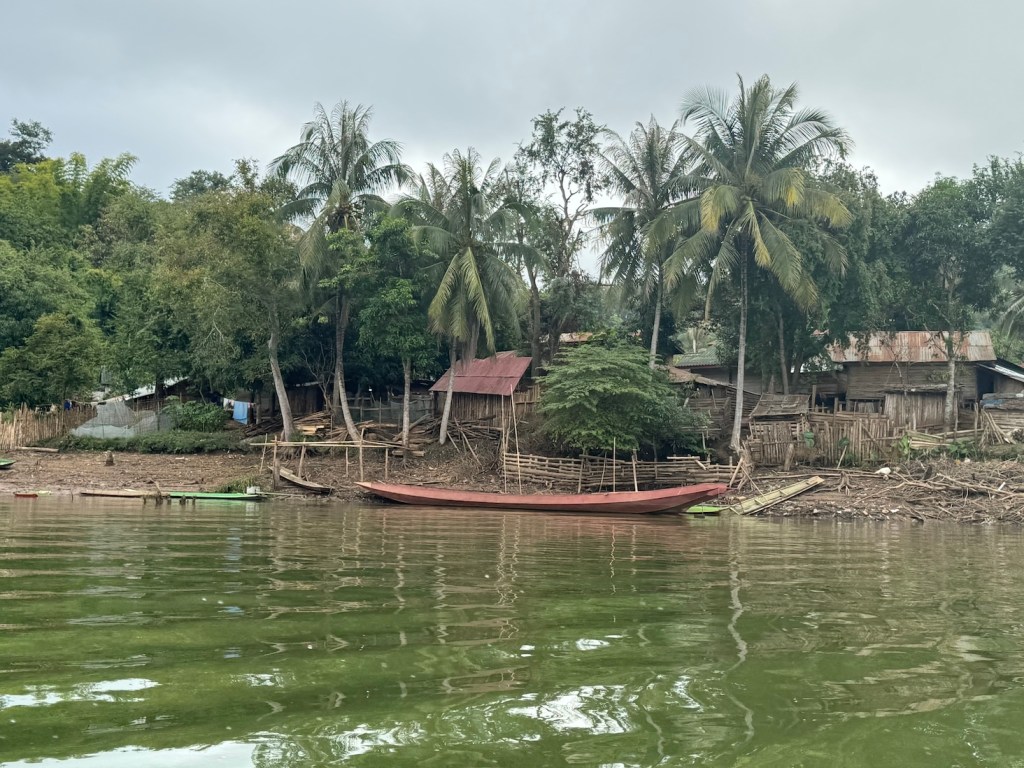
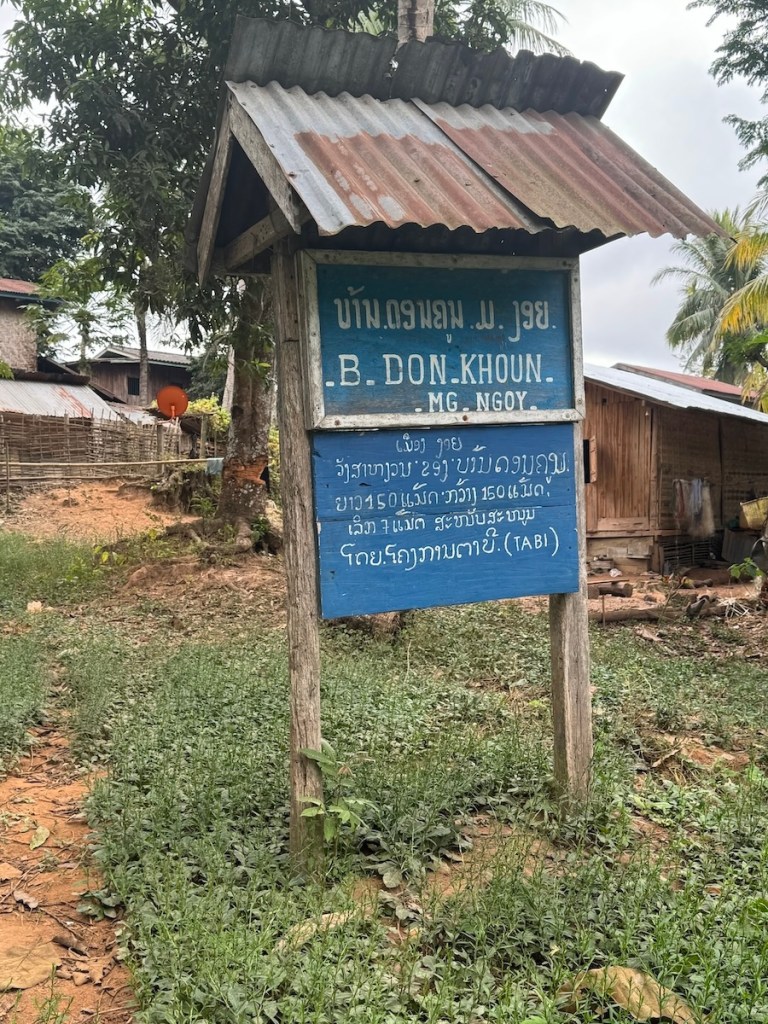
What To Take to Nong Khiaw
- Water
- Cash for tips
- Good soled shoes/hiking boots
- Sunscreen
- Bug repellent
- Toilet Paper
- Hand sanitizer
- Hat
- Sunglasses
- Camera
- Mosquito repellant
- Chapstick (it’s dry in December)
This article is a fantastic guide on Nong Khiaw.
Central Laos
Thakhek is a town and a nature lover’s paradise. Caving, hiking, swimming, and kayaking await. Thakhek loop is popular amongst bicyclists but can also be done by car. It can take 2-3 days and what you do is drive and along the way come across beautiful lagoons where you can swim, then you drive and come to some beautiful caves, or go ziplining with views of the jagged mountains surrounding you. Along the way there are backpackers hostels and places to stay. You can organize boat trips to see the lakes and rivers.
Kong Lor Caves
These are wet caves that stretches for more than 7.4km and you can view via canoe. It’s approximately a 5 hour drive, east from Vientiane. Most people visit as an overnight multi-day trip. After visiting the caves stroll through Kong Lor Village for a taste of local culture and visit the national park for other hiking and other outdoor activities.
Southern Laos
Wat Phou is a Buddhist temple today but has a Khmer Hindu history. Wat Phou is a Unesco World Heritage Site and considered an archaeological phenomenon as the temple is preserved in a mountain. Its name means mountain temple. Walk throughout the grounds and to other smaller temple sites that are now ruins, while enjoying the flowing Mekong River in the background.
Khone Phapheng Falls The Mekong River flows into a lake creating the largest waterfalls in the world in terms of volume and width. These falls are definitely off the beaten path. Few tourists visit as they are far from any cities and local transportation is pretty basic.
Pakse means mouth of the river and is considered the entry point to southern Laos. It’s a colonial town on a peninsula in between the Mekong and Xe Don Rivers. Its capital Champasak is the 2nd most popular destination in Laos. In the city you’ll find historic sites, a Vietnamese neighborhood, Buddhist and Chinese temples and a Catholic church. There’s a one or two day loop via vehicle called the Pakse Loop. It’s pretty popular with lots of things to do and see along the way such as beautiful waterfalls. However, keep in mind that the roads are not good. Along the way you will won’t find hotels, rather Homestays.
Things To See in and Near Pakse
It’s very popular to do the Bolaven Plateau/Pakse Loop, a 4 day itinerary via motorbike that starts in Pakse. You don’t have to do this. For example motorbiking is not our thing. There are 3 waterfalls that can be done as a day trip from Pakse as well as Wat Phou – see details about those 3 waterfalls and Wat Phou below.
Tad Yuang Waterfall is the most popular waterfall in the area as such there are restaurants, bars and stores at the entrance. It’s approximately a 45 minute drive east of Pakse and costs approximately $2USD per person to get in and there are narrow (slippery!) steps lead to the edge of the water. There are picnic grounds at the top of the falls. There are several concrete stair cases to walk down to get to the falls. It’s beautiful, even in the dry season. You can go all the way down to pool and climb the rocks and get in the water.
One of the most unique aspects of this waterfall is you can go right up to the drop and peak over the cliff! Not something you can do at a lot of waterfalls.
Tad Fane Waterfall plummets almost 400 feet (120m). You enter via a resort so that may be why it costs more. You can zipline (approximately $50USD) above the canopy which takes about 2 hours. You can’t get close to the waterfall like Tad Yuang – hence the zipline. This video (from 7:15-7:40) gives you a great sense of what the experience is like. Approximately $4USD per person to visit the falls only.
Also, I highly recommend subscribing to Paddy Doyle’s channel. His videos about his travels are authentic, detailed and the footage is incredible. By the way, I have no affiliation with the Paddy Doyle channel, nor him. His videos were helpful when I planned our trip to Vietnam and I find most of his videos enjoyable.
Tad Champi Waterfall where you can walk along the bridges over the water and swim in the pool. There are two ways to get down to the pool: the easy way (walking) or the “be careful” way – steep stairs. (approximately $1USD per person). Tad Champi is very close to Tad Yuang Waterfall, about a 6 minute drive. It’s also called the Cave Waterfall because there’s a cave under it.
Be advised, this tourist area seems to have been neglected or forgotten about during COVID if you watch these two videos: this one from February 2020 (from 3:06) vs. November 2022 (starting from 8:57-10:15), the Champi Waterfall area is unrecognizable. BUT the waterfall is still really beautiful!
Wat Phu (or Phou) was built by the Khmer Empire in the 5th century, 200 years before Angkor Wat was built. It was originally built as a Hindu Temple dedicated to Lord Shiv. When Buddhism replaced Hinduism in the region, the structure was altered and most of the structures standing today are from the 11th to 13th centuries. (approximately $5USD per person).
One thing travelers love about this temple is that there are not pushy vendors selling their wares – rather happy local that will happily sell you goods but won’t be pushy about it.
Tad Ltou Waterfall there are stairs that lead down closer to the Falls.
Khone Phapheng Waterfall is the largest waterfall (by volume) in southeast Asia. It’s just a 15 minute walk to the viewing platform and is often referred to as the Niagara Falls of Asia. The View Restaurant has excellent reviews and even has vegetarian options.
Tad Hang Waterfall is a multitiered waterfall on the Salavan Province approximately 2 hour drive northeast from Pakse.
Vat Phou Salao roughly translates to Mountain of Wasted Whiskey. It is hard to miss as it’s the large Golden Buddha overlooking the city from the Mekong River and houses over 1200 golden Buddha statues. The legend behind this temple is long ago there were two kings who arranged for their respective son and daughter to get married when they grew up. When the time came, the young prince was saddened to learn that the princess had fallen in love with someone else. On his journey back home he and his troops stopped on this hill to drink their sorrows away – the whiskey they had intended to enjoy as part of the marriage celebration.
Si Phon Don also known as 4000 islands is very close to the border with Cambodia and just a little south of Pakse. These are many, mostly, small uninhabited islands in the Mekong River Delta. For those seeking adventure and waterfalls this is a great place to visit. The biggest islands are Don Det and Don Khon. And these two are where you’ll find tourist accommodations and activities. There are incredible waterfalls and a laid back lifestyle.
It was famous for the Irawaddy Dolphins that lived in the Mekong River. However, in 2022 very sadly they went extinct.
Don Det vs. Don Khon Islands
What’s the difference between the two islands? How do you decide which to visit if you can only go to one?
Don Det is more popular amongst backpackers with restaurants and bars.
Somphamit Falls (aka Li Phi Falls) are on Don Khon and the locals believe that the rapids are a a trap to ensnare bad spirits from washing down the river. This is a fun area to explore with lots of paths leading to the water’s edge. During the dry season a white sandy beach appears. Locals don’t like it due to the superstitions of the bad spirits so it’s more popular amongst tourists.
Bolaven Plateau features coffee estates, over 300 species of birds including the Hornbill, home to leopards, tigers, elephants, and monkeys and some of the most magnificent waterfalls in southeast Asia. The climate is generally colder here as its 1000-1350m above sea level.
Visiting a coffee plantation is a popular activity.
Cambodia
Cambodia is a tropical, Buddhist (Theravada) country just a little above the equator and known for Angkor Wat and beautiful beaches. While Angkor Wat is fantastic there is more to the country. It’s one of only 3 places in the world to see Irrawaddy dolphins (sadly they became extinct in Laos in 2022), some excellent birding, scenic hiking, and beaches (but being real the snorkeling isn’t anything to write home about), and elephant sanctuaries.
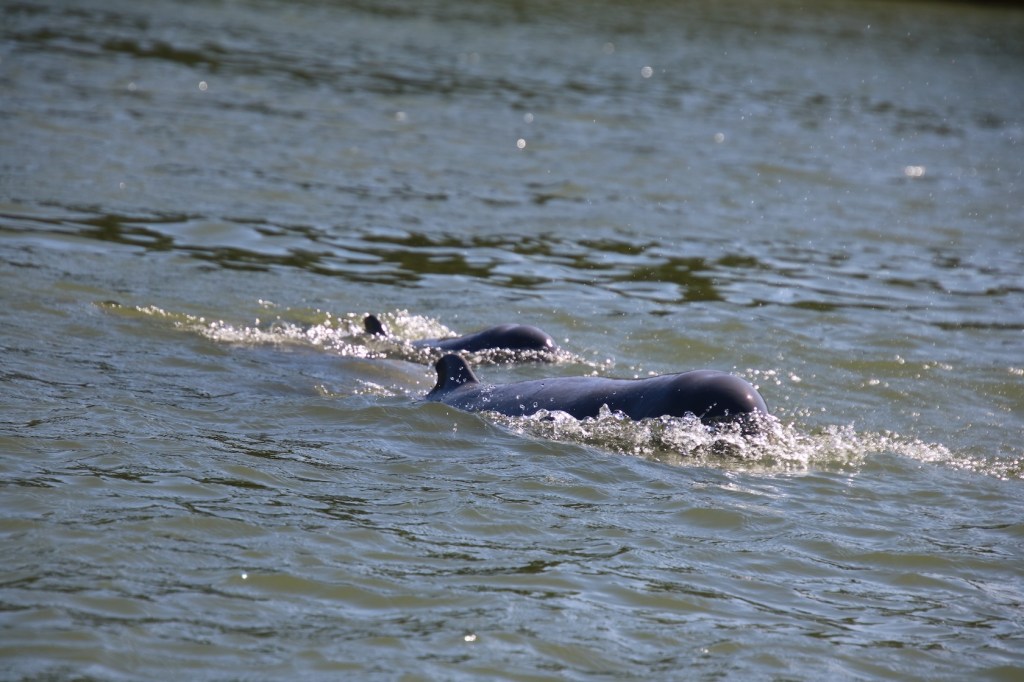
Cambodia is a small country – roughly a little bigger than the state of Missouri. The population is about 16.59 million. Cambodian people and the Cambodian language are called Khmer (pronounced kh-my). The currency is the Riel. But the Cambodian Riel is hard pegged to the USD at 4000 Riels. US dollars are widely accepted throughout Seim Reap and most prices and signs are in USD.
The capital city is Phnom Penh, pronounced “nom pen”.
Weather in Cambodia
Cambodia has two seasons: dry and wet. The cool and dry season is from November thru March and the rainy, warm season is from April thru October. ProTip for the Ladies: From November thru March pack leave-in conditioner or hair serum to give your locks extra moisture during the dry season. From April thru October pack humidity serum (and a good poncho) for the rainy season.
The hottest months are March, April and May. The coolest months are December and January, but it’s still 60-85 degrees during that time. Cambodia is a tropical country that lies just above the equator, thus it’s warm year round.
Should You Go To Cambodia?
For us, Angkor Wat, alone, made it worthwhile to visit Cambodia. In addition to Angkor Wat, the opportunity to see the endangered Irrawaddy dolphins made Cambodia very appealing. There are really nice home stays along the countryside that are remote and truly give you the feeling of escaping the hustle and bustle of everyday life. We stopped at one for lunch on the way back to Siem Reap after a day trip and if we had, had the time I would have enjoyed staying for a night or two.
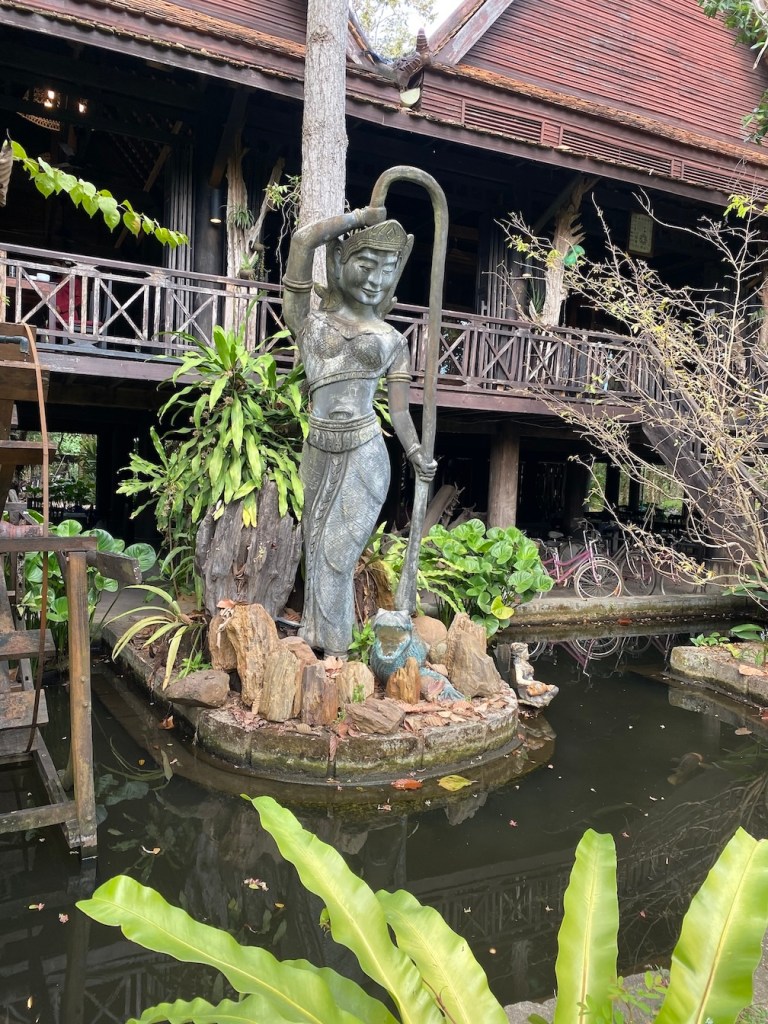
Cambodia has lots of beautiful national parks and waterfalls, scenic hikes, cool caves, temples and beaches, but to be very honest, you can find those things in neighboring countries.
For me, one thing that made Cambodia stand out from all of its neighbors and that I thought was SUPER cool was the influence of Hinduism in that country. In Hindi we call it Samudr Manthan, in English it’s called the Churning of the Ocean which is an ancient event from Hindu mythology which has great significance to the overall well being of mankind. That story was depicted throughout the country – from Angkor Wat to our hotel’s pool.
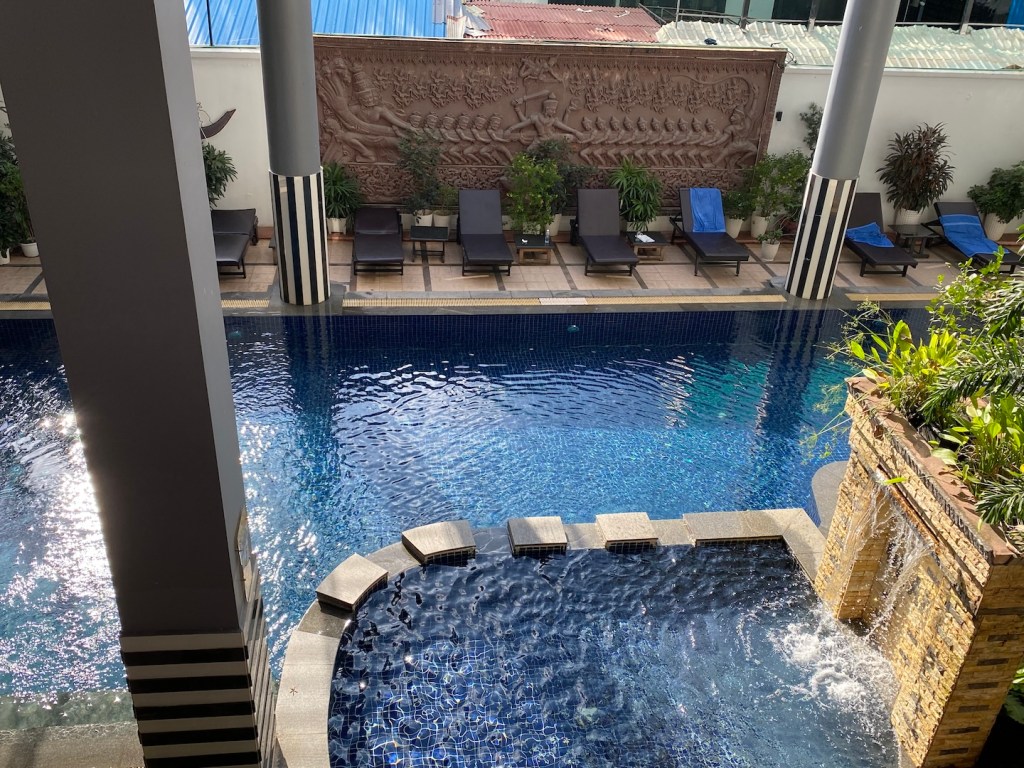
In the same vein, one thing I did not like in Cambodia was Hanuman beer. Hanuman is a Hindu God – deeply respected and revered by many and I did not appreciate that in Cambodia there is a beer brand called Hanuman. On Pub Street there is even a bar called Hanuman. I sent photos to my cousins in India and relatives around the world and there was a unanimous big thumbs down for Cambodia on this.
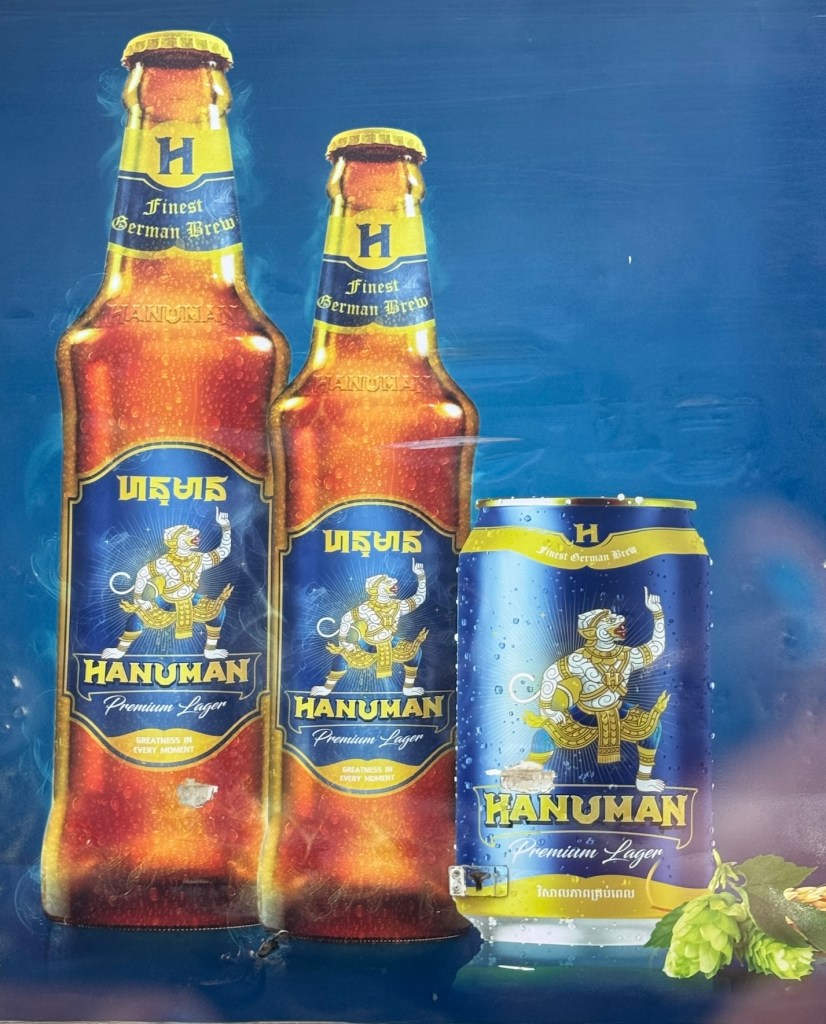
Should You Go To Angkor Wat?
Yes. Even if temples and ruins aren’t your thing, yes. Certainly everyone can appreciate what an architectural marvel it is. Angkor Wat was built between 1113 and 1150 A.D….when there were no cranes, nor modern construction equipment and no electricity. The intricacy of the carvings is another marvel – they’re incredibly detailed depictions of ancient Hindu and Buddhist mythological stories. Moreover the complex and multiple temples are huge.
You can imagine how much of a logistical undertaking it was to transport all of those materials when there was no modern technology. Materials were transported via elephant during the dry season and bamboo floats during the rainy season.
It took over 30 years and 300,000 workers to build Angkor Wat. It is a multi building complex with temples that are miles apart from each other. There’s the main famous structure that you see mostly depicted but for instance the “Tomb Raider” temple where Angelina Jolie shot a scene from the movie is miles away – you have to drive.
If temples and ruins aren’t really your thing, just get a 1 day pass and you will have enough time to visit the main Angkor Wat complex with time to spare to go to Bayon Temple, Banteay Srei, and Ta Phrom. Note: If you do all of these in 1 day, it will be a long day, but it can be done.
These temples are all between 2-20 miles from each other. A lot of people hire a tuk tuk and driver for the day. This driver will take you temple-to-temple, wait for you at each location, and eventually drive you back to your accommodation or final destination. More about the various temples below.


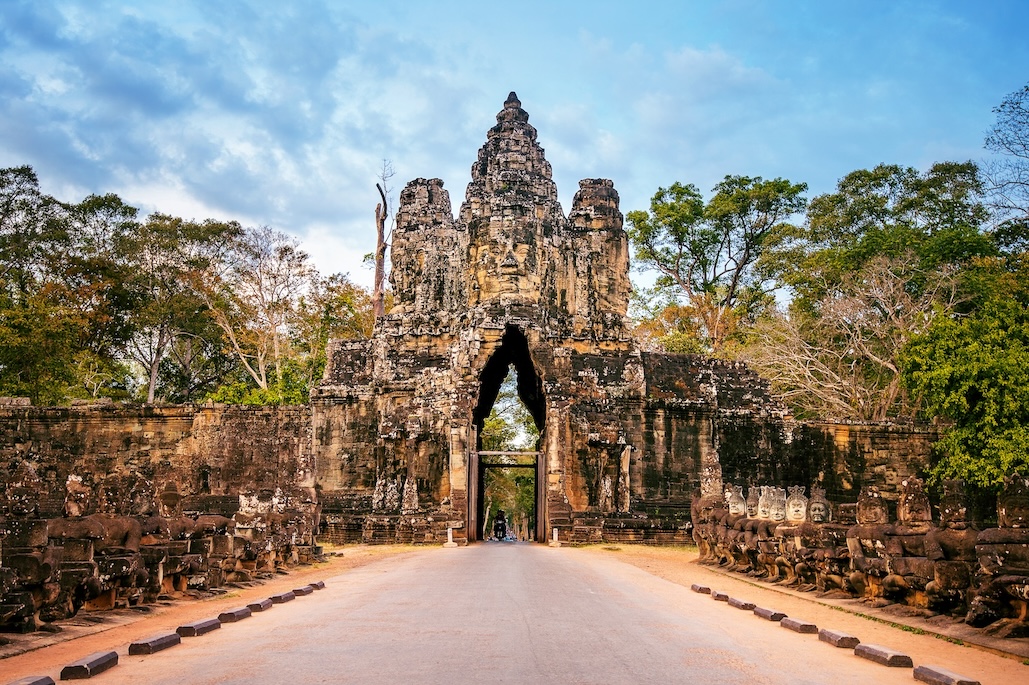
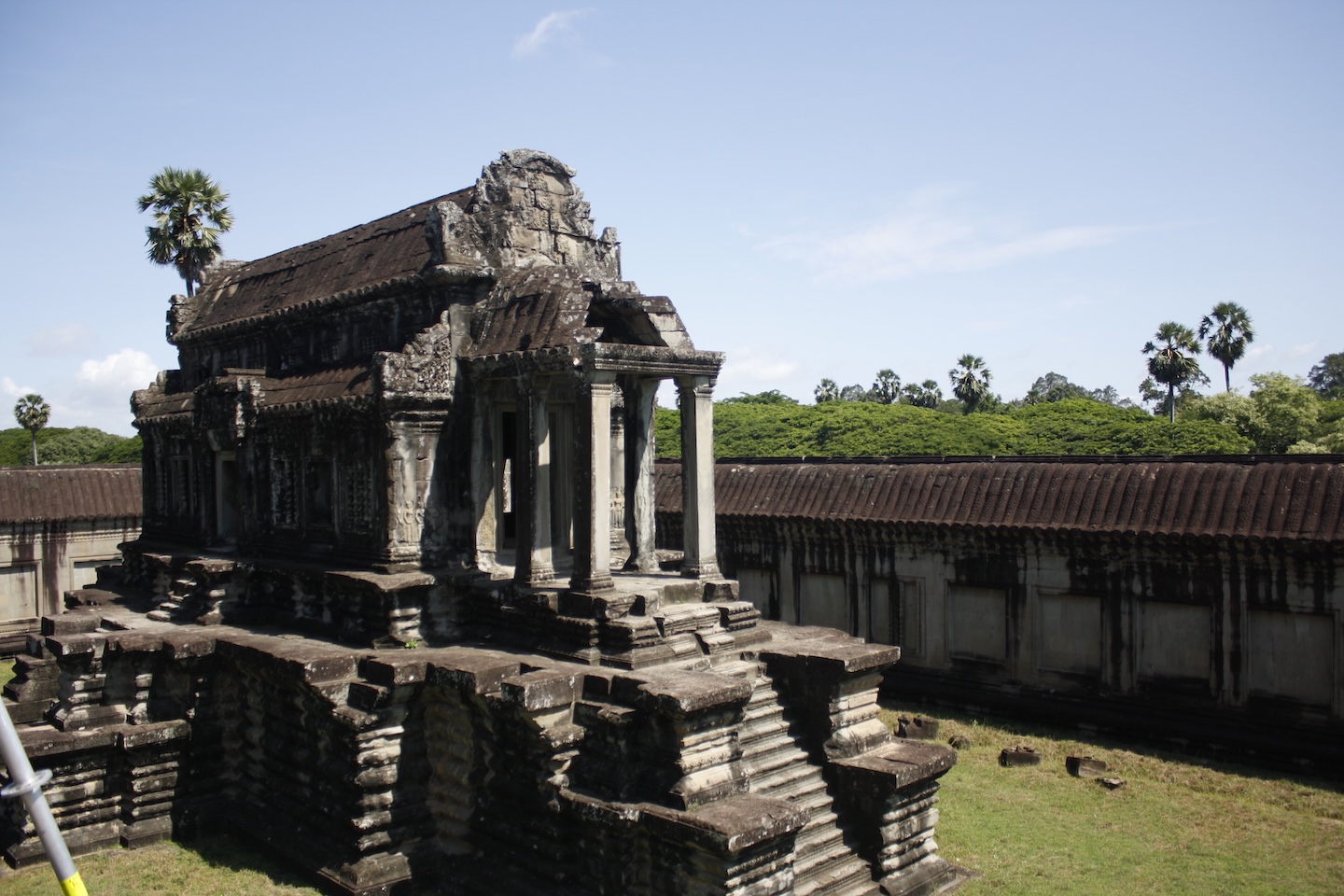
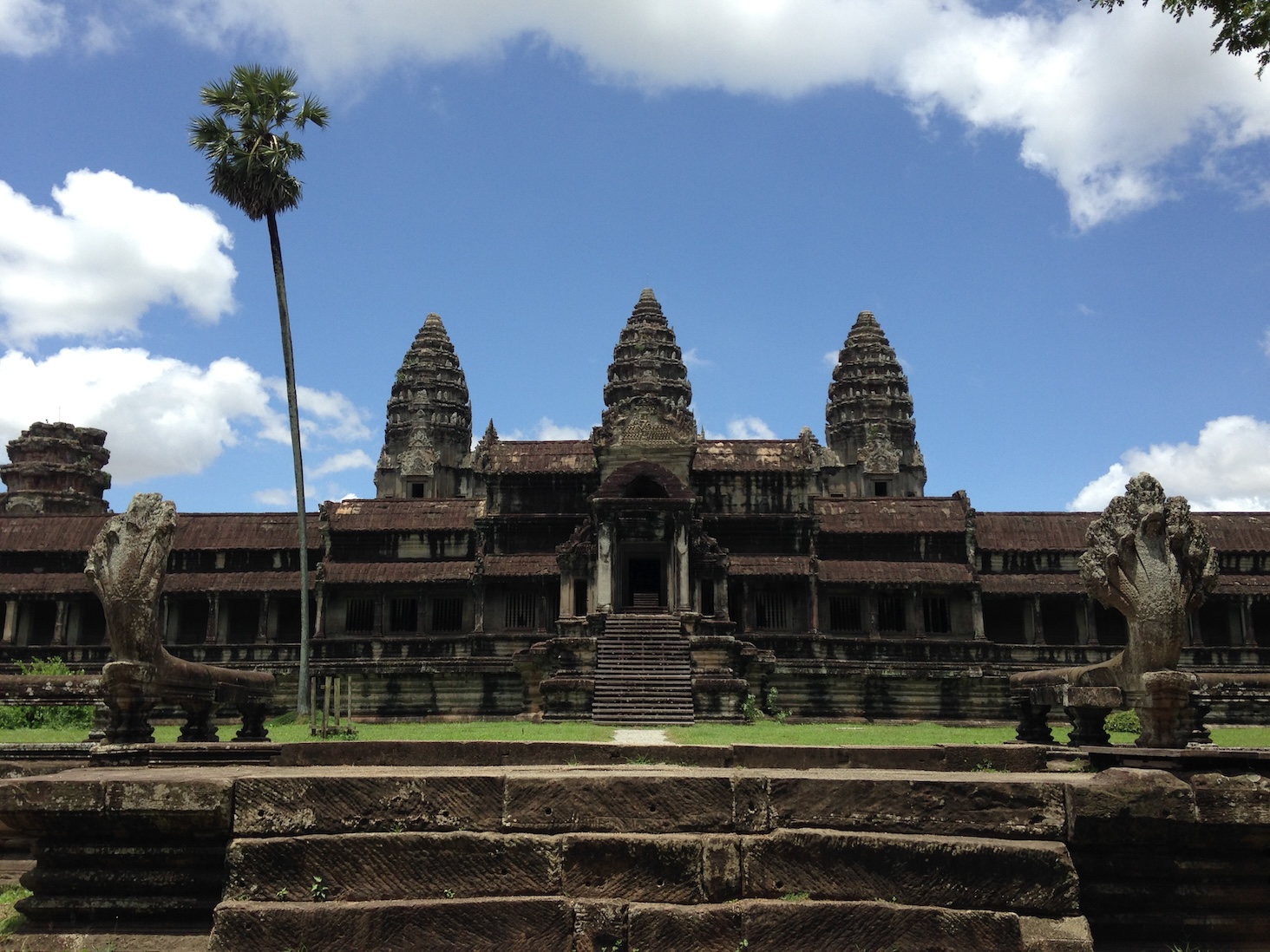
How to Buy Tickets For Angkor Wat
Read this carefully. Think it through. All tickets are non-refundable and non-transferrable. There are specifics for buying in-person vs. online, so again read carefully.
Option 1: Buy Angkor Wat Tickets In-Person
You can purchase a 1, 3 or 7 day pass.
1 day $37 per person
2 days $62 per person
3 days $72 person
You can pay by credit, debit card, or cash in USD or Cambodian Riels. If you need change, they will give change in Cambodian Riels. There is an ATM in the ticket office. Cash in USD is their preferred method of payment.
If you’re going to buy in-person, everyone in your party must be physically present at the ticket office because each ticket holder’s photo will be taken and printed on the ticket.
The ticket office is about a 15-20 minute drive from the Siem Reap city center. The ticket office is not at Angkor Wat. The ticket office is about 4 miles, away from Angkor Wat. On Google Maps it’s called the “Angkor Park Pass Ticket Counters”.
The ticket office opens at 5am and closes at 5:30pm.
This post focuses on visiting during the last two weeks of December which is the peak of peak season. At that time give yourself 1.25-2 hours for buying tickets in-person. Even though there are like 25 ticket windows there can be long lines (especially during peak season) and each guest can take a while, especially if paying by credit card.
When you arrive at the office, follow the signs and get in line based on the type of ticket you want (1, 3, 7 day).
Kids 12 and under enter for free and they are the only ones who need a passport during your visit, as the patrollers throughout the park will check it to verify their age.
Keep Your Ticket Handy. Expect tickets and passports to be checked multiple times throughout your visit. Keep your ticket handy and do not lose it! If you get caught without a ticket, you could face a fine of $100-$600USD.
Sunrise. The Angkor Pass does NOT include entrance to the park if you’re going for sunrise. You must buy that separately.
ProTip: Sorry to repeat myself but the average person needs to read/hear something 7x before it commits to the brain. December is peak of peak season. Expect long lines to form before the ticket office opens at 5am. Also expect long lines by 4-4:30pm when people arrive to purchase tickets for the next day, as the office closes at 5:30pm.
Our Experience. We arrived at Angkor Wat at 4:30am to see sunrise at 6:24am. In my opinion buying tickets, the morning of your visit is not ideal. By the time you will get to Angkor Wat after purchasing it’s too late. You’ll be behind a lot of people – diminishing your view – especially if you’re a short person.
ProTip: Protect Physical Tickets. If you are buying a ticket in-person, protect your ticket in a plastic cover. Don’t let it get wet, torn etc. Cambodia is a tropical country, it’s always hot. Hot means sweat. Sweat could get on your ticket. The photo on your ticket could get ruined or your ticket could tear. Your ticket will be checked every time you enter a temple. If your ticket is damaged or the photo is unidentifiable you will have to purchase a new ticket.
Option 2: Buy Tickets Online
If you buy an electronic ticket, you’ll save time and won’t have to worry about losing or damaging it.
There are two options for purchasing online: directly through Ankgor Wat’s website or through an agent i.e, Viator or Green Era Travel. The benefit of going through the website directly is you’ll pay the same price as the in-person ticket whereas the fees are higher through a 3rd party website.
If you go through Viator or Green Era Travel the prices are (rounded to the nearest dollar):
1 day $60 instead of $37 per person
2 day $91 instead of $62 per person
3 day $103 instead of $72 person
So why would anyone go through Viator or Green Era? Peace of Mind and Convenience
You can book tickets with Green Era up to a year in advance whereas through the Angkor Wat website, max 30 days in advance.
When you buy through the website, you have to upload every ticket holder’s photo and if it’s not the right size etc. you’ll get an error message. When you purchase through Viator or Green Era you just email the photos – which is easier.
Green Era delivers your physical ticket to your Siem Reap hotel by 6pm the night before. You can also arrange pick ups, drop offs and travel throughout the day as not all the temples are within walking distance to each other.
Regardless of whether you purchase online directly through the Angkor Wat website, Viator or Green Era you do not need to go to the ticket office. You can go straight to the entrance of Angkor Wat.
We bought our tickets through the Angkor Wat website and were glad as we didn’t spend time going to the ticket office etc. e had no issues with the website (which some san can be finicky) and no issues with availability. We purchased exactly 30 days in advance of our visit.
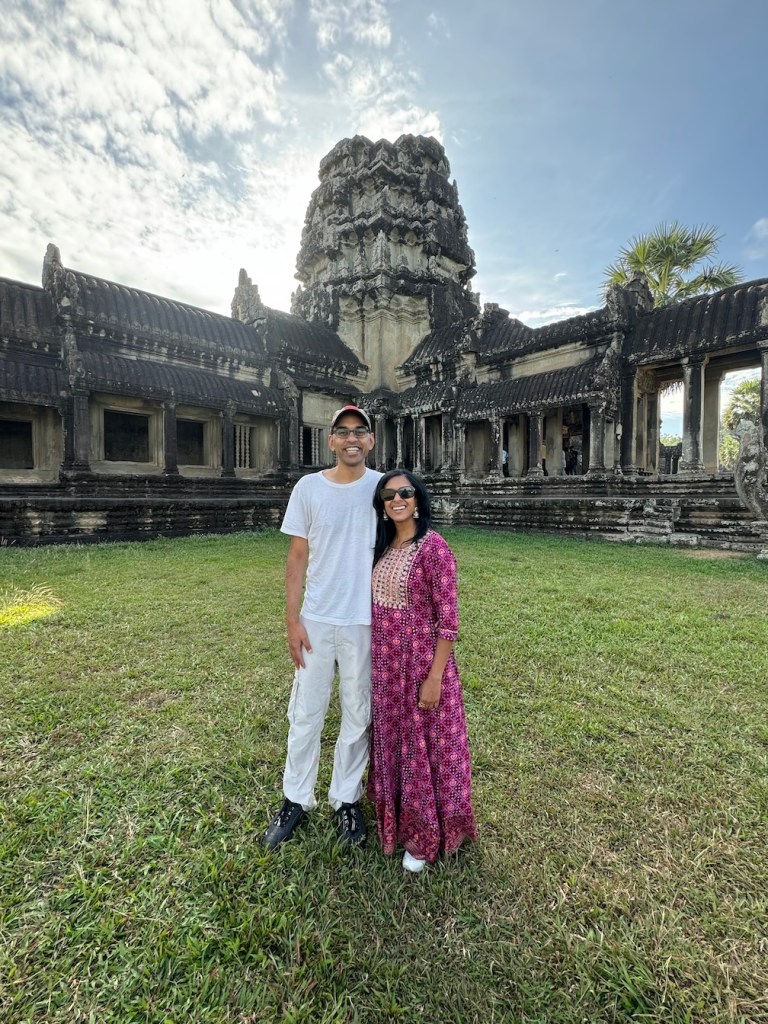
Details About How Angkor Wat Passes Work
All Angkor Passes have two dates associated with them: an entry date and an expiry date. The entry date is the earliest date you can pick up your pass and enter the park.
The countdown for the expiry date for, tickets purchased in-person, starts from the day you purchased your ticket. If purchased online, the expiry countdown starts from the first date of entry you indicated at the time of purchase.
Note:
3 and 7 day passes do not have to be used on consecutive days – see more info below.
You may enter, leave and re-enter on the same day.
The 1 day pass is valid for any single day within 5 days of purchase.
The 3 day pass does not have to be consecutive days. You have 3 full days within 10 days of purchase.
The 7 day pass can be used within 30 days of purchase.
Angkor Wat is not 1 location. It’s a massive 500 acre complex with many locations and buildings. That’s why there are multi day passes. Most people buy the 3 day pass and spend two full days. As you can see from the pricing above, it doesn’t make sense to buy two 1-day passes.
Sunrise at Angkor Wat is definitely the thing to do. Angkor Wat is open 365/7. The ticket office opens at 5am, but most of the temples open at 7:30-5:30pm. But the temples that are popular for sunrise and sunset open earlier and stay open later.
- Angkor Wat & Srah Srang – open 5am – 5.30pm
- Pre Rup & Phnom Bakheng – open 5am – 7pm
General Angkor Wat Tips For a Better Visit
Arrive EARLY for sunrise. If you are going for sunrise, arrive at Angkor Wat as early as 4:30am. We did and I’m so glad! We were standing right in front which was really important for me especially, as I am 4’11”. If I hadn’t been in the front, it would have not been nearly as good of an experience. Note, I didn’t say start your day at 4:30am. I said arrive at Angkor Wat at 4:30am.
In December sunrise is around 6:20am. To be fair, 4:30am arrival may be a bit early but you’re working with a double whammy – sunrise at Angkor Wat is the most popular activity in Siem Reap and December is the peak of peak season. Traffic slows to a snail’s pace as everyone else will be making their way for this epic sunrise.
Best place for sunrise. The best place to be for sunrise is in front of one of the reflection ponds (left or right) so you can capture a photo of the reflection of Angkor Wat. Don’t be afraid to move away from the crowds to other sides of the pond. This is where having a guide is very useful. Our guide took us to the side where there was no construction/restoration going on so our views would be free from that view. We wouldn’t have known that otherwise.
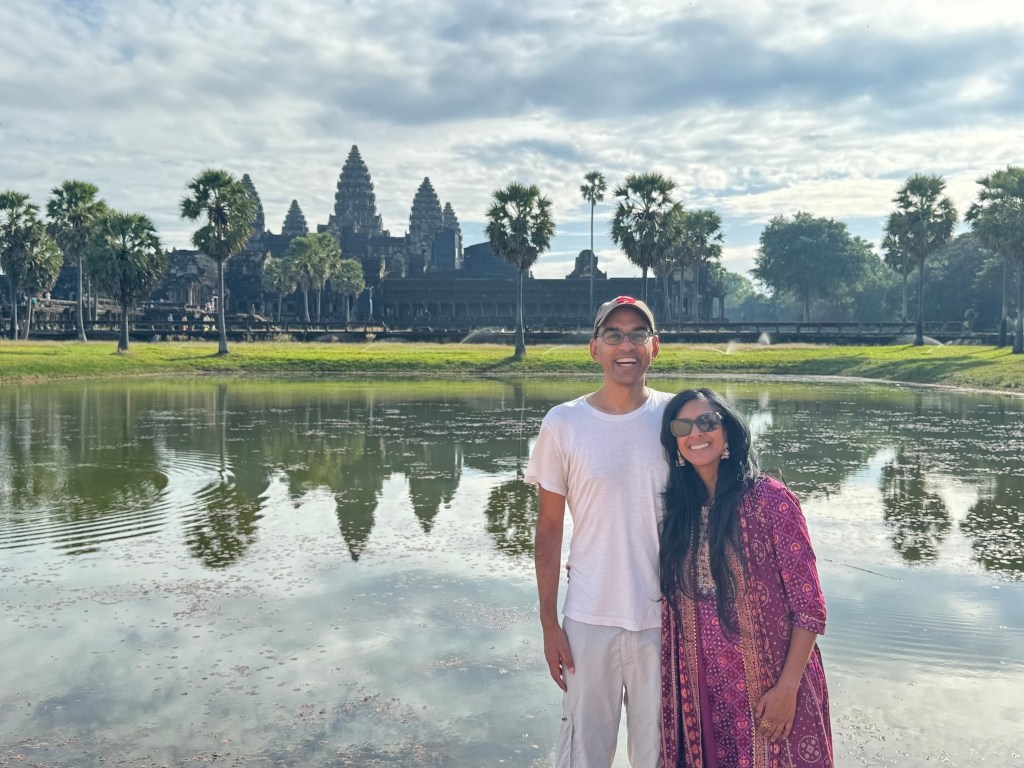
ProTips: Bring a good flashlight for sunrise. No, your iPhone flashlight won’t cut it. We got there at 4:30am – it was dark and there were no lights. You have to do a fair bit of walking to get to the reflection ponds. Wear comfortable shoes too. I packed two of these (one for me and one for my husband) and people around us were commenting, “I should have brought a better flashlight”.
After Sunrise; Don’t Go Back To Your Hotel. Stay at Angkor Wat.
After sunrise a lot of people leave Angkor Wat and return to their hotel for a rest and breakfast; which means that’s a great time to stay and avoid crowds. That’s what we did and were SO glad. Th day before we arranged for our hotel to pack breakfast for us. It was still busy after sunrise as a lot of people were there but it definitely got busier around 11am when people were returning for the day.
DSLRs and other cameras. DSLRs and selfie sticks are allowed inside Angkor Wat but tripods, monopods and professional camera equipment and drones are not without a permit.
Hire a Guide. Having a guide to walk you through Angkor Wat and explain the meanings of the inscriptions and history of the temple was key to the enjoyment of the day. Also guides are great for taking photos!
Take a Bathroom Kit. By bathroom kit I mean toilet paper, hand sanitizer, soap sheets, compressed towelettes. I also pack disposable toilet seat covers and a travel door hook or carabiner so you don’t have to put your bag on the bathroom floor. Also, a small quick dry travel towel.
By the way, my take a bathroom kit tip, applies to the whole world.
What To Pack In Your Day Pack. Water, sunscreen, hat, camera, sunglasses, bathroom kit. It’s considered disrespectful to wear a hat inside. But you’ll be glad you brought it to wear outside the temples.
Line To The Top. There are staircases leading to elevated areas. If the line to the top is super long (think waiting for 45+ min) then you might consider skipping it. The view’s nice but, in my opinion, not worth waiting in line that long. By the way, we only waited for maybe 10 minutes and we were there right before Christmas.
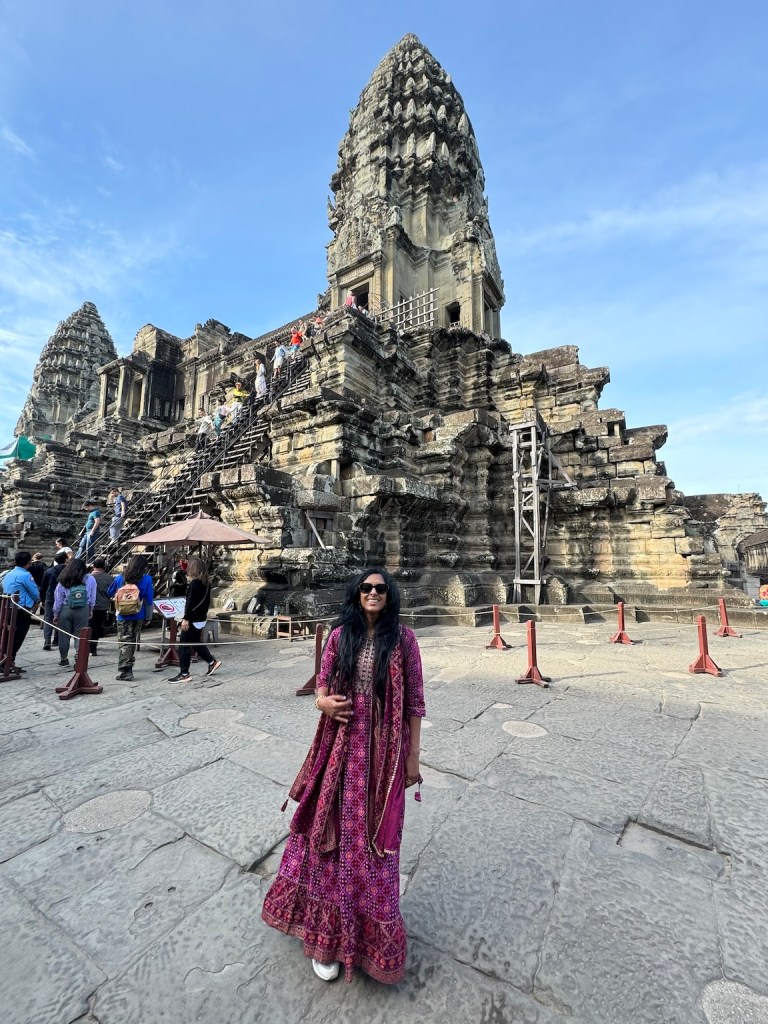
Children Selling Knick Knacks and/or Beggars. If you’ve traveled to other countries in Southeast Asia, South Asia, parts of South America, and Africa you’ve probably encountered local children trying to sell you trinkets. Sadly, many children are exploited and skip school to work. While it will be very tough to say no, it’s generally considered bad to buy anything from these children because…positive reinforcement means the problem won’t get solved.
What To Wear At Angkor Wat
They are stricter at Angkor Wat compared to other pagodas and wats throughout southeast Asia. People abide by the rules as no one wants to go all that way there only to be denied entry.
Cover your shoulders and knees. If your top is sleeveless, simply wrapping a sarong around your shoulders will not cut it and they are likely to deny entry. Your top itself must cover your shoulders. A lot of blogs that I read, said to cover your elbows. I disagree. I saw plenty of people with short sleeves – both men and women and that was fine.
But make sure your shoulders and knees are covered. Below are some more guidelines.
Don’t wear:
shorts (anything above the knee)
low cut tops
sleeveless
strappy
backless
see-through, mesh
form fitting
skirts/dresses with long slits
Basically be modest.
Midi or maxi skirts and dresses are fine as long they don’t have long slits. Leggings with a top that covers your bum are fine. I wore an Indian outfit as you can see below. Some blogs I read before going, said wearing a long skirt/dress would be cumbersome. I did not find that to be the case.
My Indian outfit (below) is called an anarkali which is effectively a fit and flare maxi dress with matching leggings underneath and a scarf-like matching piece of cloth called a dupatta, which is not as small as a scarf but not as big as a shawl. Below I am carrying it across my arms for the photo, but when I was walking around Angkor Wat I had it draped around my neck like a scarf.
For the morning sunrise I was glad to have my packable puffer jacket. Once it got warm, we put our jackets in our daypacks.
As you can see my husband wore cargo pants, a white t-shirt and sneakers. He was comfortable.
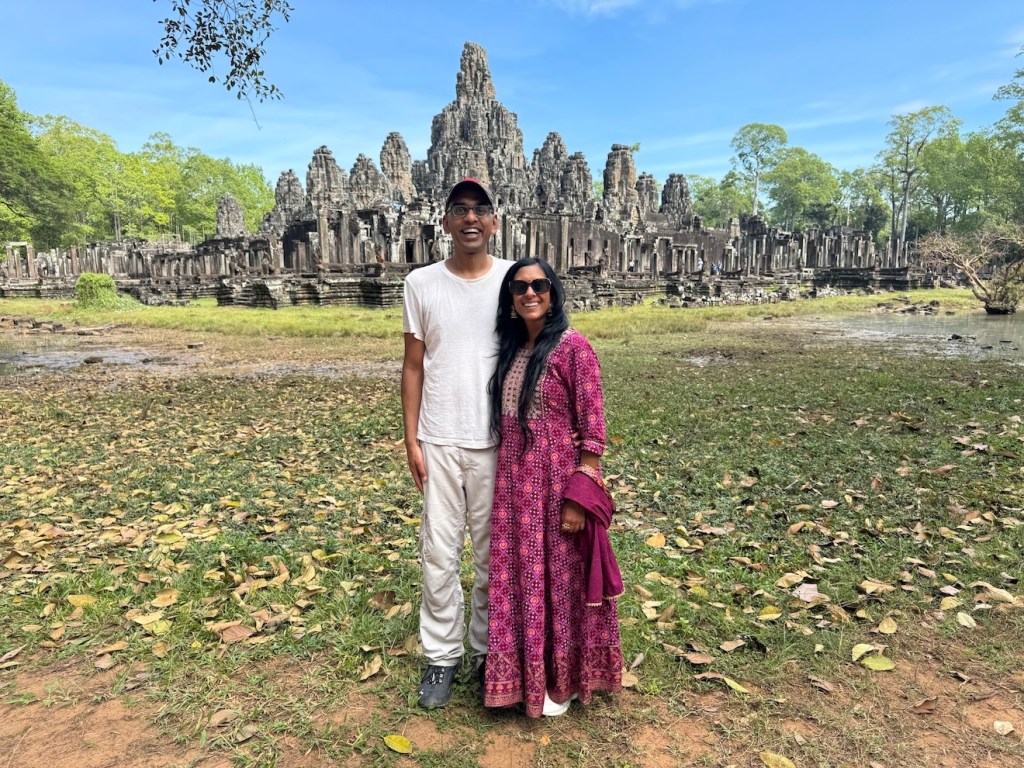
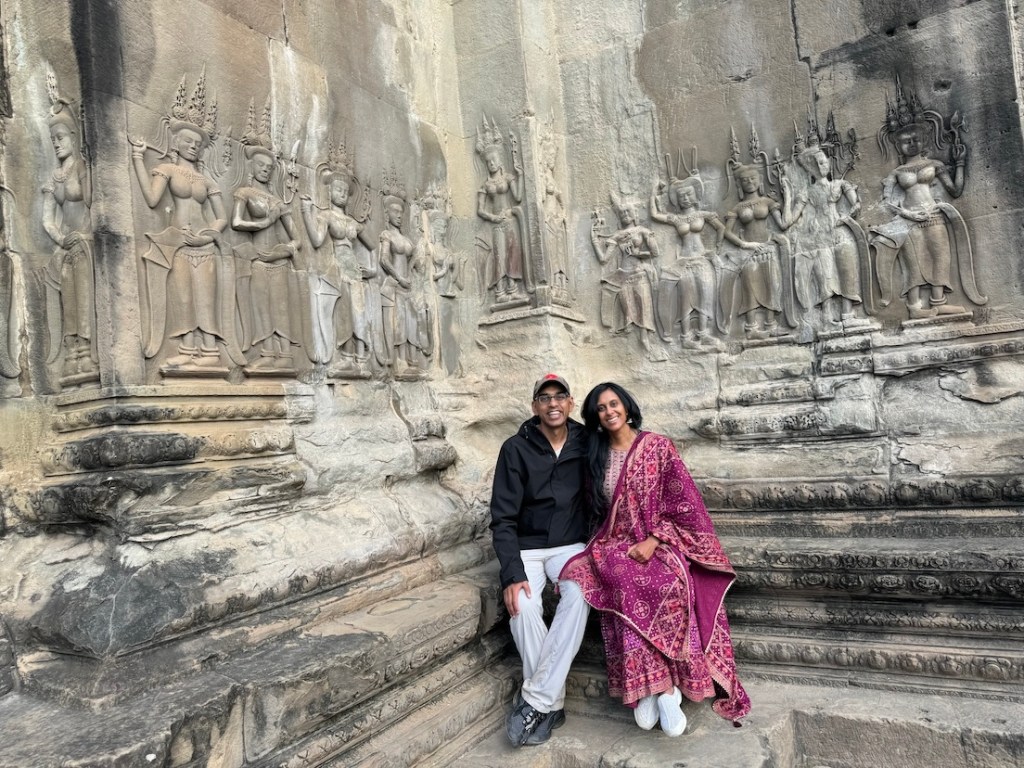
Temple vs. Wat vs. Pagoda
Let’s get this terminology straight as the terms are often used interchangeably and if you’re traveling in southeast Asia then it’s pretty likely that you’re going to visit a temple, wat, or pagoda at some point.
Temple: is a place for worship. This does not necessarily mean religious worship. In Vietnam, a temple is honors leaders and heroes of the country. A temple can also be a complex, kind of like a college campus – a collection of buildings composed of temples, stupas and pagodas. You’re probably wondering, wait a sec, what’s a stupa? A stupa is a dome or bell shaped monument designed to store and protect statues of Buddha. A stupa does not have an opening so the statues are always safe and protected.
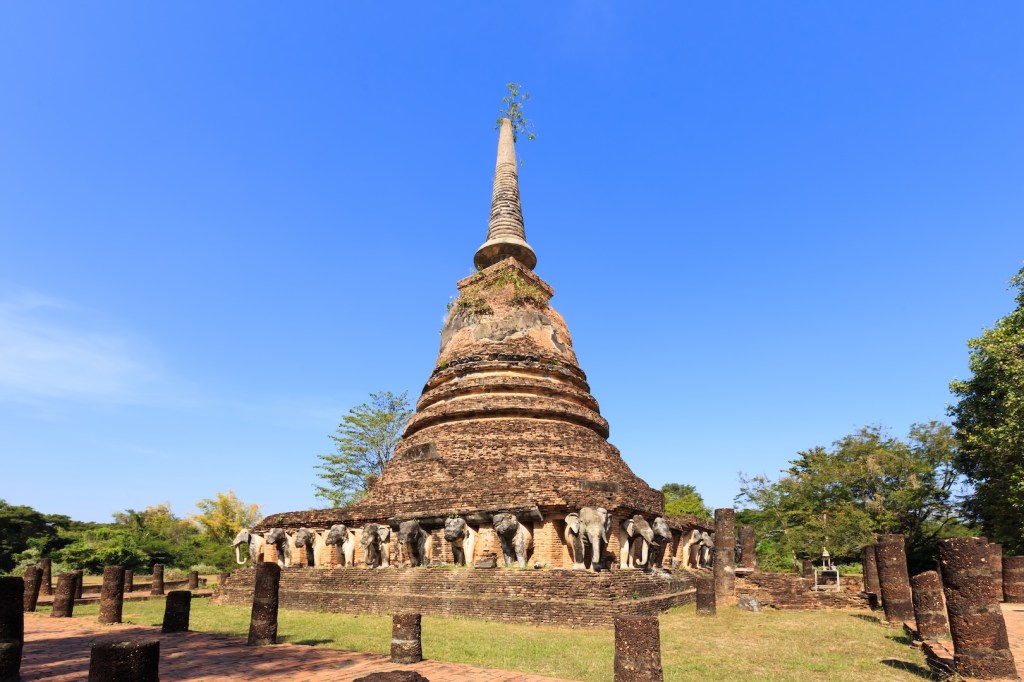
Pagoda: a pagoda is a place of religious worship, specifically to worship Buddha. A monastery in southeast Asia is also often referred to as a pagoda. It’s usually a multistory building. The architectural styles vary across cultures.
Wat: a term used for pagoda used throughout southeast Asia.
About Angkor Wat
Main Angkor Wat Complex. The main complex is the place you see in all the photos and first images in most vlogs and videos. It’s where you’ll come for sunrise. It was designed to look like the heavenly abode of the Hindu Gods and Jain Tirtankars and the center of Buddhist cosmology, on Mt. Meru aka Mt. Sumeru.
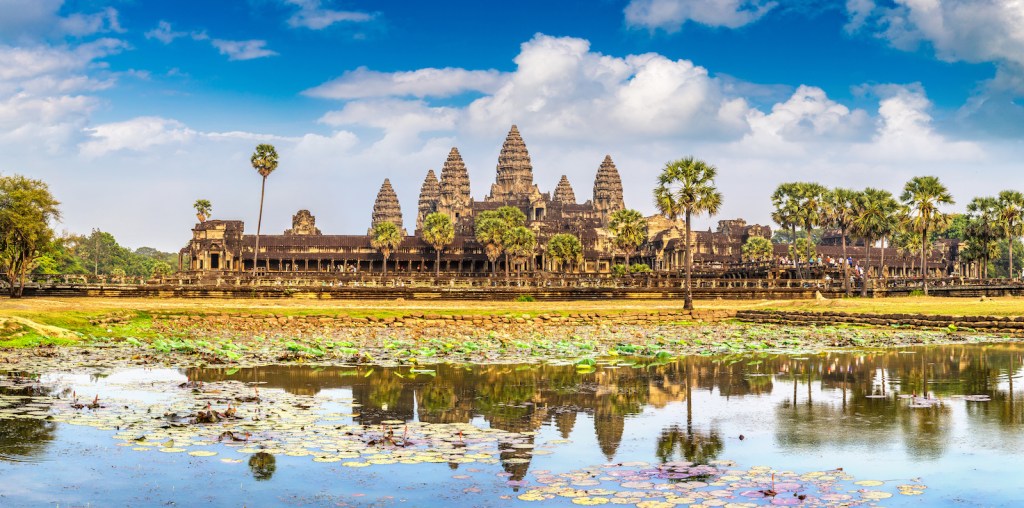
Mt. Sumeru is considered sacred in Hindu, Jain, and Buddhist religions. Its distinguishing feature is the 5 peaks – which you can see above.
Angkor Wat was built by King Suryavarman as a Hindu temple dedicated to the Hindu God Vishnu (more about Vishnu below). Generations later King Jayavarman II lost faith in the Hindu Gods when he lost a battle and thus converted to Buddhism which led him to build the Bayon Temple.
Thankfully even though he shifted from Hinduism to Buddhism, he did not destroy the temples and structures that had been built until that point – so we get to enjoy them today.
In Hinduism there is a Trinity of Gods. In Hindi we call it “Trimurti” which means 3 forms. The Gods in the Trimurti are: Brahma (the Creator of the Universe), Vishnu (the Protector of the Universe), and Shiv (the Transformer of the Universe). Some people refer to Shiv (aka Shiva) as The Destroyer. I don’t like that word. Shiv represents and oversees the universe’s constant state of change (hence the crescent moon in his hair).
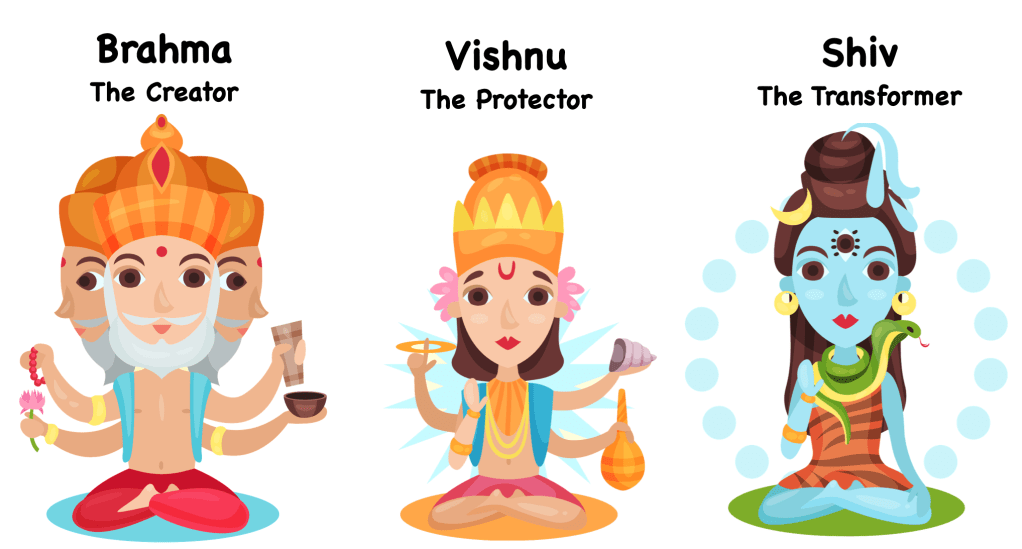
King Suryavarman favored Vishnu and dedicated Angkor Wat to him, as he hoped and wished for Vishnu to protect him, his reign, and his legacy. Vishnu’s consort is Goddess Lakshmi, the Goddess of success, good fortune and wealth. You can see the gold coins spilling from her bag in the image below. As the consort of Vishnu, there are depictions of her throughout Angkor Wat as well the entire Trimurti.
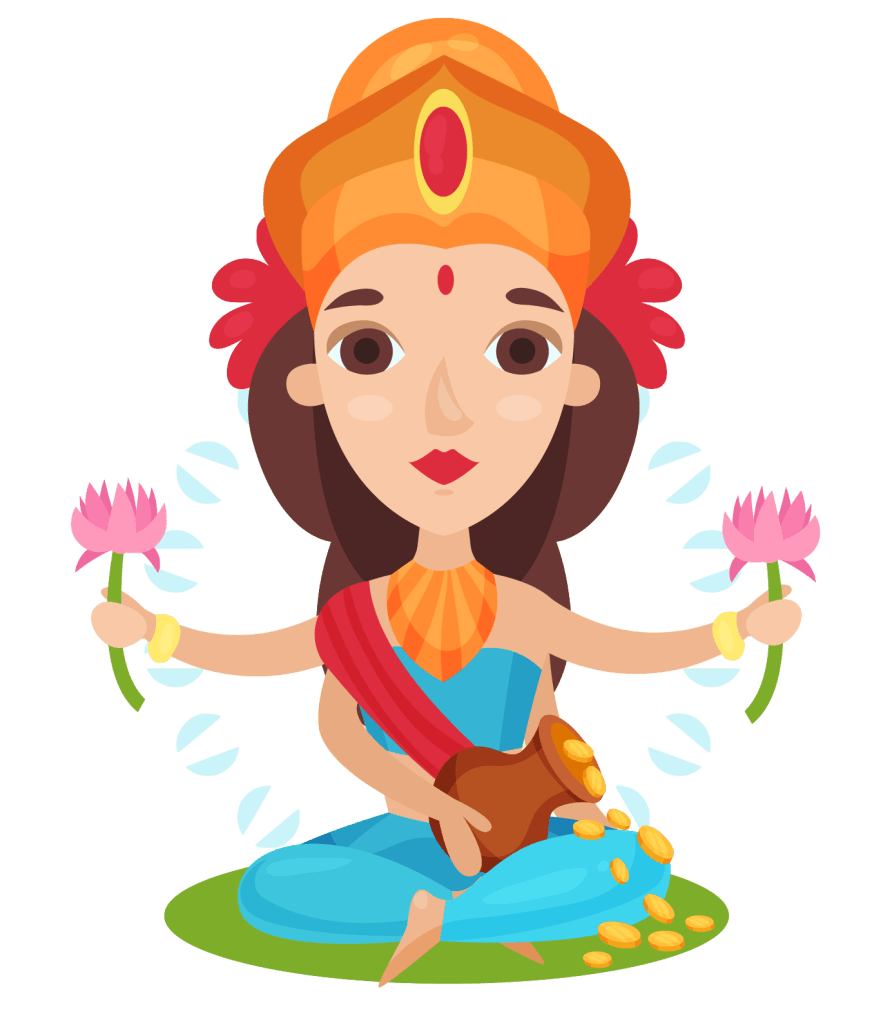
Vishnu’s Avatars
Did you know the word Avatar is a Sanskrit word meaning descent? Its original meaning is the material appearance or incarnation of a powerful deity or spirit – on Earth. In other words whenever things got really bad on Earth, Vishnu would take on an avatar of a person or animal and come to Earth.
What do I mean by “really bad on Earth”? To put it in simplistic terms, each of Vishnu’s avatars has an interesting legend that involves overcoming a great challenge by stopping a really bad guy and teaching humanity important lessons. There’s far too much detail and intricacy of each avatar for me to explain here.
You will see depictions of these avatars (Ram, Krishna, Vamaan, Narashima) throughout Angkor Wat.
Being from Indian (India) heritage and being a Hindi teacher, I thoroughly enjoyed visiting Angkor Wat and the depictions of the ancient Hindu epics Ramayan and Mahabharat as well as the mythological stories about Buddha, Krishna, Lakshmi, Shivji and Saraswati.
Explanations of What You’ll See At Angkor Wat
These are short and sweet, oversimplifications of some of the epic tales from Hindu mythology that you will see at Angkor Wat, but I thought them useful to include so you have some context going into your visit.
Ramayan: is the life story of a virtuous, prince named Ram. His wife was kidnapped by the mighty and evil Raavan and the story is about his quest to get her back. He enlists the help of Hanuman and his monkey army along with his loyal younger brother Lakshman.
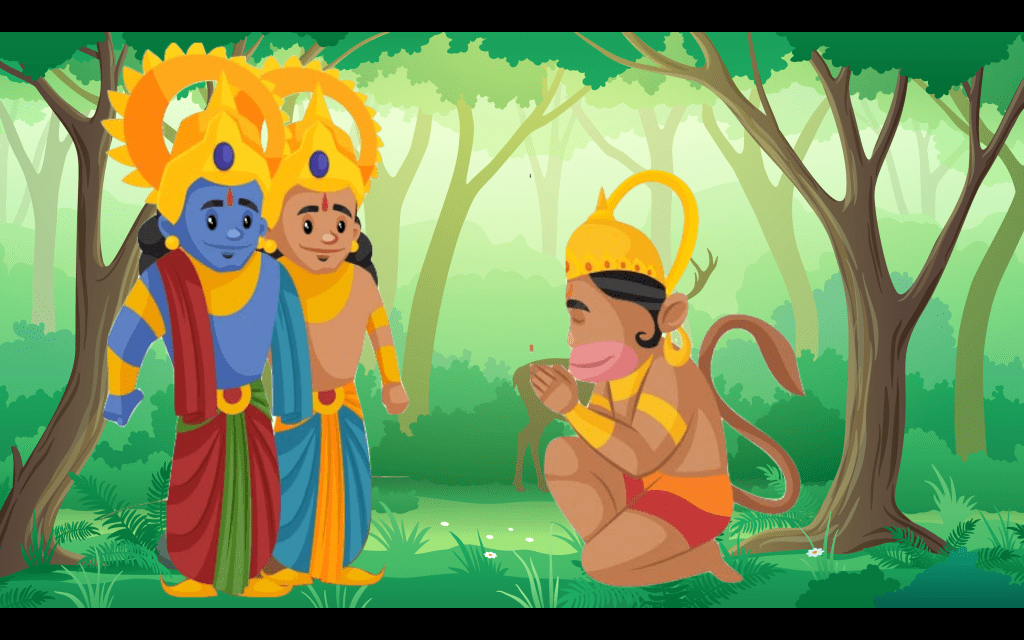

Mahabharat: just to help you wrap your head around this tale, Mahabharat is like the OG Game of Thrones. Centuries ago, a king had two sons. The elder son was supposed to be the Crown Prince but because he was blind, the younger son was crowned.
Decades later when these two brothers had children of their own, there was a conflict over who the rightful heir was. That led to an epic battle between the two groups of cousin-brothers called the Kaurav and Pandav. The epic battle called, Kurukshetra unfolded and is depicted at Angkor Wat.
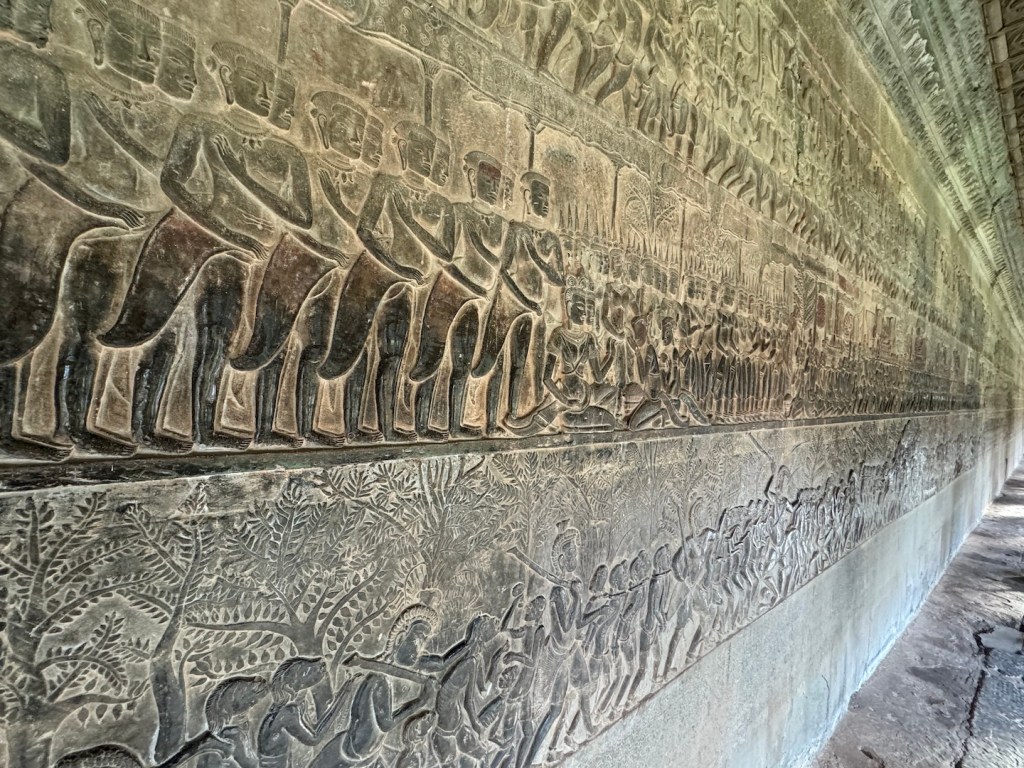
Krishna and Mount Govardhan. Krishna, the 8th avatar of Vishnu, needed to teach a lesson to the God of rain, who had become arrogant. Said God was angry that a religious ceremony in his honor was cancelled. So he sent torrential rain down on the villagers who had cancelled. Krishna protected them. He held Mount Govardhan up – like an umbrella – where the villagers took shelter for 7 days, until the God remembered his humility and asked Krishna for forgiveness.
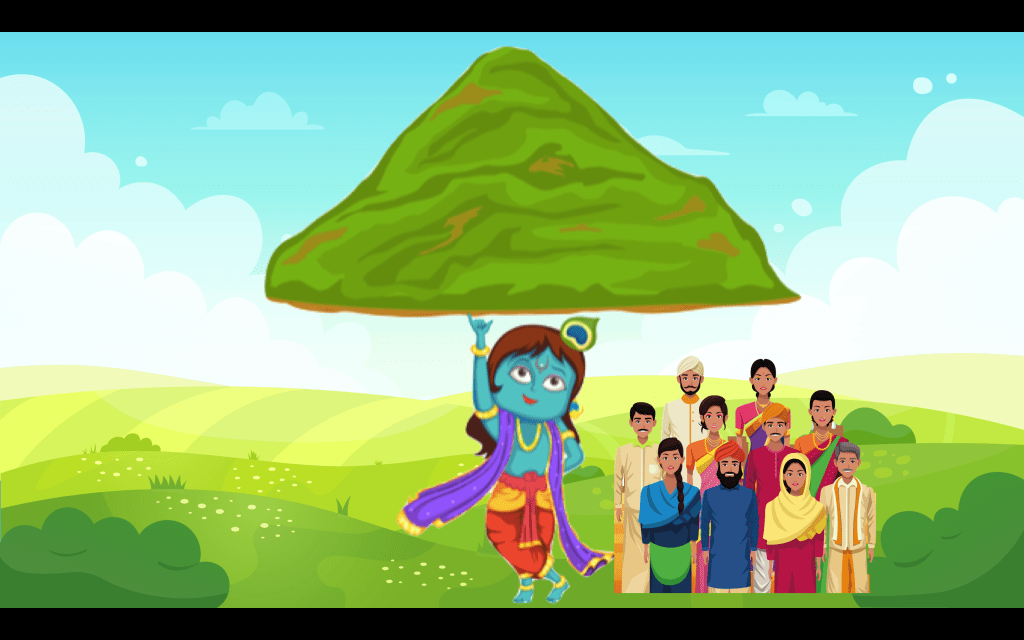
Churning of the Ocean. Below is my cartoon depiction of the story that I made as I teach kids so I use kid-friendly images. This story is depicted throughout Cambodia.
Basically, demons conquered the universe and the only way to restore the universe was to release amrita – the elixir of life. But the elixir was buried in the deepest depths of the ocean and it was not easy to acquire. Because the demons (left) wanted the elixir just as much as humanity (right) did, they worked together to churn the ocean to release it.

They used a mountain and the God Shiv’s serpent as tools to release the elixir and they engaged in a sort of tug-of-war to churn the ocean and release it. But the elixir was not the only thing that emerged out of the ocean. According to Hindu mythology the first doctor – Lord Dhanvantari emerged and spread health to all humanity, Goddess Lakshmi emerged and spread wealth to humanity and of course the elixir spread across the sky to restore the universe and whisk away the demons.
So at this event, humanity received the gifts of health and wealth…so kinda a big day.
When you go to the Bayon Temple, the entrance with rows of people is this story. On the left are the Gods and the right, the demons.
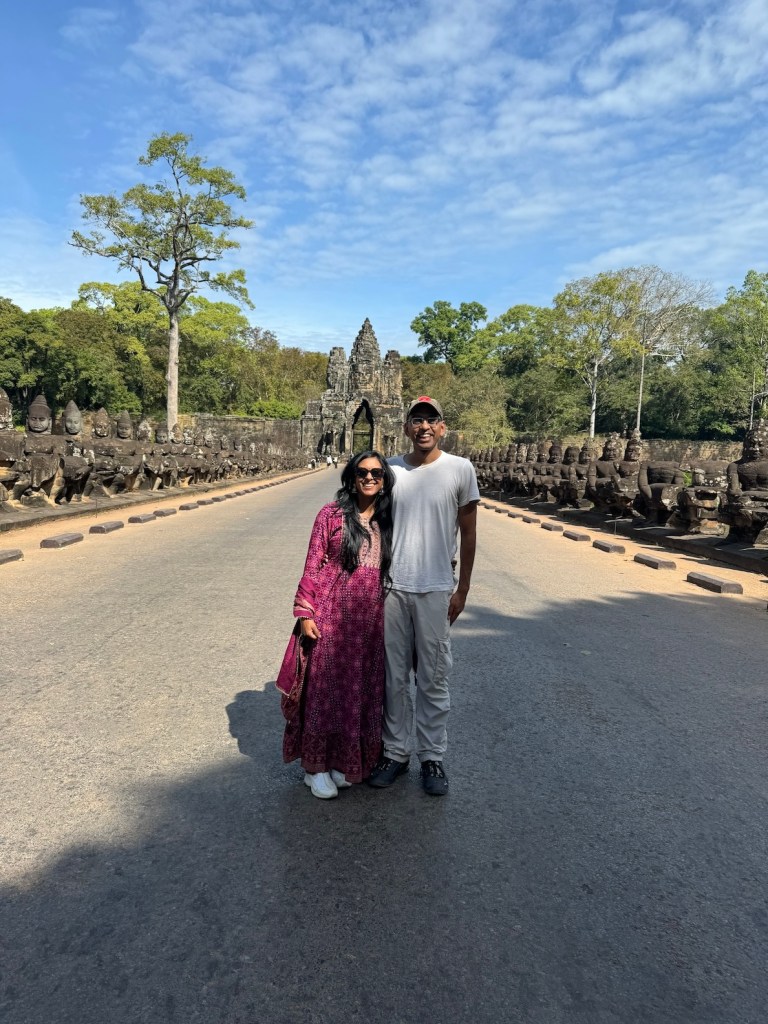
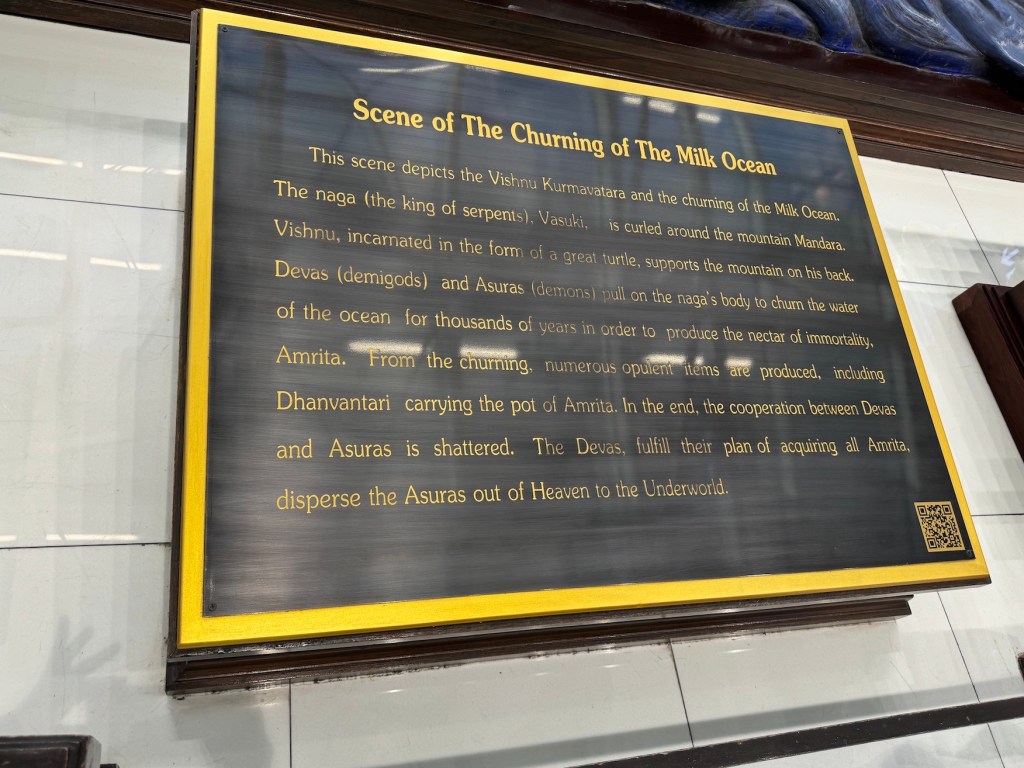
Besides Angkor Wat, Places To Go In Cambodia
If you’re entering Cambodia via Phnom Penh, in the southern part of the country, immerse yourself into the nation’s past and Buddhist religion by visiting the many museums and temples. As you probably know, Cambodia has a harrowing history which is preserved in the capital. You can even go see one of the killing fields.
Kep. Head over to Kep on the southern coast for the Kep Beach, the Kep National Park, Butterfly Garden and more.
Kampot. In Kampot there are waterfalls, hiking, national parks and caves.
Sihanoukville. Keep traveling west to Sihanoukville for beaches and hiking in the national park.
Koh Trong. Heading north to Koh Krong, you’ll be delighted with beaches, the Cardamom Mountains, and the Tatai Waterfall.
Battambang. Continuing our journey north, you’ll come to Battambang where you’ll see the original Bamboo train and a swarm of bats fly out of a cave every evening.
Siem Reap. Next is the famous Siem Reap with the entire Angkor Wat complex and Phnom Kulen National Park. When you’re in Siem Reap on Pub Street, you won’t feel like you’re in southeast Asia anymore. There are super modern and big restaurants, night clubs and bars blaring hip hop mixed with street food stands, ice cream stores and clothing boutiques and stalls.
I was happy to find a Lakers jersey.
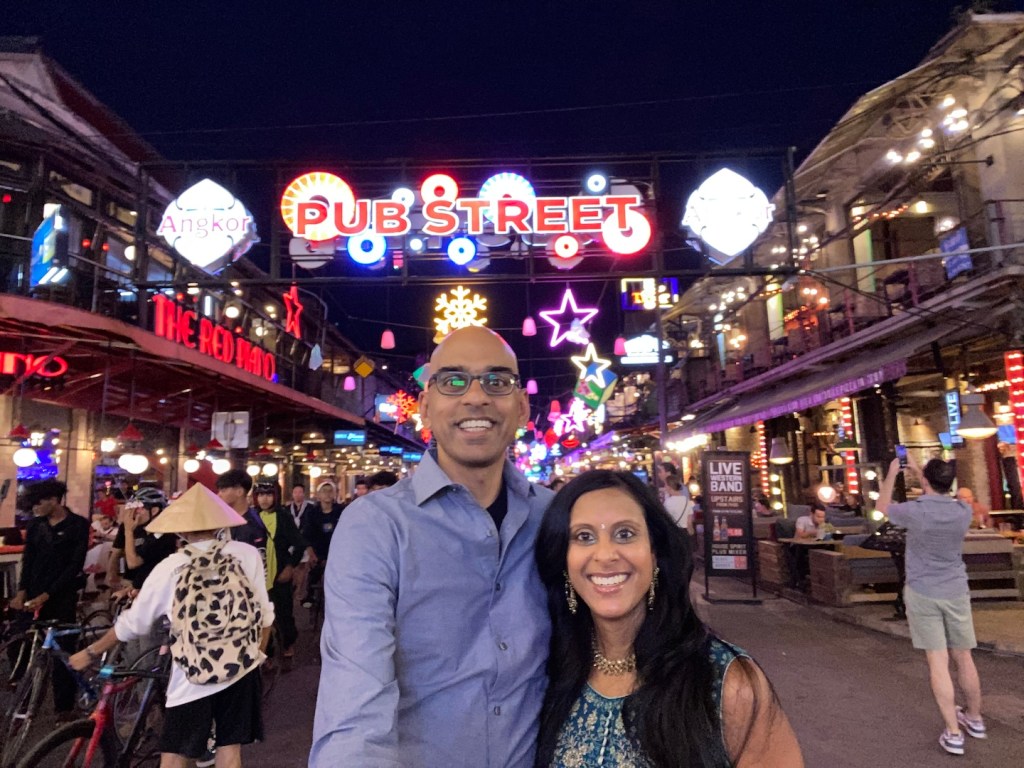
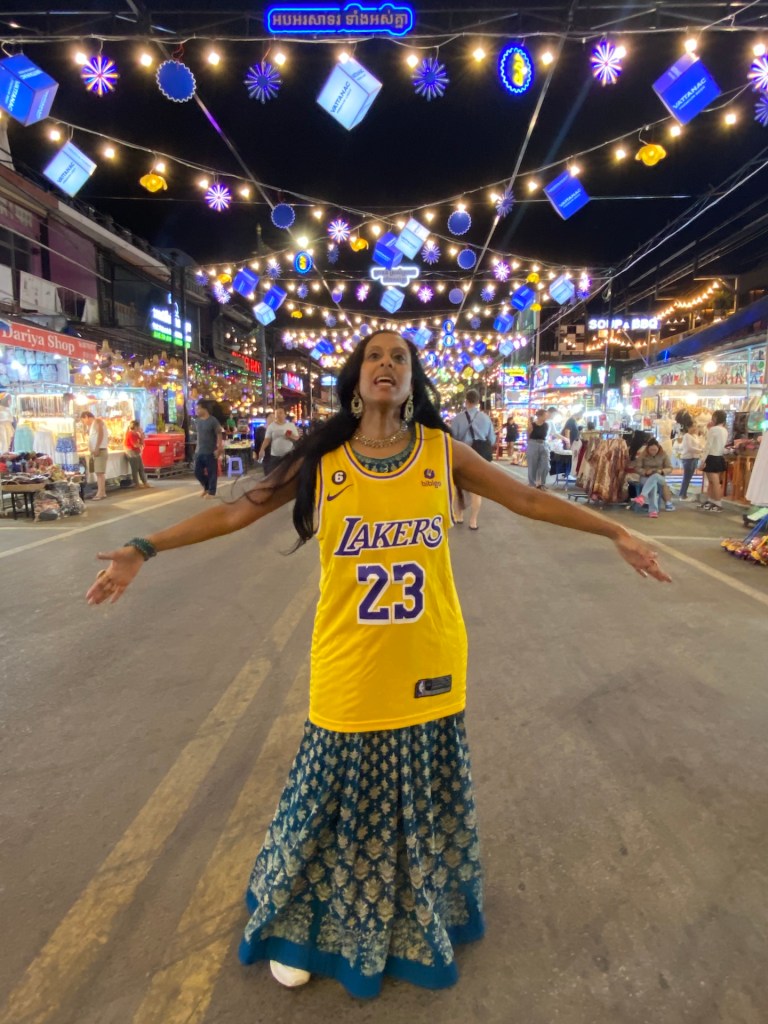
We did a day trip to see the 1000 Shiva lingas as well as Phnom Kulen National Park. You can see the lingas submerged in the water below. Lingas in India look different, so this was not what I was expecting to see – but cool, nonetheless. This was a really nice day trip where we got to see two beautiful waterfalls, outdoor pagodas and a huge reclining Buddha….on the top of a hill.
I took two pairs of shoes : water shoes to wear for the waterfalls and my slip on sneakers that were perfect as we kept taking our shoes on/off to visit the wats. If you’re going to go in the water, take all the gear you’d take for swimming. There is a place to change your clothes there.
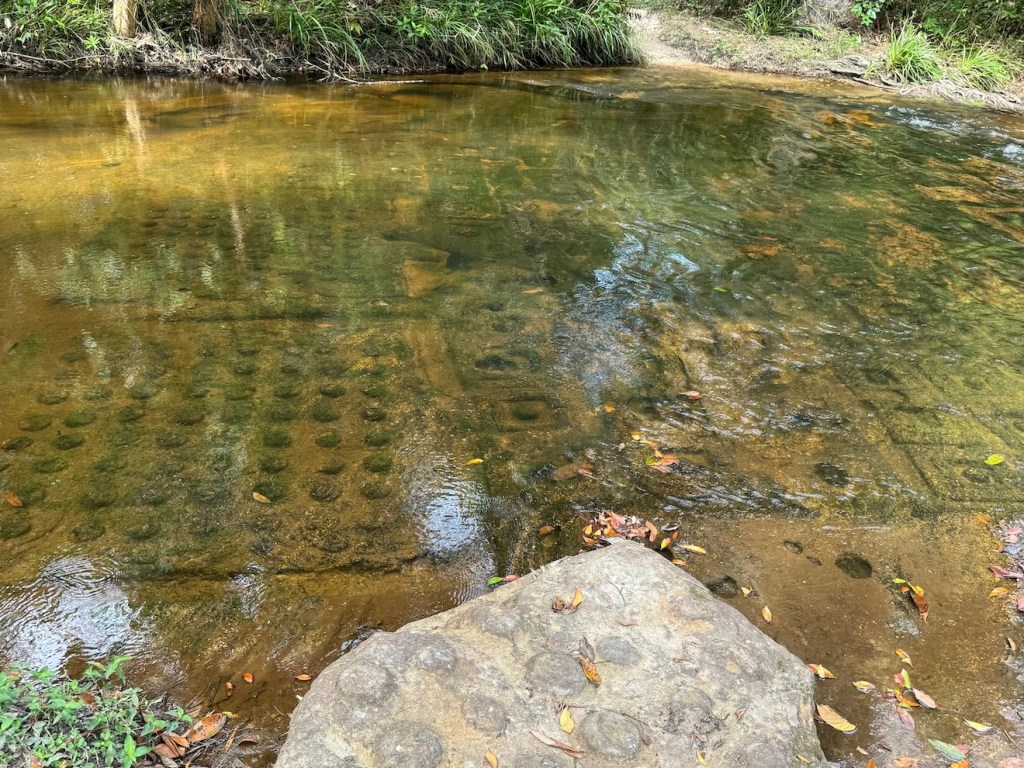
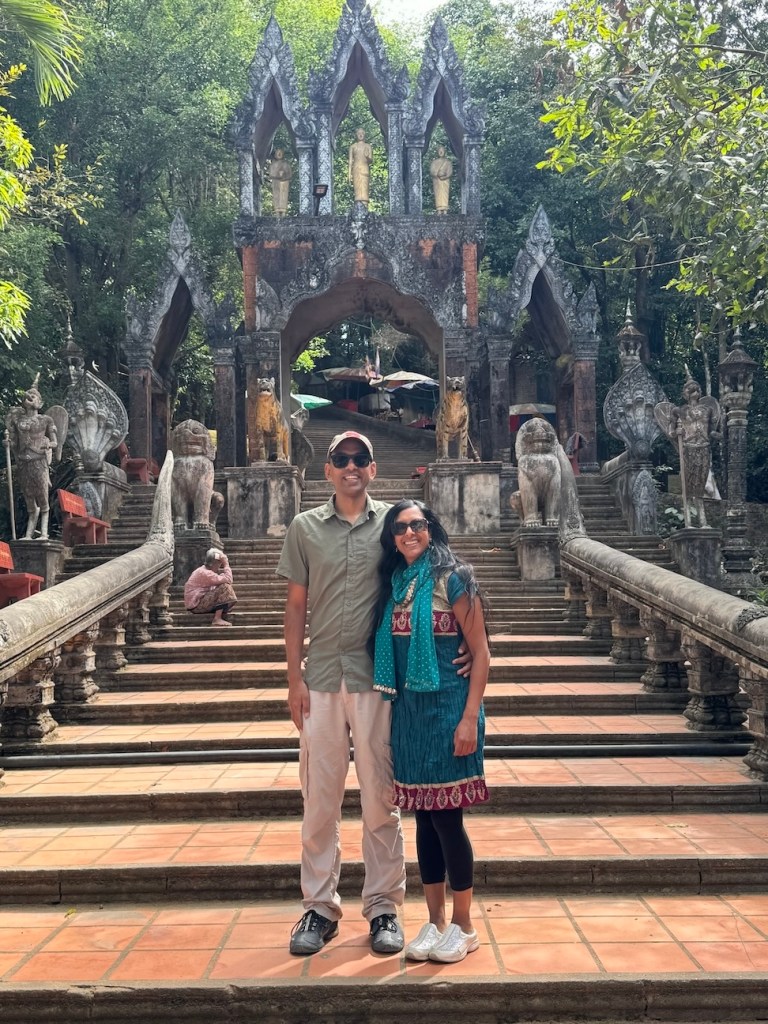
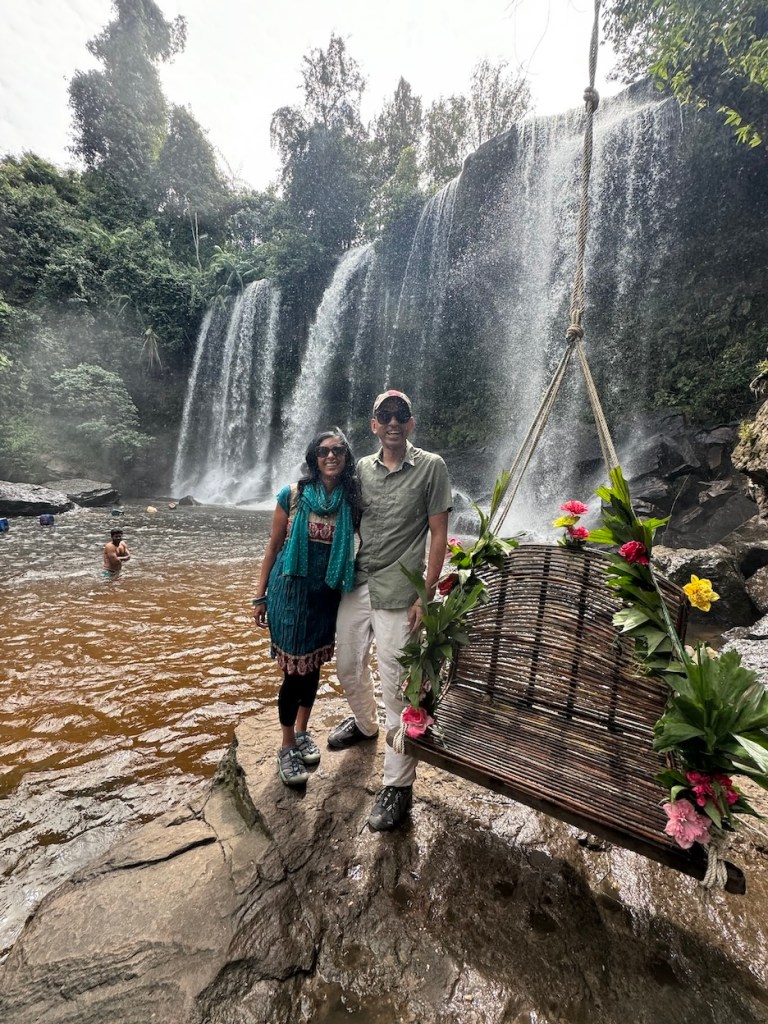
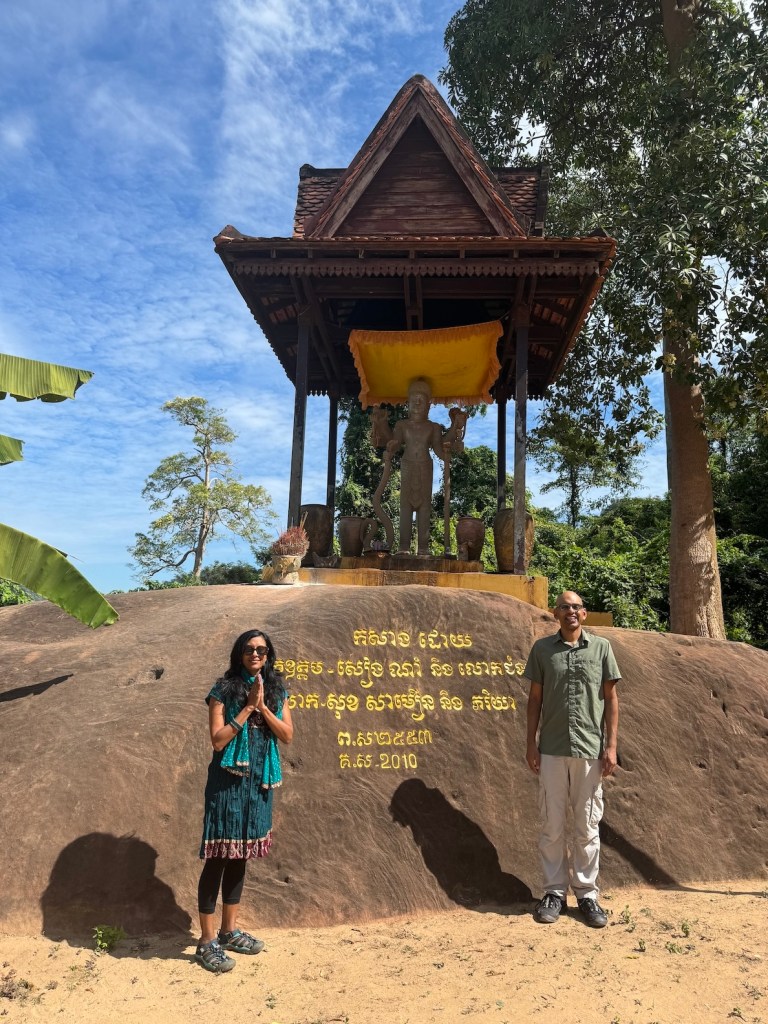

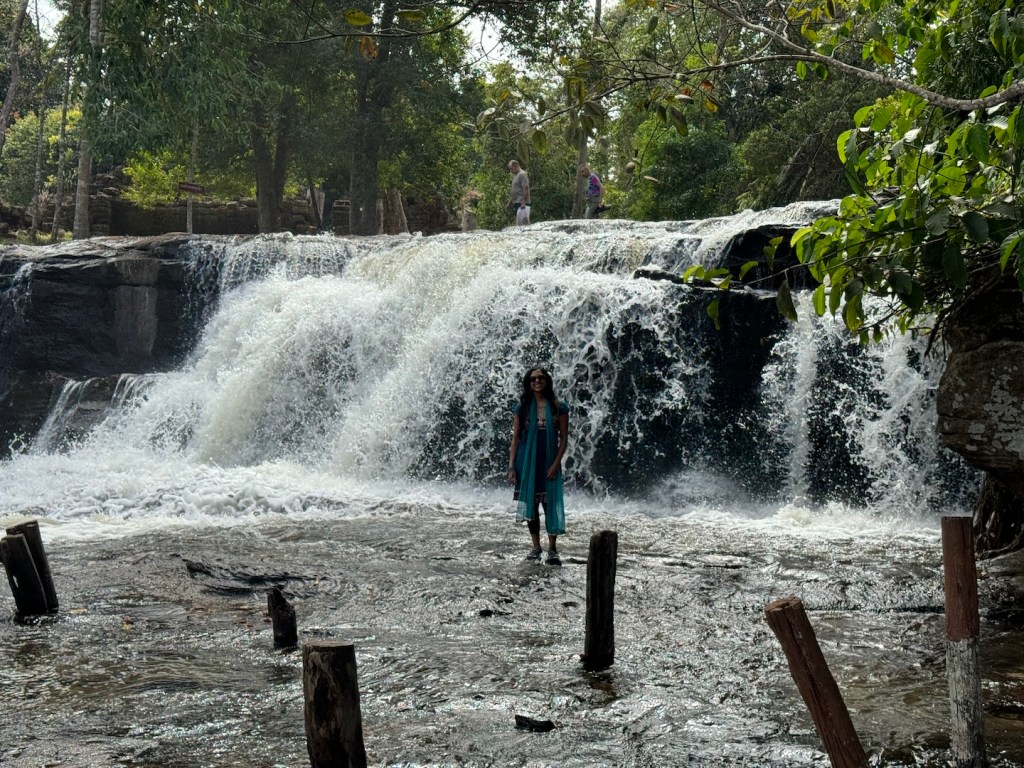
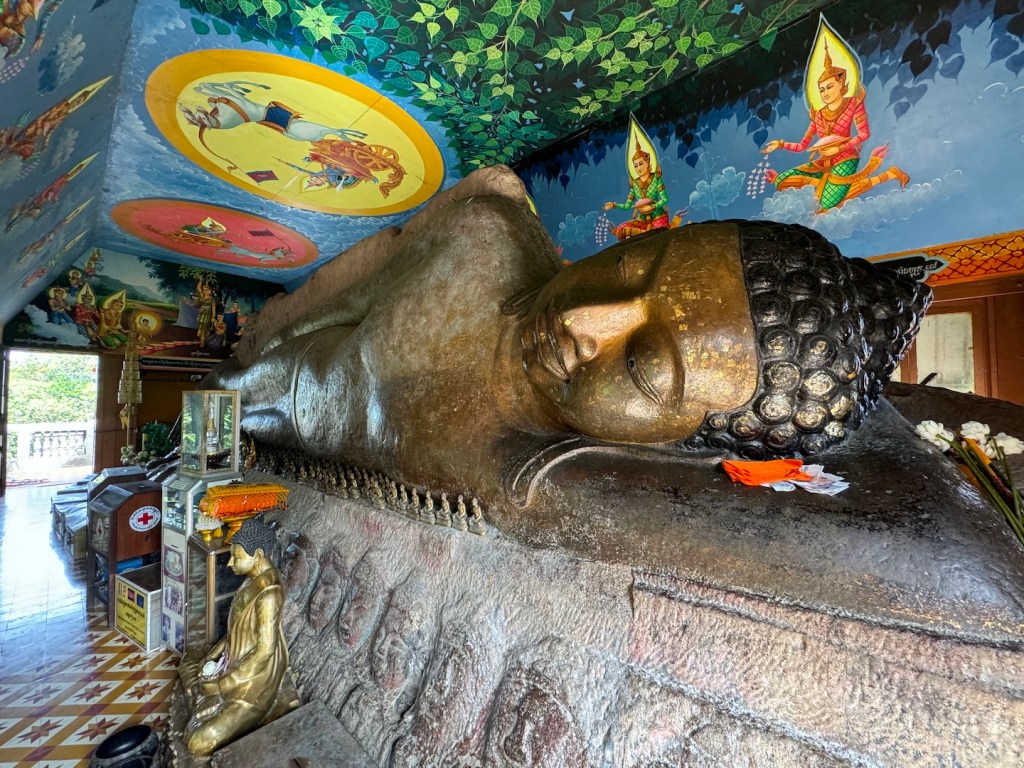
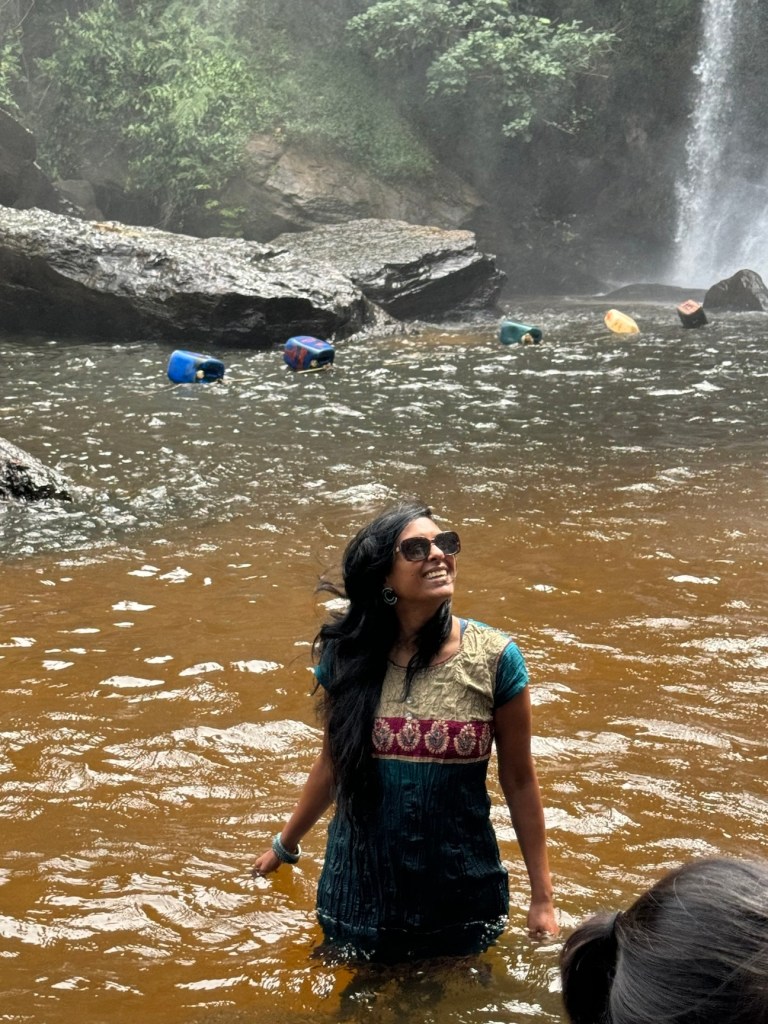
Where to Stay in Siem Reap
There are 5 main areas:
- French Quarter
- Old MarketWat Bo
- Taphul Village
- Charles De Gaulle Blvd.
The French Quarter is the main city center close to Angkor Wat. This is where you want to be if you want to be near the action. There are loads of restaurants, shops, cafes, the Grand Royal Residence and Royal Gardens.
The Old Market is south of the French Quarter and walking distance to it. Pub Street is in the Old Market area. This is where to stay if you’re looking for great nightlife.
Taphul Village is west of the French Quarter. It’s safe and quiet so perfect for families and still within walking distance of the French Quarter and the Old Market.
Charles de Gaulle Blvd. is where to go for 5 star luxury hotels and resorts. It’s about a 10 minute tuk tuk to the city center.
Seim Reap is a small town with about 280,000 people.
Kratie. Head east to Kratie to go kayaking with the endangered Irrawaddy dolphins. This was a 3 day excursion for us. 1 day to drive there from Siem Reap, 1 day with the dolphins, and the last day drive to Phmom Penh. It was about a 6 hour drive from Siem Reap and a 5 hour from Kratie to Phnom Penh. We felt it was worth it.
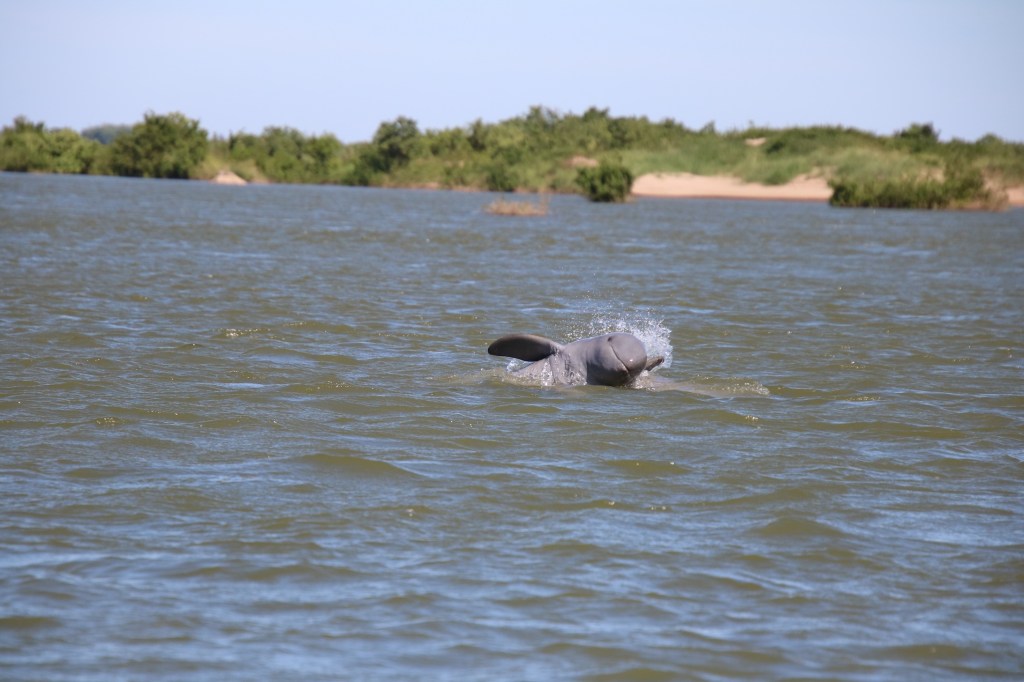
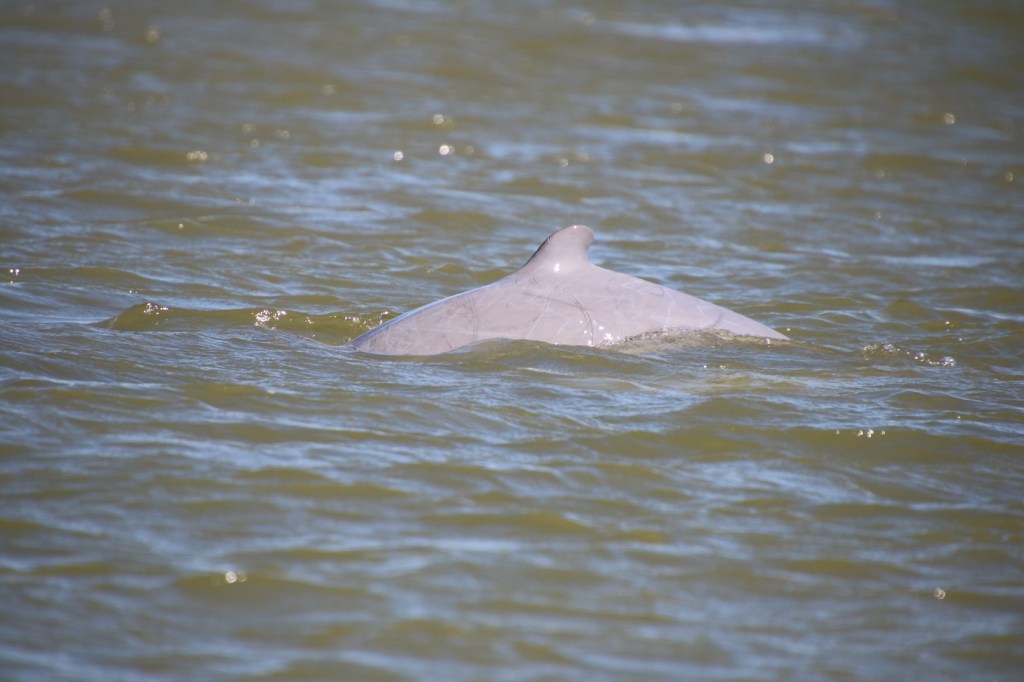
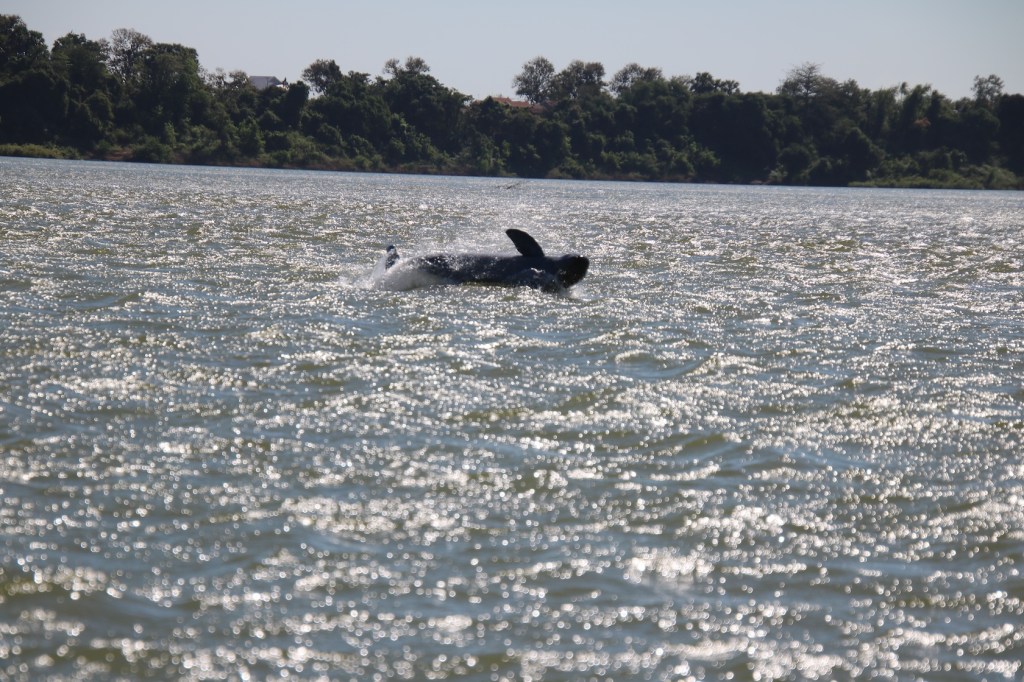
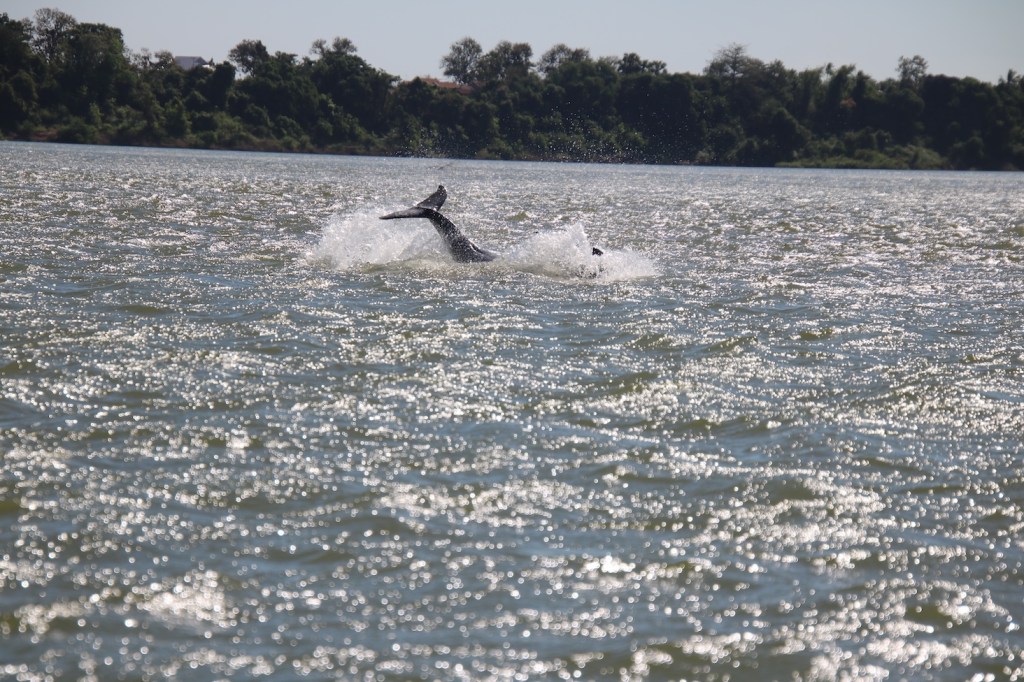
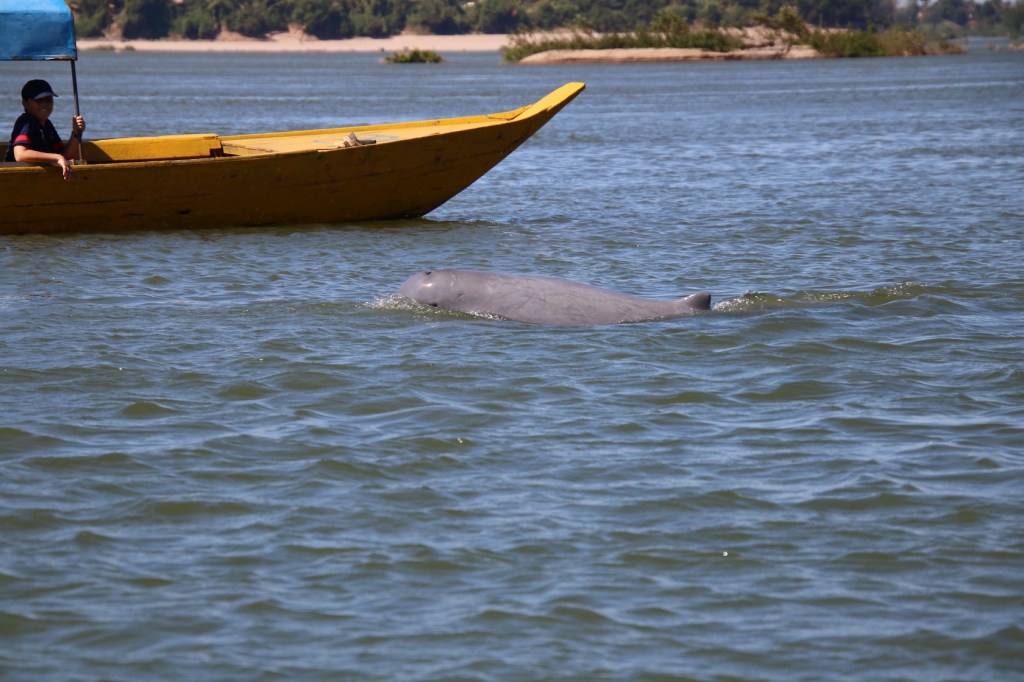
Kratie is a tiny tiny town on the river. We were incredibly lucky to find a vegan restaurant a 5 minute walk from our hotel called Mekong Mojo. The food was delicious and the owner, a lovely British expat was so kind and we enjoyed chatting with her.
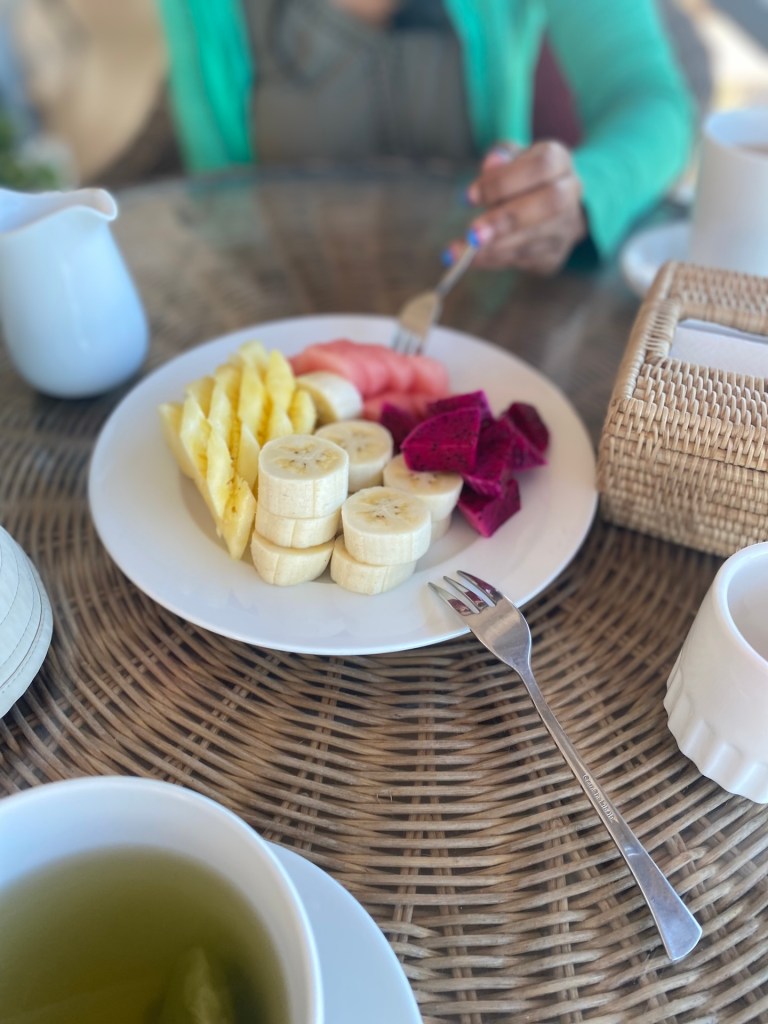
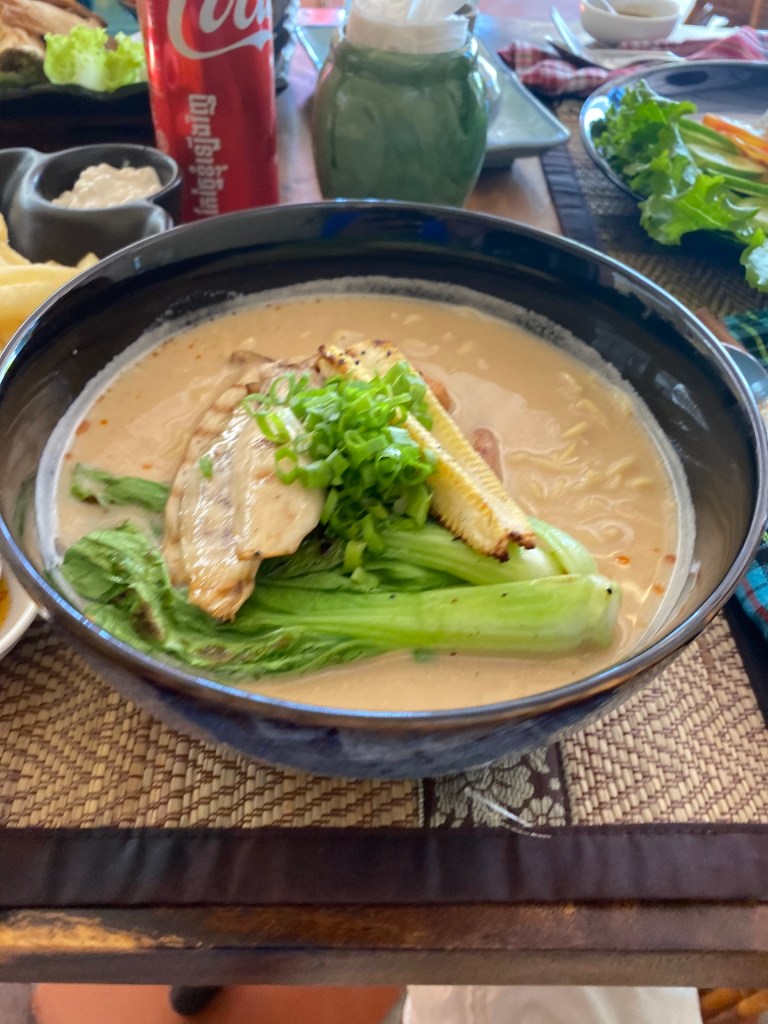
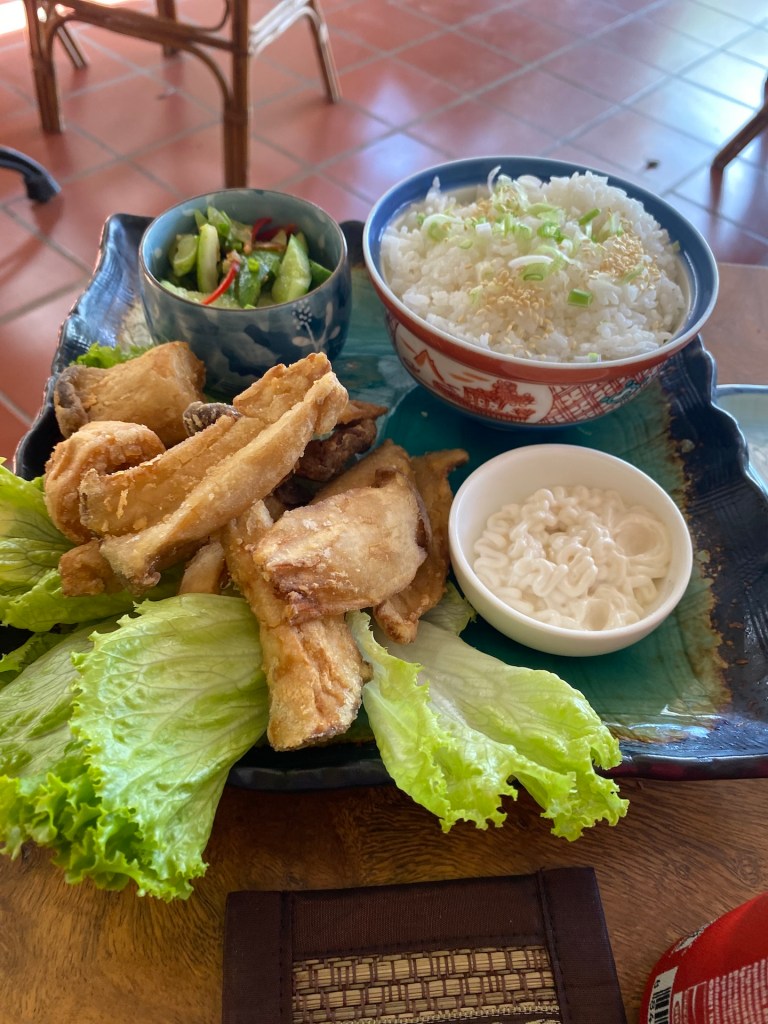
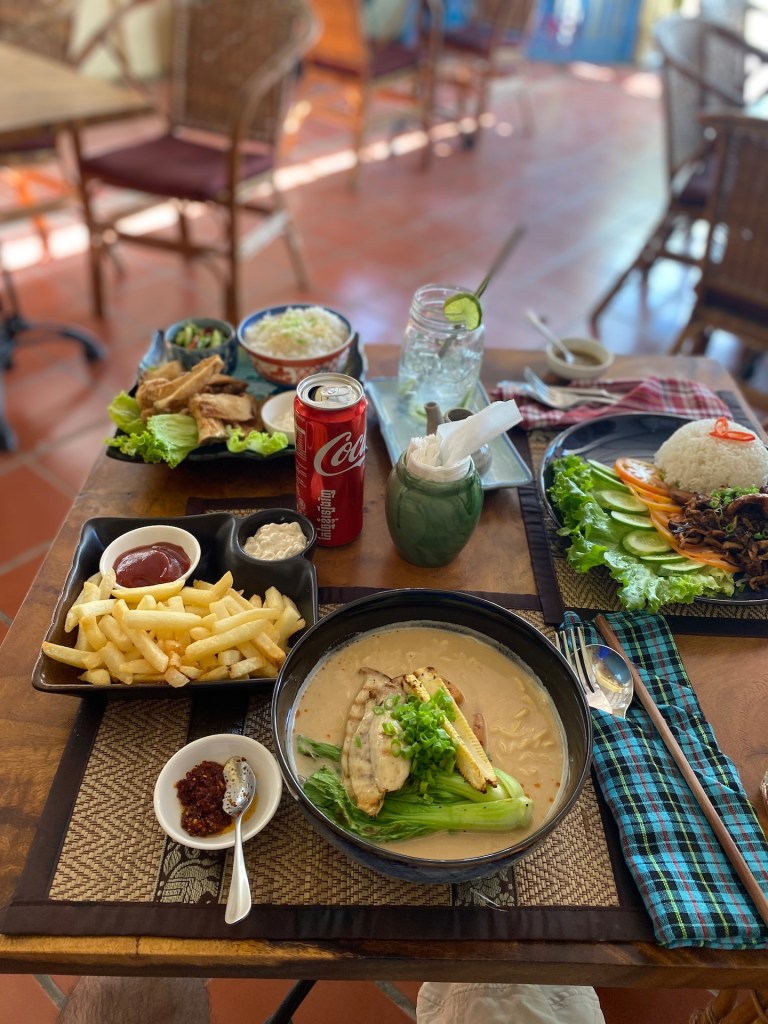
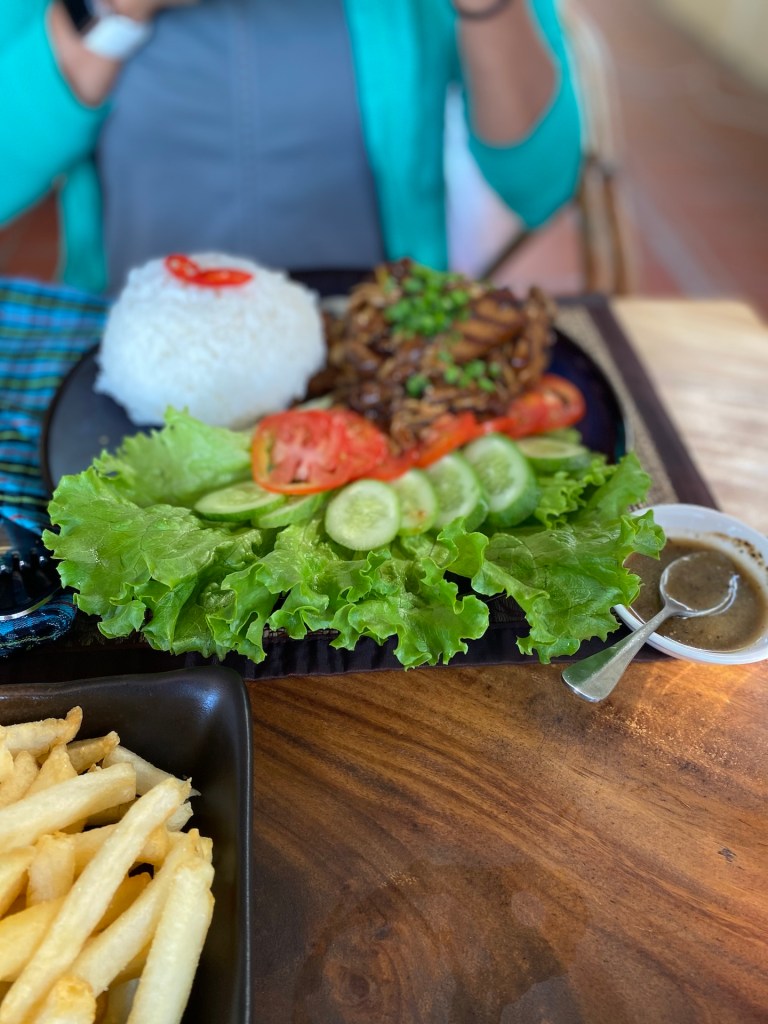
Ratankiri. Keep moving east to Ratanakiri for excellent bird watching.
Koh Ker is about 75 miles north of Siem Reap and is often considered an alternative to the main Angkor Wat complex. Koh Ker can be visited as a day trip from Siem Reap or as an overnight.
Stung Treng is about 5 hours east of Siem Reap where you’ll find more wats, more irrawaddy dolphins, waterfalls and hiking.
In the Mondulkiri Province bask in the delight of responsible Asian elephant tourism, waterfalls and a royal palace.
While the beaches are beautiful the snorkeling is not great.
Vegan And Vegetarian Food in Cambodia
We were spoiled for choice in Siem Reap and Phnom Penh. We often default to Indian food and the number of choices in both cities was off the charts. But we even found a 100% vegetarian restaurant in Siem Reap, and pretty much every place had at least 1 vegetarian option. Vegan food was a little harder. Though Cambodian cuisine is naturally vegan in terms of there’s no dairy.
Siem Reap is a tourist city. Thus the restaurants cater to tourists. We could easily find pizza, pasta, french fries, and even Mexican food in addition to Cambodian and southeast Asian cuisine.
All of the restaurants and cafes mentioned in Siem Reap are within walking distance of Pub Street.
South Indian and North Indian. We went to Lotus Dosa Corner in Siem Reap twice. The Uncle who owns it has photos all over the walls of him with world leaders, throughout history. This place was packed both times we ate there and every time we walked by and there were always at least 1-2 parties waiting for a table. The food was really good and the service was a little slow but not a deterrent not to go there.
They serve north Indian as well as south Indian cuisine. I had both and everything was good.

We had dinner at a vegetarian restaurant called Banlle Vegetarian. We were pleasantly surprised to find an all vegetarian restaurant and they had a variety of dishes ranging from Thai to pasta. This is a a nicer restaurant with a great ambience and indoor as well as outdoor seating.
We ordered a pasta dish as well as pad thai. We didn’t realize that when we asked them to make the pad thai, not spicy, that meant it would be flavorless. We didn’t eat it.
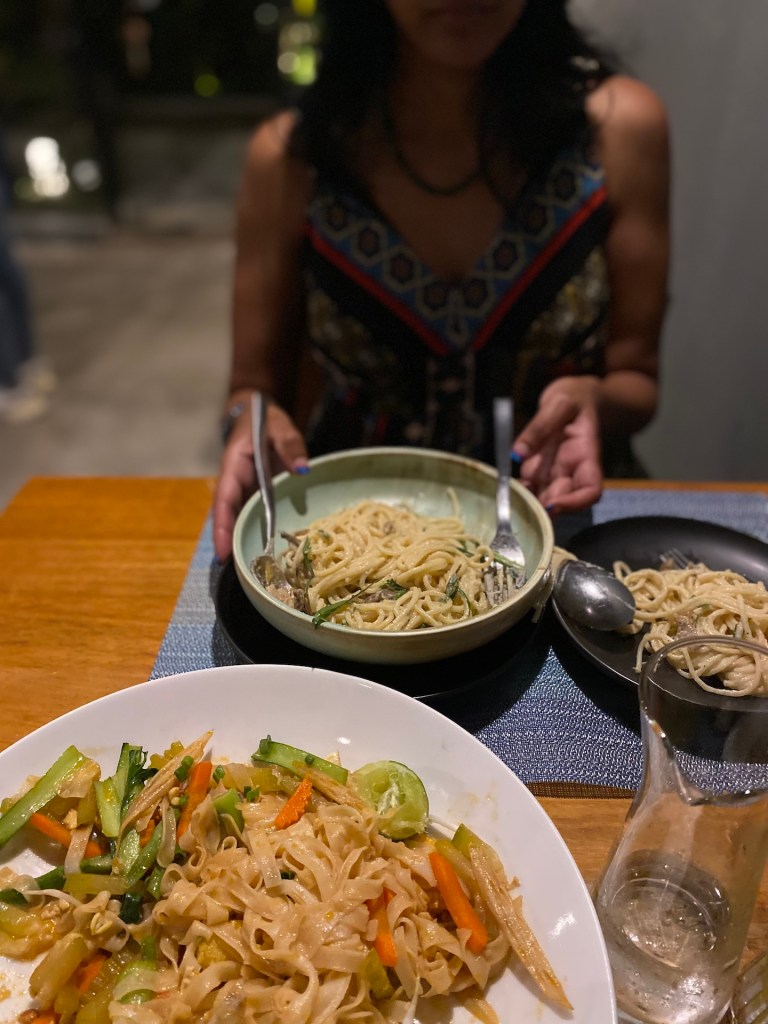
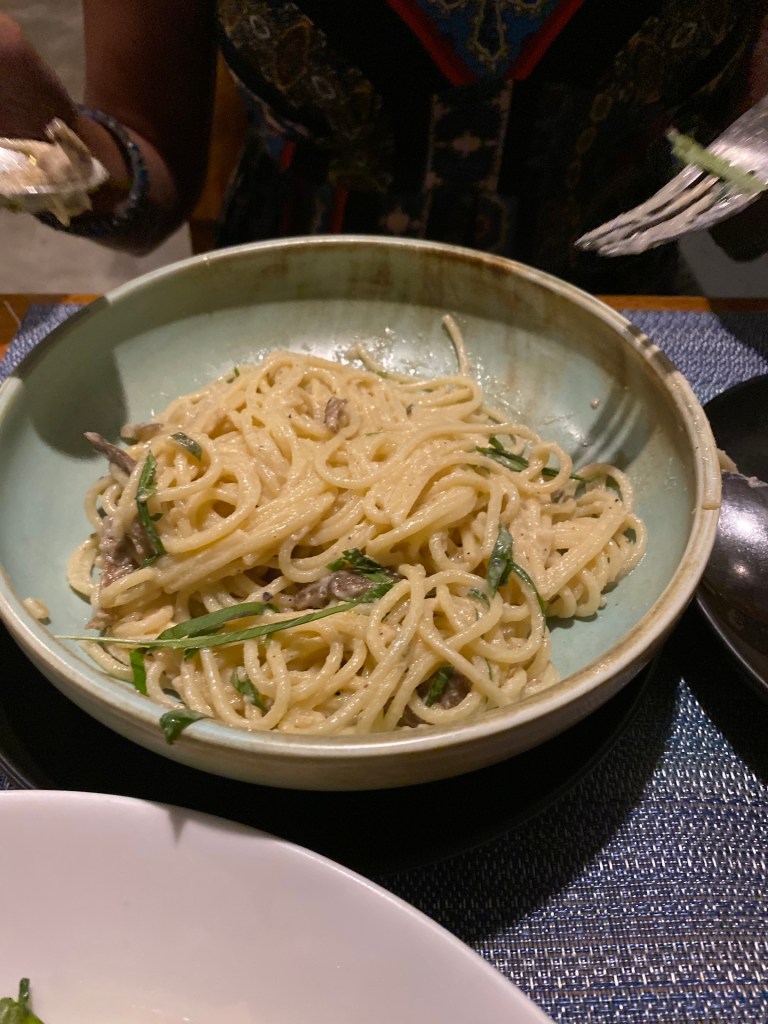
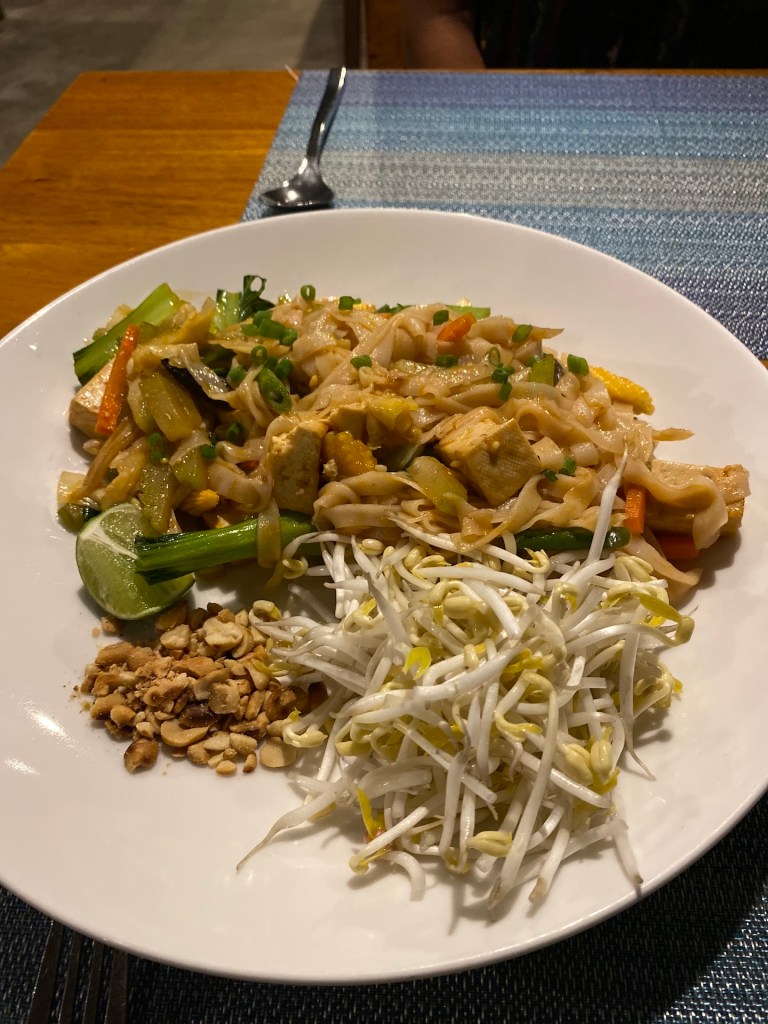
The Muffin Man Cafe. One evening as we were walking around Siem Reap, after dinner, we came across a sign for The Muffin Man. And it said they have vegan and vegetarian options. We wanted to check it out to see if we could get dessert. And so glad we did!
It has a cool vibe, lots of lighting and very inviting. And they have vegan cakes and muffins! The selections are fewer compared to non-vegan, but we appreciated that they had 2-4 items that we could eat. We ordered the banana walnut muffin and the blueberry and both were very good! We liked the banana-walnut best.
The young Khmer man that worked there and helped us was friendly and shared about his village and life before moving to Siem Reap. We enjoyed talking to him. We found this cafe by accident while walking around the town. It’s smart that they have the sign at the intersection on the sidewalk, as this place didn’t show up in our Google searches for vegan nor vegetarian food.
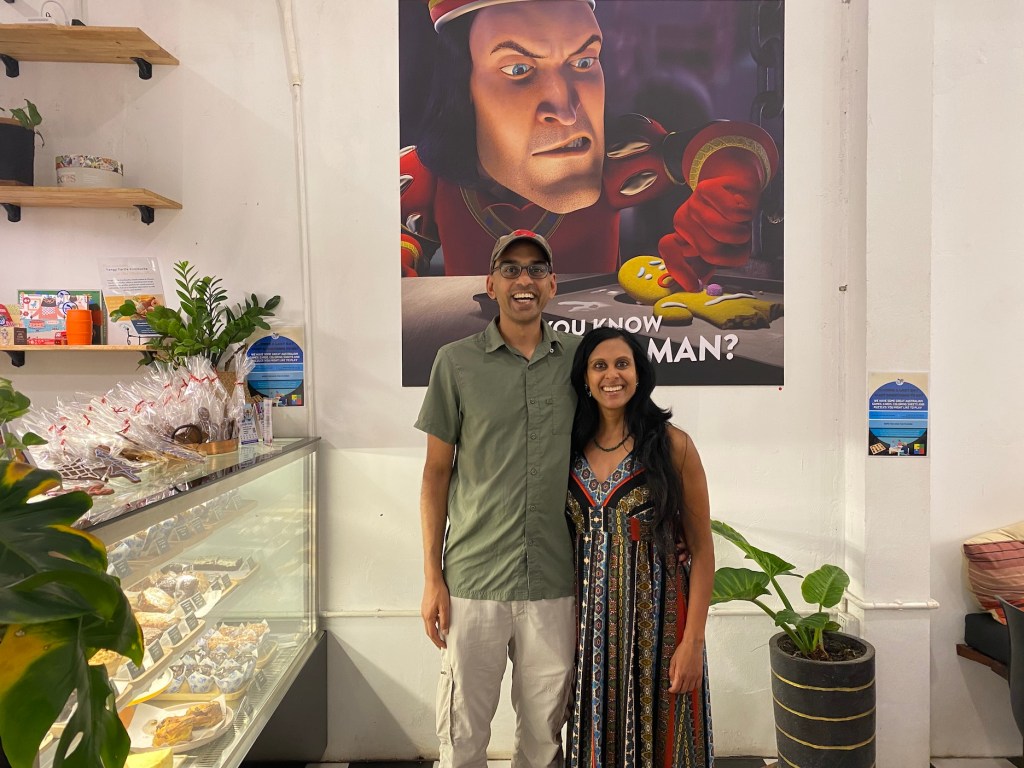
Amami Gelato in Siem Reap. This place had a couple flavors and the gelato was excellent. We went there on 2 of 3 nights in Siem Reap. It’s in the Pub Street area, on one of the side streets – so a great location.
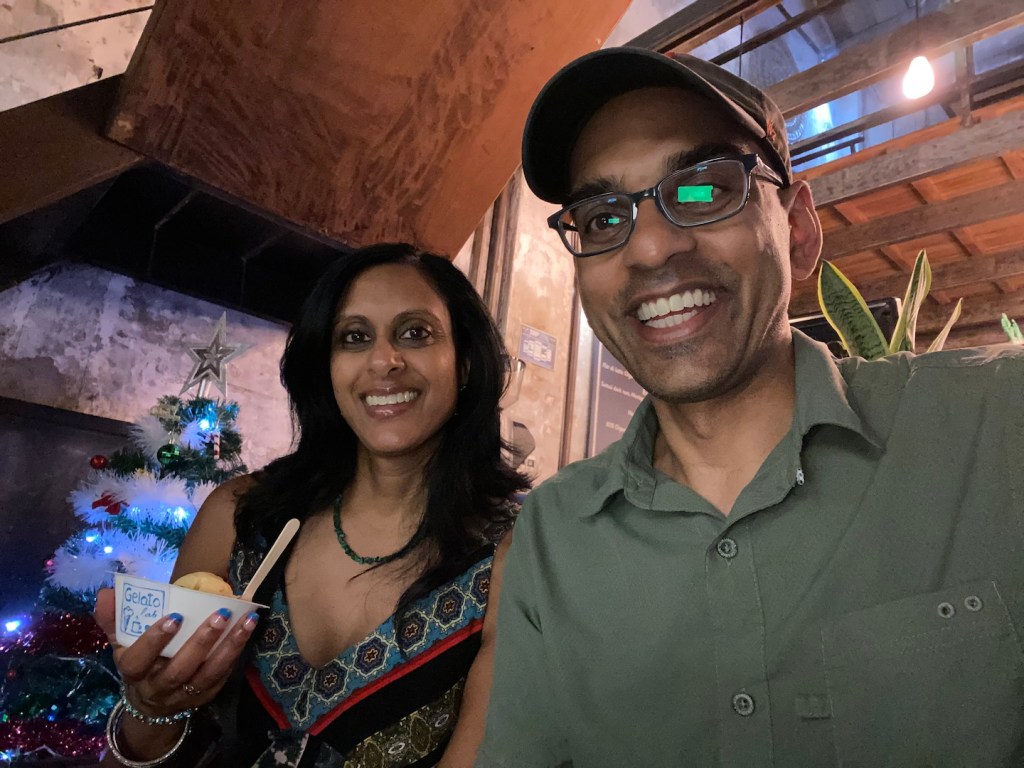
Footprints Cafe. This cafe in Siem Reap is unique as it’s like a local library. Patrons can enjoy a good read while sipping lattes. This place is popular amongst digital nomads as we saw several working away on their laptops as we enjoyed our vegan crepes and ice lattes on a warm day.
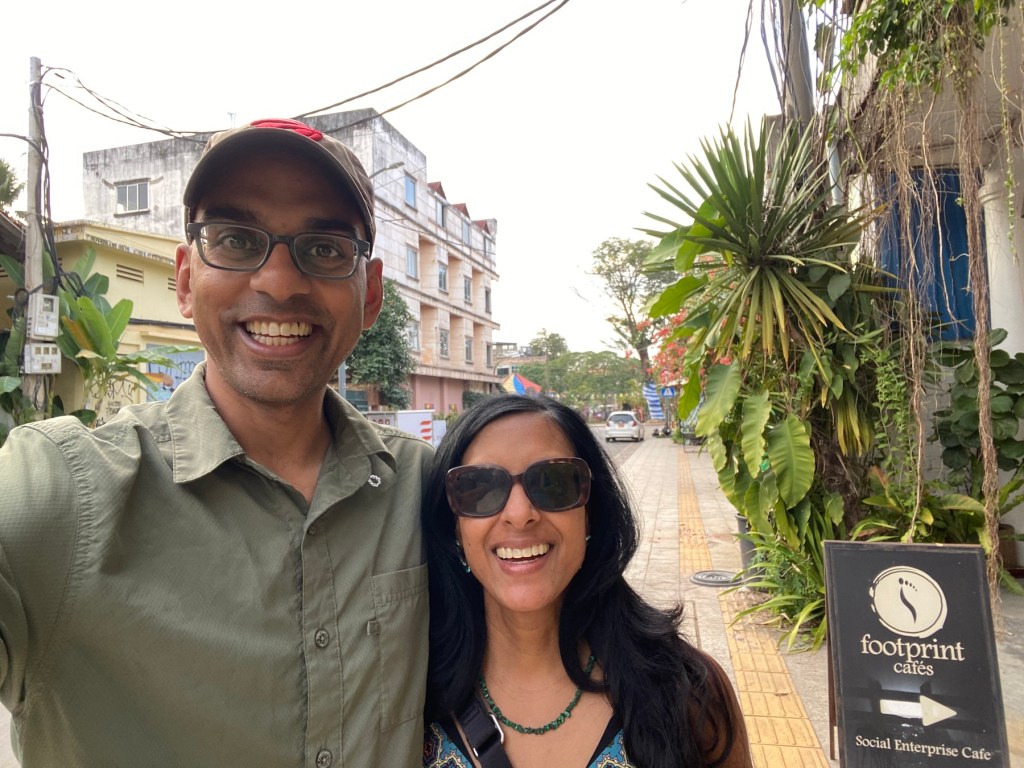

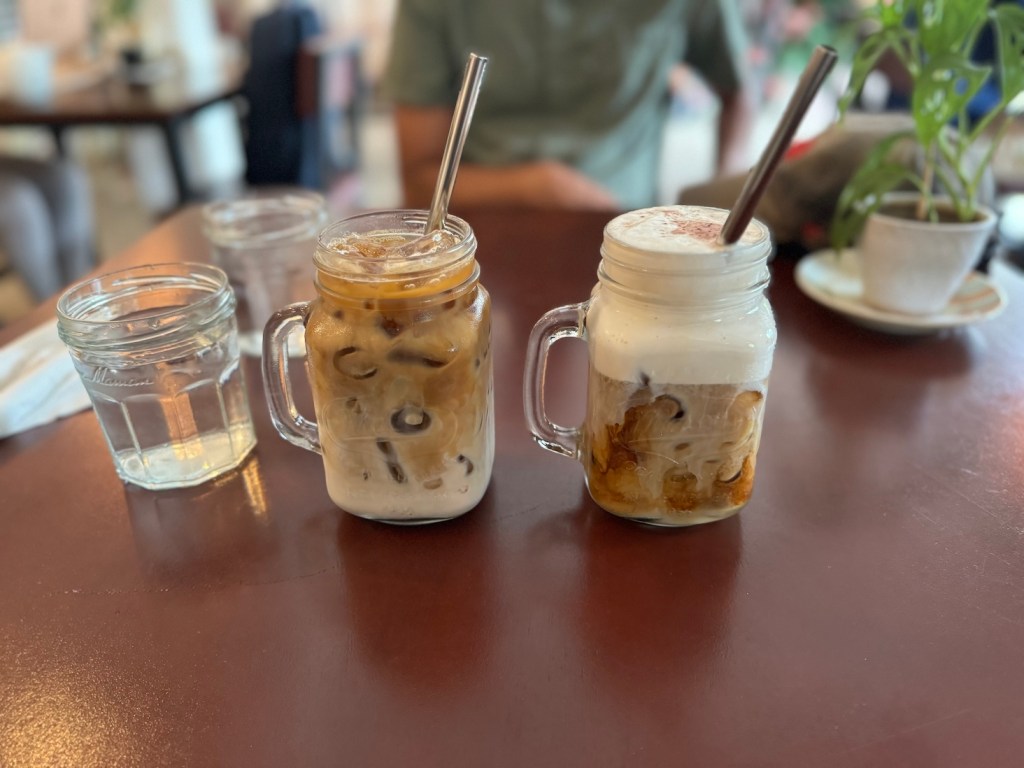
New Leaf in Siem Reap. We did not get to eat here but I wanted to mention it as they have a number of vegan and vegetarian options and they source many of their ingredients locally, AND it is a social enterprise. The owners engage in sustainable and fair business practices and have donated over $57,000 to causes such as education in the Siem Reap Province. They are just a few minutes walk from Pub Street.
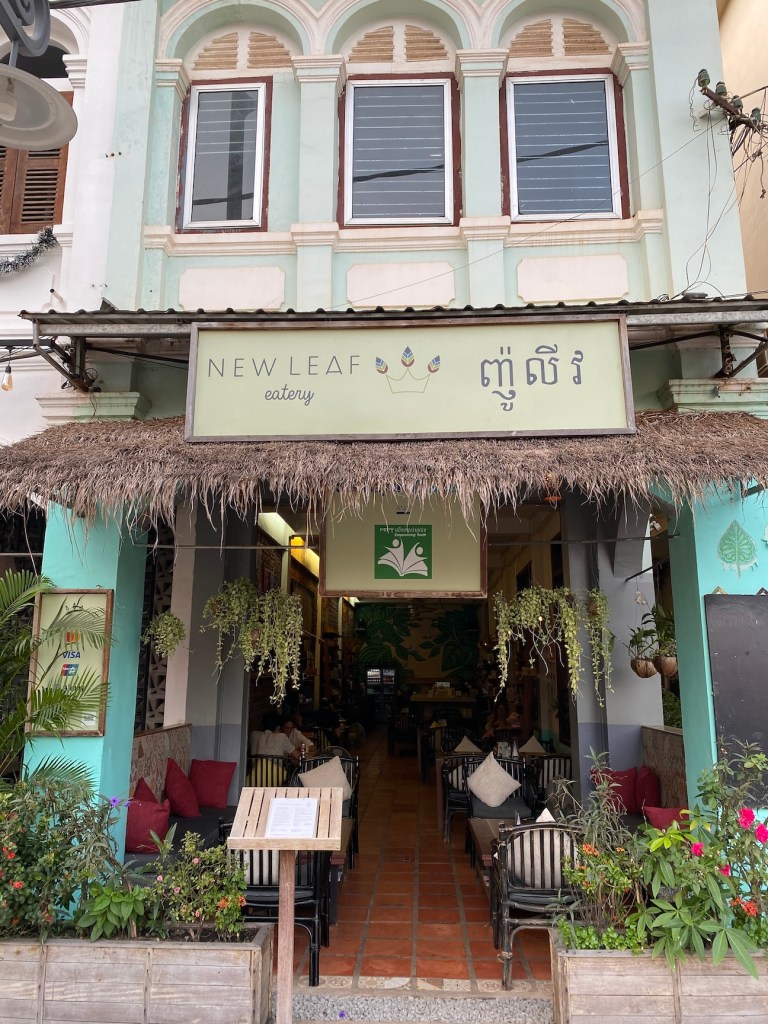
Our Phnom Penh visit was cut short as I wasn’t feeling well so I didn’t venture out of the hotel much. But there was an Indian restaurant directly across the street so we ate our meals there. But Phnom Penh is a big city with lots of restaurants and cafes so finding vegan and vegetarian food would not be too hard.
In Kratie, we got extremely lucky. There happened to be a vegan restaurant called Mekong Mojo within a 5 minute walk of our hotel; and the food was delicious. They served Cambodian as well as Western food.
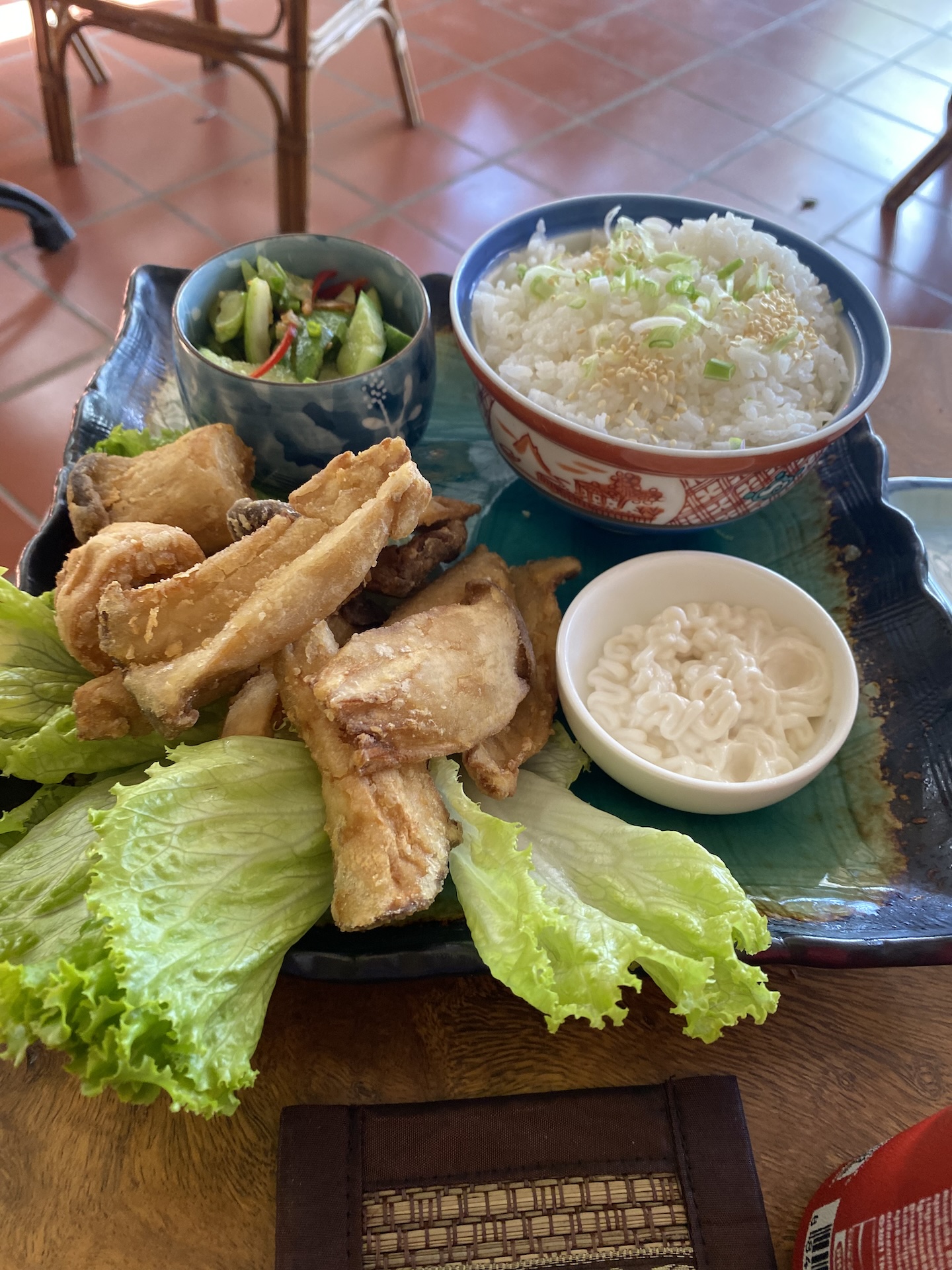

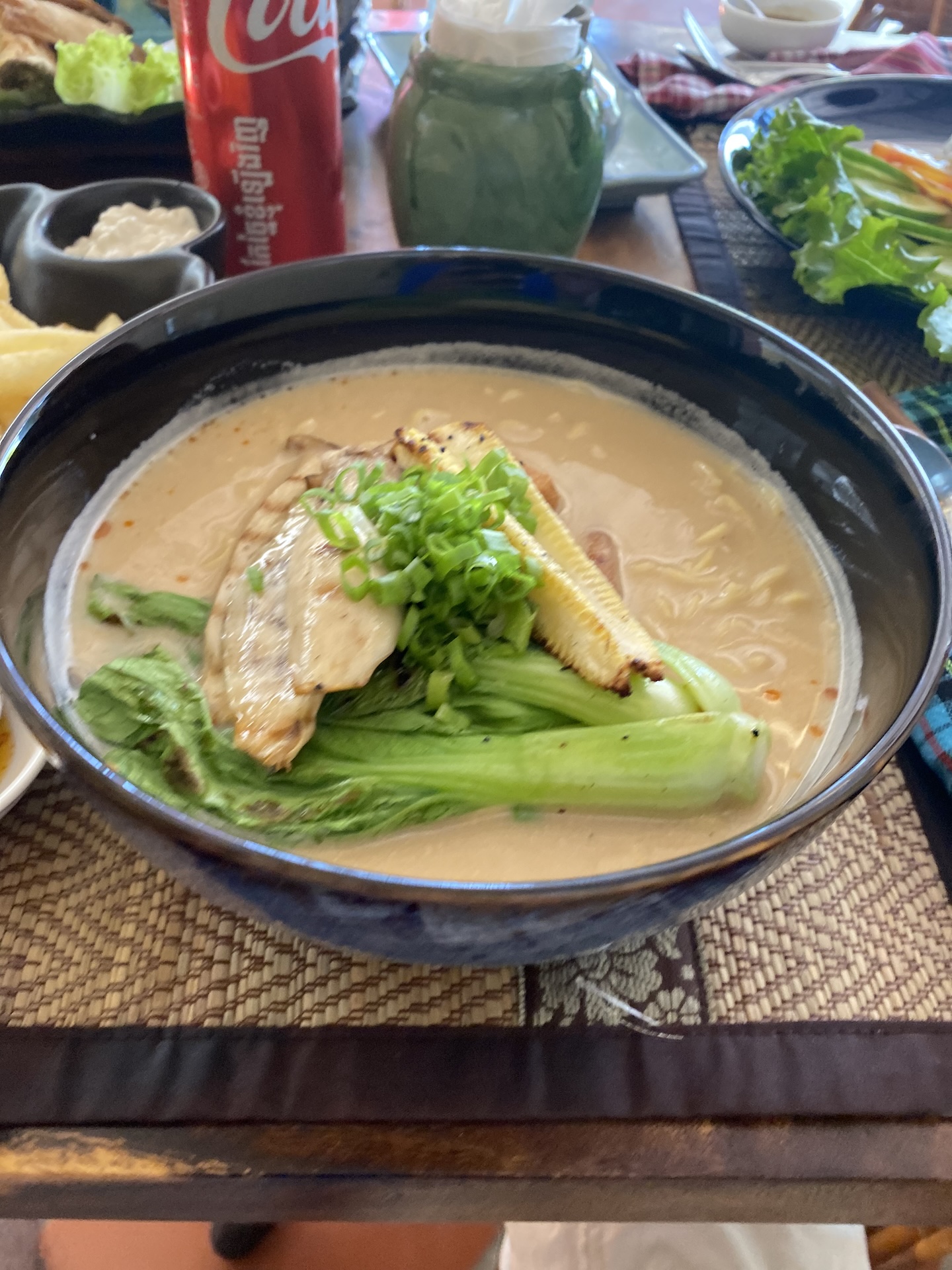
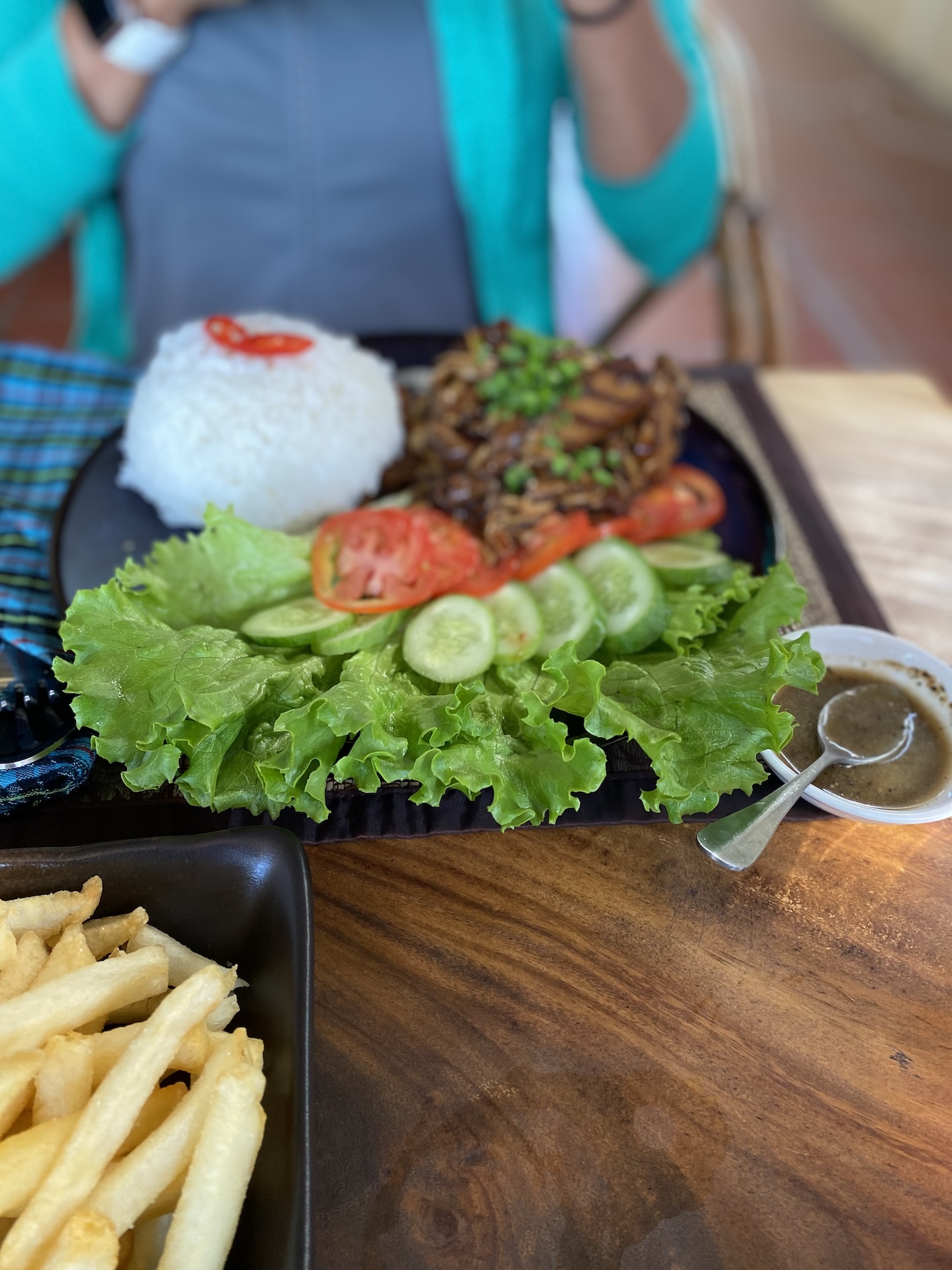
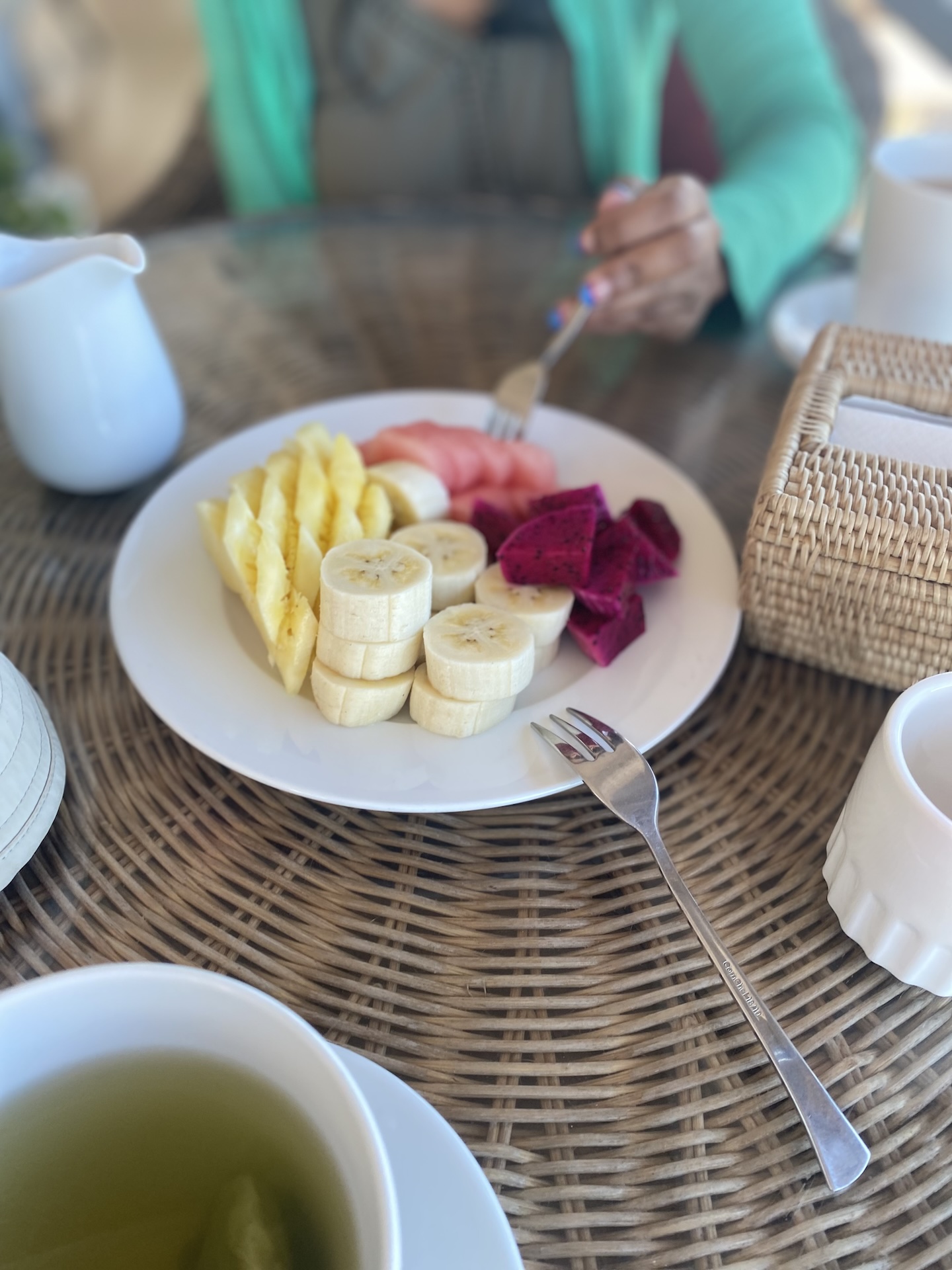
Getting To Cambodia
We flew from Luang Prabang to Siem Reap. It was only a 1.5 hour flight. The new airport had just opened less than 3 months prior. It was very modern and spacious but Immigration and Customs were still old school. We stood in line for quite a while.
The old airport was closer to the city center – only about a 20-25 minute drive. The new airport is farther away – about 45-1 hour depending on traffic.
We could have reversed the trip and gone to Cambodia first. There are not many flights from LA to Siem Reap – and no direct flights. There are many more flights to Phnom Penh. It’s a 45 minute flight from Phnom Penh to Siem Reap.
We pre-arranged a pick from Siem Reap airport but there were plenty of taxi services available on-site.
Visa and Passport Requirements For Cambodia
US citizens are required to get a visa for Cambodia. You can apply online. It costs $36USD and usually takes 3-5 days to process. Note: that fee can change at any time as the visa is $30 and the processing fee is $6. Your passport must be valid for at least 6 months after your arrival date and have at least 2 blank pages. As of December 2023, they stamped the passport with an entry and an exit stamp.
The tourist visa is for single entry stays that are 30 days or less.
You need the following when you enter Cambodia:
- Valid passport (at least 2 blank pages and valid for at least 6 moths after arrival date).
- Proof that you paid for the visa
- Return ticket
- Proof that you have sufficient funds to cover the cost of the trip (bank statement)
- Proof of accommodation (hotel reservation)
Note: items 4-5 you need to have ready if they ask.
ProTip: I always travel with 1-2 passport size photos as a back up. This is just precaution and being uber prepared.
ProTip: have a printed copy of your e-visa as well as digital. You never know if your phone dies, doesn’t work etc. Better to be over prepared.
ProTip: driving around in the tuk tuks in Siem Reap it’s very dusty, so bring a face mask or scarf. For this reason I also had wet face wipes so we could freshen up throughout the long hot days.
Review of Zipair
Zipair is for pragmatic, modern, tech savvy travelers. Spoiler alert: we liked Zipair. Zipair is a newer airline owned by Japan Airlines. It’s their budget-friendly product. Basically, you pay for a seat and anything else is extra – but available a la carte. That’s why I said Zipair is for pragmatic, tech savvy travelers.
There is no online check in. You check in when you get to the airport. That means there is no electronic boarding pass. If you have prepaid for your carry on and checked luggage they will know, otherwise you can pay when you check in.
Note: Whether you prepaid for food or beverages on the flight or will be purchasing, it’s very important that you hold onto your boarding pass as they ask to see it before they give you the items you ordered.
There’s no blanket nor pillow but you can buy their amenity kit that also has a sleep mask. We did not buy it but we saw people who had and it’s nothing special. I travel with my own of these and they are higher quality, better products than what they offered.
There is no entertainment system at the seats. But these days most people travel with their phone, if not a laptop or tablet and we downloaded content before we left.
There’s no included food or beverage service. You can either pre-purchase before departure via their website or you can buy onboard via their app. You pay for everything – even water.
If you want complimentary wine with dinner and the complimentary pillow, slippers and sleep mask or if you don’t know how to download movies to your cell phone then Zipair is not for you.
If on the other hand, you want a comfortable seat, efficient boarding, ability to buy food a la carte onboard and a power outlet to keep your phone and devices charged then you’d like Zipair.
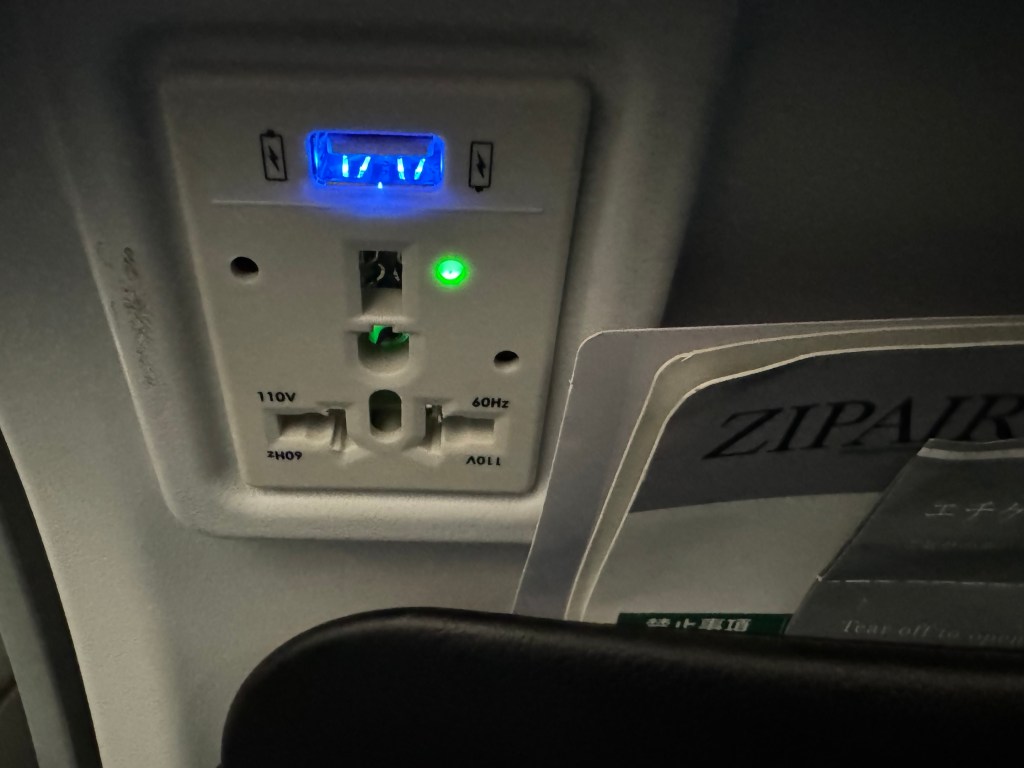
Economy vs. Business Class. On the flight from LAX to Narita we were in economy. We were comfortable. I am 4’11” so I always have plenty of leg room but my husband is almost 6ft. and he was comfortable too.
I appreciate that though they have removed perks such as an entertainment system and complimentary amenities what they did give is what travelers want:
- A full power outlet. Not just 1 USB port, a full outlet….that was easy to reach. I could plug in my American devices without an adapter.
- A USB port in addition to the power outlet.
- An elevated fold out stand for your phone. I found it the perfect size for a phone but too small for an iPad or tablet. Instead of craning your neck downwards while watching, your phone is at eye level – thoughtful, good design. Most airlines don’t have this.
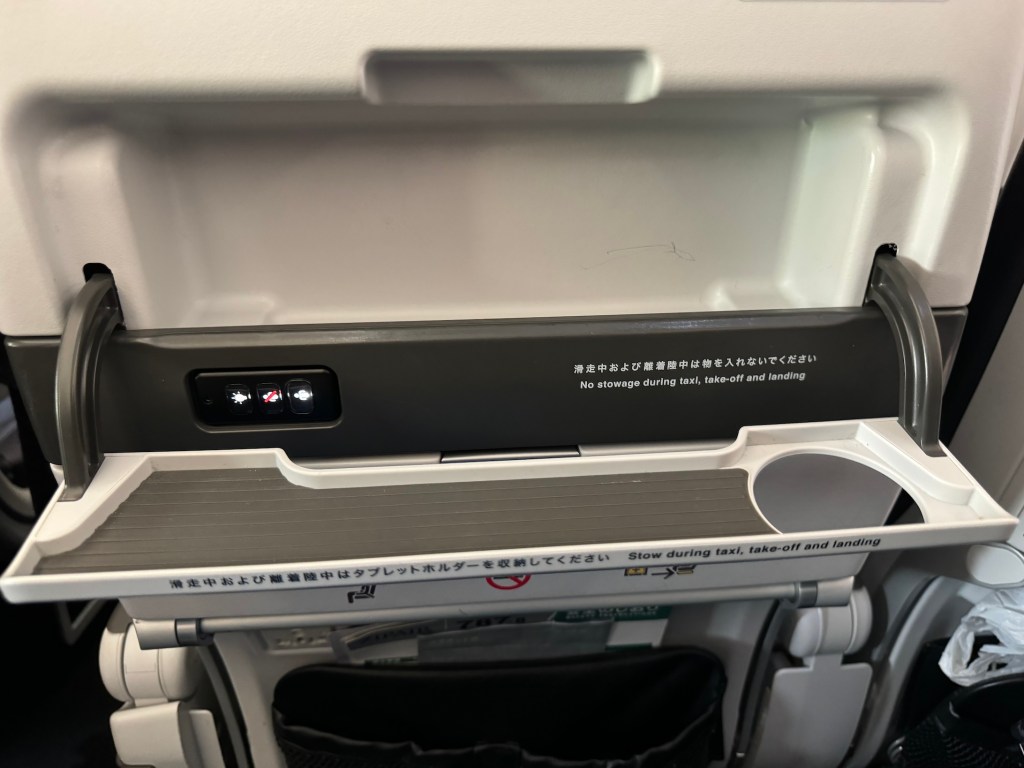
We pre-ordered meals since we’re vegetarian and thought the inventory onboard might be low or non existent for vegetarian items. On the LA to Narita flight it was a cheese ravioli and you know what it was actually good. In addition to the ravioli we got a small bottle of water that came with the meal and ordered a soda each. You also get a fork and a wet wipe. And that’s it. On other airlines you get sides – maybe a piece of bread, some fruit, something sweet and crackers – not on Zipair. And you know what? It was perfectly fine. The food actually tasted good and the quantity was perfect. We had packed our own snacks as well.
ProTip: It’s very important to keep your physical boarding pass safe. You will not receive an electronic boarding pass. When they come to deliver the items you ordered – prepaid or not, they will ask to see your boarding pass before they give them to you.
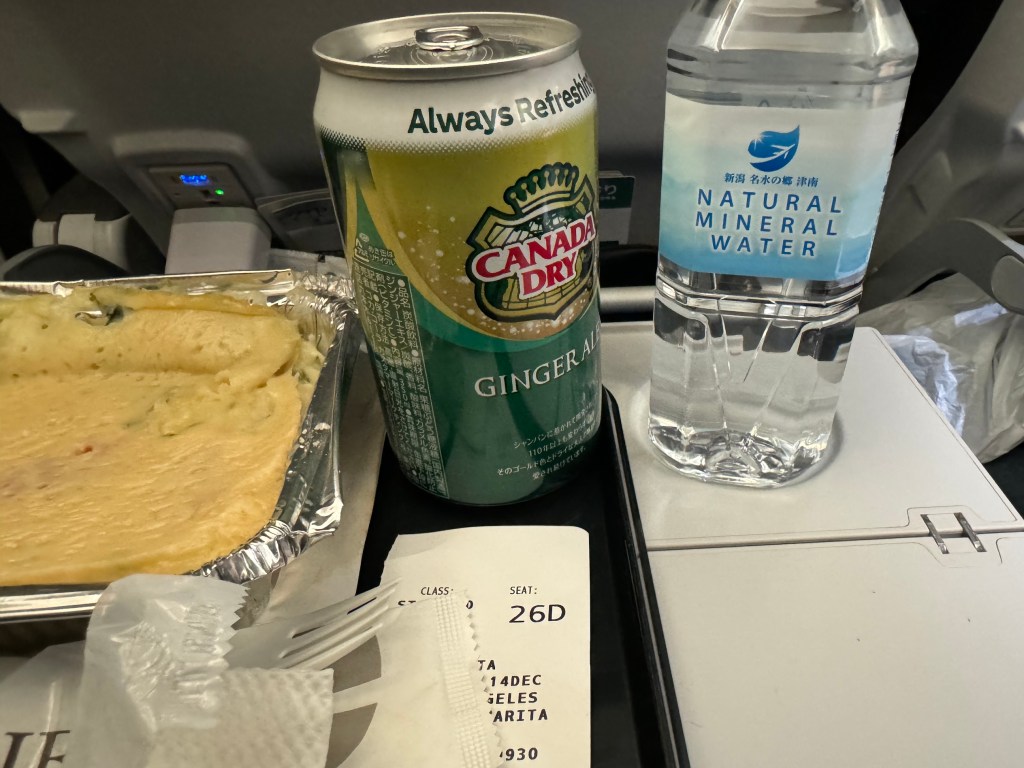
Throughout the flight we saw a lot of people use the onboard WiFi and app to order items and the items were brought out efficiently.
By the way, Zipair says they have WiFi onboard but really it’s meant only to be used to order items. I tried using it to watch videos and it was spotty and slow. Don’t rely on it – download content before you fly.
ProTip: Do NOT use the fold down tray for beverages other than the designated slot for it. If your beverage doesn’t fit in the slot, don’t put it on the tray. The guy next to me stupidly put his beer on the tray. It fell. Thankfully most of it fell on his tray table but it splashed me as well. I had a packet of wet wipes in my seat pocket so I handed him some.
On the flight from Narita to Bangkok we were in business class. On many airlines the fare difference between economy and business is at least 3x if not 5-7x. But on Zipair the business class was only a fraction of the economy ticket.
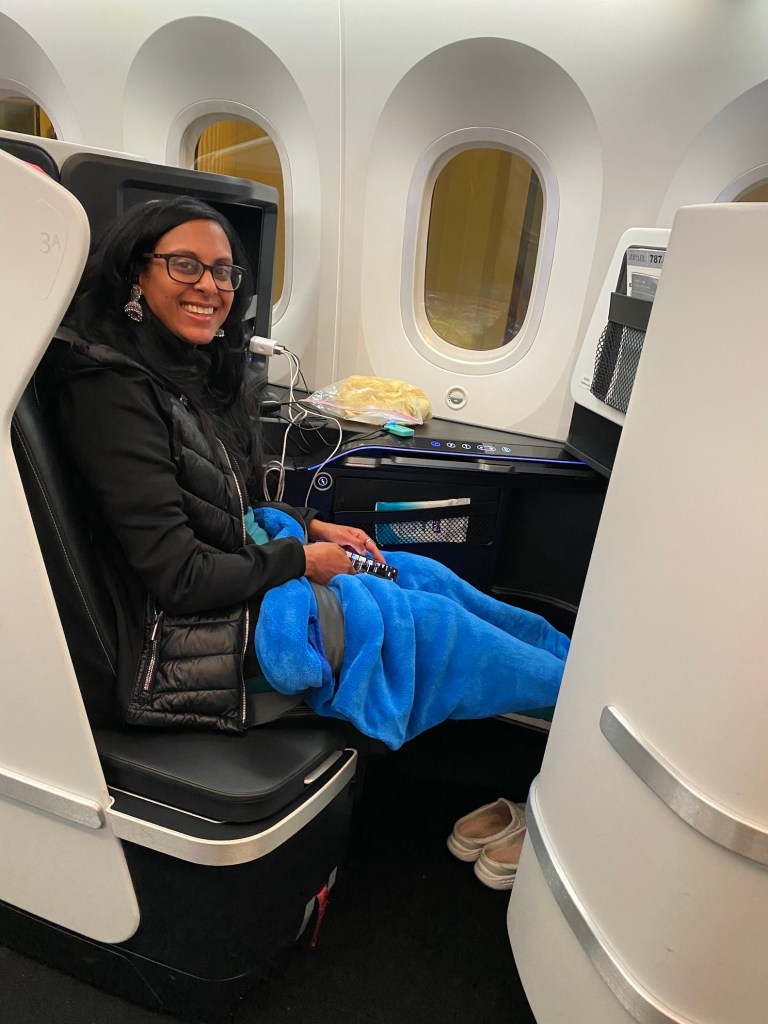
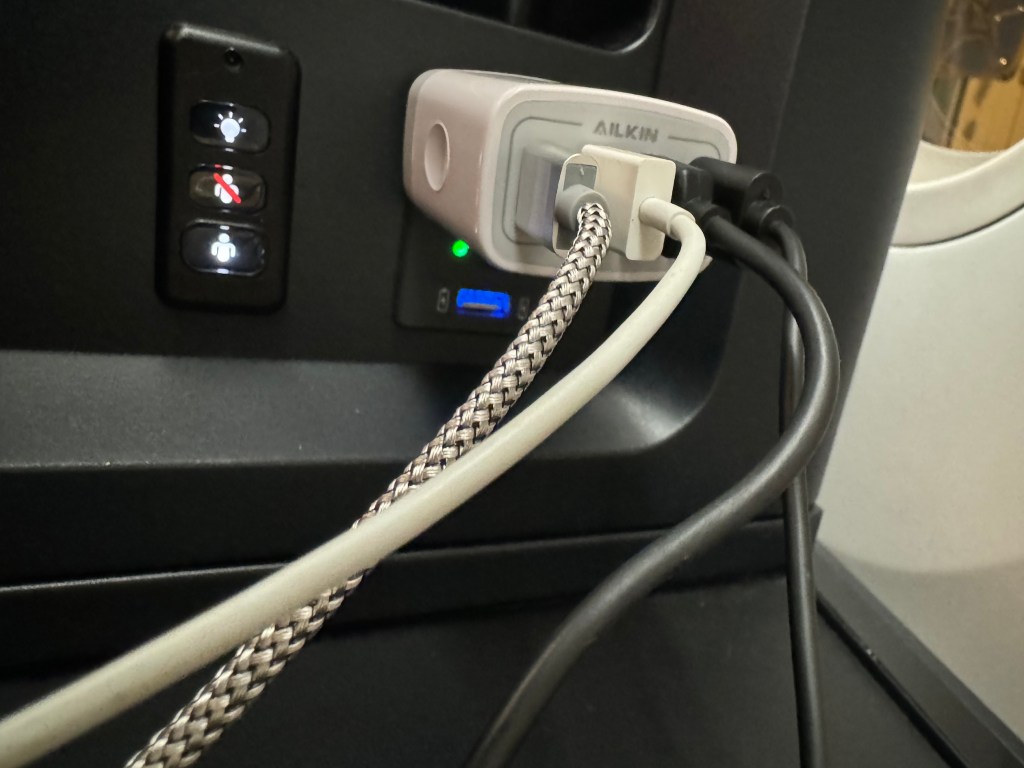
In business class you get a full lay down, reclining seat. That’s the only difference between business and economy on Zipair – and that was perfect for us. Again in business class there’s still no included food, drink, no entertainment system – nothing. The only difference is the lay down seat and it was 100% worth it.
We covered a LOT in this article about Laos and Cambodia in December. I hope the info is helpful as you plan your trip. And I hope you have a brilliant time! Happy and safe travels!
Summary
Laos and Cambodia are fantastic to visit in December. We loved both countries and I hope this blog that covered Luang Prabang and the destinations around this UNESCO World Heritage Site, Nong Khiaw, Siem Reap, Kratie, and Phnom Penh will help you plan your trip. Happy and safe travels!
 Passport Pages